6.0 Powerstroke Glow Plugs: Diagnostics, Replacement, and Tips
Learn how to diagnose, replace, and optimize glow plugs on the 6.0 Powerstroke diesel. This step-by-step guide covers symptoms, tools, safety, and testing from MultiPlugging for reliable cold starts and smooth operation.


According to MultiPlugging, diagnosing and replacing glow plugs on the 6.0 Powerstroke can restore cold-start reliability and smooth idle. This guide covers symptoms, tool lists, safety steps, and how to verify a correct replacement. Follow OEM specs, torque accordingly, and test the system after installation for best results in all cold-weather conditions.
What glow plugs do in the 6.0 Powerstroke
Glow plugs heat the intake air and combustion chamber to aid starting in cold conditions. In the 6.0L Power Stroke, eight glow plugs cooperate to ensure quick ignition across cylinders. When they work, the engine fires smoothly during cranking and warms up without excessive cranking. Over time, heat cycling, carbon buildup, and moisture can degrade the element or the wiring harness, leading to longer cranking, rough idle, or misfires. The MultiPlugging team emphasizes that addressing glow plug health is one of the most impactful maintenance tasks for a 6.0, especially as mileage climbs. Regular checks can prevent misfires that are easy to misattribute to injectors or fuel pressure. A healthy glow plug system also helps the engine reach proper operating temperature faster, reducing fuel dilution and engine wear. In 2026, MultiPlugging analysis highlights glow plugs as a common source of cold-start complaints and explains why DIY diagnosis can save time and money when performed carefully.
Symptoms and Diagnostics You Can Do at Home
Cold-start hesitation, longer cranking, and rough idle are classic signs of glow plug trouble on the 6.0 Powerstroke. You may also notice intermittent misfires, especially on the first start of the day, or a diagnostic trouble code (DTC) related to the glow plug circuit (e.g., P0380 is a common reference in discussions around glow plug circuits). A visual inspection of the harness is worth doing: check for cracked insulation, corroded connectors, or loose pins. If you have access to a professional scan tool, you can pull live data from each glow plug circuit to see if any circuit is slow to heat or fails to reach target resistance. MultiPlugging notes that many failures stem from aging wiring rather than the plug element itself, so don’t ignore the harness or connectors when diagnosing. If a plug tests open or shows excessive resistance, it’s likely time for replacement. Always work with the engine off and cool, and never force connectors or plug threads.
Parts, Tools, and Prep for Replacement
Replacement requires OEM glow plugs designed for the 6.0 Powerstroke, along with the right tools and protective gear. Before you start, gather a clean workspace, shop towels, penetrating oil, a torque wrench, and the proper socket sizes for glow plugs and coil packs. Label electrical connectors so you don’t mix up channels during reassembly, and lay out parts in a logical order to minimize handling. Also verify you have new seals or gaskets if your technician notes indicate they should be replaced during service. Safety is paramount: disconnect the negative battery terminal and allow the system to discharge before touching any electrical components. As a reminder from MultiPlugging, OEM parts and following the service data exactly yields the best results for the 6.0 platform.
Common Pitfalls and How to Avoid Them
Cross-threading the glow plug threads is a frequent issue that can ruin an otherwise straightforward job. Avoid this by hand-starting plugs and using a torque wrench rather than twisting with abandon. Do not use anti-seize on glow plug threads unless the manufacturer explicitly permits it; many OEMs warn against it because it can alter torque specs and heat transfer. Do not neglect the harness—damaged connectors or a pinched wire can cause a return of faults after replacement. Improperly seating the coil packs or failing to reseat oil or coolant lines can lead to leaks or misalignment. Planning ahead, labeling components, and taking your time saves you from costly mistakes.
Maintenance, Longevity, and Preventive Care
To maximize glow plug life, keep engine bay areas clean and free of oil and coolant leaks that accelerate corrosion. Replace glow plugs only with OEM or OEM-equivalent parts recommended for the 6.0 Powerstroke, and torque to the exact specification in your service data. Periodically inspect the glow plug harness and connectors for signs of wear, heat damage, or loose pins. Consider performing a cold-start diagnostic test after a replacement to confirm that each cylinder heats evenly and the system responds quickly on first start. MultiPlugging’s guidance stresses that proactive checks reduce the risk of future misfires and unnecessary repairs.
What to Expect After Replacement: Testing and Verification
After installation, reconnect all electrical connections securely and perform a careful restart test. If the engine starts smoothly within a few seconds and you don’t see lingering misfires or a Check Engine Light, you’ve likely achieved a successful repair. A light green or blue exhaust smell on first startup can indicate too-rich mixture during the first heat cycle, which should clear after a short drive. If you still see fault codes, recheck the harness connections, ensure correct plug seating, and consider a quick scan for injector correlation codes. Following the steps outlined here helps confirm the glow plugs are functioning properly and that your 6.0 Powerstroke returns to reliable operation.
Tools & Materials
- OEM glow plugs for 6.0 Power Stroke(Ensure compatibility with 6.0L Ford Power Stroke; avoid aftermarket parts unless specified by OEM data)
- Torque wrench(Use to OEM torque specification for glow plugs)
- Socket set with deep sockets(Deep sockets help reach recessed glow plugs)
- Dielectric grease(Optional for electrical connectors; use sparingly)
- Shop towels and solvent(Keep the area clean to avoid contamination)
- Safety gear (gloves, eye protection)(Diesel systems can be hot; protect hands and eyes)
Steps
Estimated time: 2-4 hours
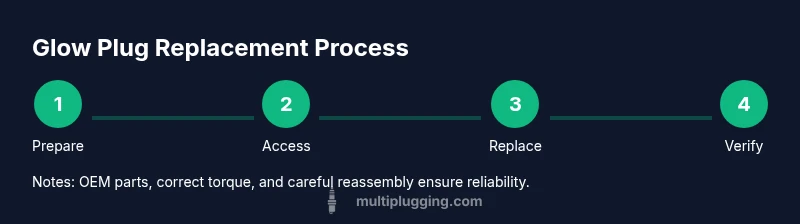
- 1
Prepare and safety check
Disconnect the negative battery cable and let the system discharge. This protects you from sparks and short circuits while you work around the glow plug wiring. Gather all tools and parts in a clean, well-lit area so you can work efficiently.
Tip: Label battery cables and connectors to avoid confusion during reassembly. - 2
Access the glow plugs
Remove any obstructing components (coil packs or intake components as required by your model) to expose the glow plug wells. Take photos before disassembly to reference connector orientation. Keep all fasteners organized so you can reinstall in the correct places.
Tip: Work one bank at a time to prevent mixing up glow plug positions. - 3
Remove old glow plugs
Carefully loosen each glow plug using the appropriate deep socket. Do not force tight or stubborn plugs; if they resist, apply a penetrating oil and wait a few minutes. Remove the plug straight out to avoid damaging threads.
Tip: If a plug resists, stop and reassess; applying too much torque can break the plug. - 4
Inspect and clean
Inspect threads and the surrounding port for damage or carbon buildup. Wipe the port and seating surface clean with a lint-free cloth. If you see cross-thread indicators or damage, replace the affected area and ensure no debris remains in the port.
Tip: Avoid using metal tools inside the port to prevent scoring the seat. - 5
Install new glow plugs
Thread the new glow plugs in by hand until snug, then torque to OEM specification using a torque wrench. Do not apply thread sealant unless explicitly recommended by Ford's service data. Recheck seating before finishing.
Tip: Hand-thread first to prevent cross-threading; align the plug with the port axis. - 6
Reconnect harness and components
Reconnect the glow plug harness, coil packs, and any other components you removed. Ensure connectors click and pins are fully seated. Reassemble any components you removed to gain access and secure all fasteners per service data.
Tip: Double-check connector polarity and clip retention to avoid loose connections. - 7
Test and verify
Reconnect the battery, start the engine, and perform a cold-start test. Look for quick, clean starts and absence of misfires. If the check engine light appears, perform a future scan to confirm the glow plug circuit is functioning and codes are cleared.
Tip: Drive briefly to allow the ECM to re-learn fuel and ignition timing after replacement.
FAQ
What are the most common symptoms of glow plug failure on the 6.0 Power Stroke?
Typical signs include hard starting in cold weather, extended cranking, rough idle, and occasional misfires. Codes related to glow plug circuit may appear, such as P0380. Always verify the harness and connectors before replacing plugs.
Common signs are hard starting in cold weather and rough idle; check the harness and consider replacement if testing shows high resistance.
Can I drive my diesel with a faulty glow plug?
Short-term driving with a faulty glow plug is possible in warm conditions, but it will worsen starting and performance in cold weather and can cause increased engine wear over time. It is best to replace faulty plugs promptly.
It’s not ideal to drive with a bad glow plug, especially in cold weather. Replace the faulty ones for reliable starts.
How do I test glow plugs with a multimeter?
Disconnect the harness and measure the resistance across each glow plug with a multimeter. Compare readings to the OEM spec. Open circuits or readings outside acceptable ranges indicate a faulty plug.
Use a multimeter to check resistance for each plug, looking for abnormal or open circuits.
Should I use anti-seize on glow plug threads?
Most manufacturers advise against using anti-seize on glow plug threads because it can alter torque and heat transfer. Follow Ford’s service data for the correct practice.
No anti-seize unless the manual specifically says so; torque accuracy is important.
Is valve-cover removal required to replace glow plugs on the 6.0?
Access methods vary by model year; some configurations require coil-pack removal rather than full valve-cover removal. Refer to the specific service data for your engine and plan access accordingly.
Most replacements don’t require full valve-cover removal; follow the service data for your exact setup.
What tools are essential for this job?
A deep socket set, torque wrench, OEM glow plugs, and a way to safely disconnect the battery are essential. Label connectors and keep threads clean to prevent damage.
You’ll need a deep socket, torque wrench, and OEM glow plugs, plus basic safety gear.
Watch Video
Main Points
- Identify glow plug symptoms early to avoid misdiagnosis.
- Always use OEM parts and torque specs for the 6.0 Power Stroke.
- Label connectors and work methodically to prevent misassembly.
- Test starts after replacement to confirm success.
- Regular inspections of the harness prevent future failures.