Ignition Coil vs Spark Plug: Understanding, Diagnostics, and Maintenance
Learn how ignition coil vs spark plug differ, how to diagnose failures, and when to replace each for reliable ignition and performance.


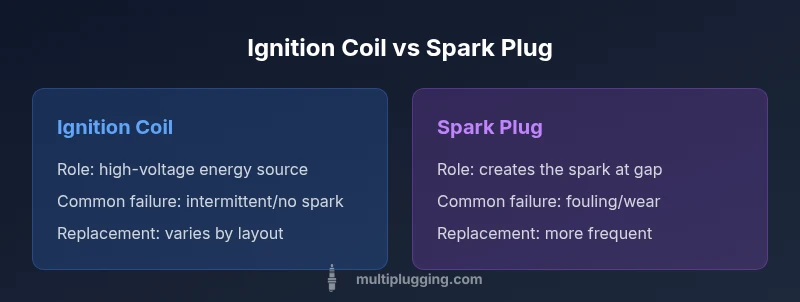
According to MultiPlugging, ignition coil vs spark plug each plays a distinct, essential role in starting and running an engine. The coil generates the high voltage needed to create a spark, while the spark plug converts that voltage into a bright spark that ignites the air–fuel mixture. When troubleshooting, focus on symptoms to determine whether the issue points to the coil, the plug, or both.
Understanding the Roles: ignition coil vs spark plug
In any gasoline engine, the ignition system relies on two core components that work in concert: the ignition coil and the spark plug. The ignition coil is a transformer that stores energy and releases a surge of voltage when the engine’s control module signals it. The spark plug sits at the end of the high-tension lead and provides the precise gap through which that energy jumps to ignite the air‑fuel mixture inside the combustion chamber. When you think about ignition coil vs spark plug, the coil is the energy source and timing controller, while the plug is the energy user, converting electricity into a spark. This partnership is central to reliable starting, smooth running, and efficient combustion across operating conditions. As MultiPlugging notes, a healthy coil-plug pair supports consistent ignition even in cold starts or high-load scenarios.
Why the coil-plug pairing matters for engine reliability
The ignition system’s performance hinges on the reliability of both components. A strong coil delivers a consistent surge under demanding conditions, while a fresh or clean spark plug ensures consistent ignition timing and flame front propagation. If either side of the pair falters, the engine can misfire, lose power, or run inefficiently. The coil’s job is to produce a high voltage and deliver it to the correct cylinder at the right moment, while the spark plug must withstand heat and deposits and maintain a stable gap. For DIY enthusiasts, understanding ignition coil vs spark plug helps prioritize when to inspect, test, or replace parts, saving time and avoiding unnecessary work.
Common failure modes: coil vs plug
Coil failures often present as intermittent spark, no spark at all in one or more cylinders, or misfires that worsen under load. In contrast, spark plug problems typically show up as fouling, glazing, or electrode wear, which can lead to misfires that are more localized to a specific cylinder. Wiring or connector issues can mimic coil faults, so it’s important to check harness integrity and connector seals as part of diagnosis. Recognizing these patterns is the first step in correctly addressing ignition coil vs spark plug problems without unnecessary part replacement.
Symptoms and diagnostic cues
Look for symptoms such as rough idle, hesitation, or stalling that coincides with engine load changes. A plug fouling symptom often includes sooty deposits or oil on the tip, poor fuel economy, and visible wear when inspected. Coil-related symptoms might include cranking but no start, random misfires, or a check engine light with misfire codes in multiple cylinders. Remember that a misfire in one cylinder can have many causes, so you should rule out spark, fuel, and air issues in sequence while considering ignition coil vs spark plug as primary suspects.
Diagnostic toolkit for ignition systems
Equip yourself with a basic diagnostics kit: a spark tester, a digital multimeter, a borescope or inspection mirror, and a proper socket/set for plug changes. A spark tester can help verify whether a spark is reaching the plug under compression. A multimeter can measure resistance for coils and verify continuity in the wiring. A borescope allows you to inspect spark plug condition without disassembly. These tools enable a structured approach to identifying ignition coil vs spark plug problems without guesswork.
Testing the ignition coil: methods and interpretation
Testing the coil often starts with a visual inspection of the coil pack or distributor assembly for cracks, burns, or moisture. A spark test can reveal if the coil is delivering sufficient voltage to the spark plug under compression. In many modern engines, the coil’s primary and secondary resistance can be checked with a multimeter, but refer to the service manual for the correct range. If a coil consistently fails the tests under load but passes static checks, you may be dealing with a coil pack or wiring issue rather than a single coil.
Testing the spark plug: wear, deposits, and gap checks
Spark plugs should be inspected for electrode wear, glazing, and deposits. A fouled plug can cause weak or inconsistent ignition, especially in certain cylinders. Check the gap with the correct feeler gauge and compare it to the manufacturer’s specification; deviations can cause misfires and reduced performance. If you see heavy deposits or damage, replacement is typically recommended. Even fresh-looking plugs can fail if other components (like coils) are compromised, so always verify system health across both sides of ignition coil vs spark plug.
Replacement guidelines: coil vs plug replacement timing
Plug replacement intervals tend to be governed by the type of plug and engine conditions; many engines show benefits from regular plug inspection and replacement at maintenance intervals. Coils or coil packs are often replaced less frequently but can be costly when failures occur, especially in modular coil packs. A practical rule is to inspect both sides during a major tune-up and replace only what tests indicate. In some engines, replacing plugs and coils together provides the best return on investment for reliability.
Installation and safety tips for DIYers
When working on ignition components, ensure the engine is cool, disconnect the battery, and relieve any stored electrical energy. Use dielectric grease on connectors where applicable and keep threads clean when installing spark plugs to avoid cross-threading. If you’re replacing coils, follow torque specs to avoid damaging the coil packs or mounting points. Always tighten plugs to the manufacturer’s torque specification and use anti-seize only where recommended to prevent over-tightening issues. Safety first keeps ignition coil vs spark plug maintenance straightforward.
Cost considerations and value for DIYers
From a cost perspective, spark plugs are usually inexpensive and quick to replace, making them a common first diagnostic target for misfires. Coils, especially in modern coil-pack configurations, can be pricier and may require additional labor during replacement. The value of replacing both simultaneously can be high when symptoms point to wear across the ignition pathway, reducing repeated labor and downtime. Consider your vehicle’s configuration, access, and the potential cost of diagnostics when deciding how to proceed.
Real-world scenarios: quick case studies
Scenario A: A mid‑size sedan with random misfires under acceleration often points to coil or coil-pack failure, especially if the problem worsens with engine load. Replacing the suspected coil or testing the coil pack can resolve the issue, though you should inspect nearby plugs for fouling caused by abnormal combustion. Scenario B: A compact car with a specific cylinder misfire and oil residue on a plug typically indicates plug wear and oil leakage issues, requiring plug replacement and a check for the source of oil intrusion. Scenario C: A vehicle that starts hard in cold weather but runs fine once warm may indicate a marginal coil or plug condition that briefly underperforms in cold start.
Best practice checklist for ignition coil vs spark plug maintenance
- Start with a visual inspection of both plugs and coils
- Use a spark tester to verify ignition reach
- Check gaps and wear on plugs, and look for fouling or deposits
- Test coil resistance and wiring continuity as a baseline
- Consider replacing plugs if any coil is suspect, and vice versa, when diagnostics point to wear in either component
- Document symptoms and tests to track component health over time
Comparison
| Feature | ignition coil | spark plug |
|---|---|---|
| Primary function | Generates high voltage and delivers it to the ignition system | Creates the spark by releasing energy at the spark gap |
| Common failure indicators | Intermittent spark or no spark, especially under load | Fouling, glazing, or electrode wear leading to weak ignition |
| Typical symptoms | Random misfires, rough running, or no-start in some cylinders | Misfire in a specific cylinder, poor fuel economy, or rough idle |
| Ease of replacement | Moderate to difficult depending on engine layout and packaging | Generally straightforward; accessible plugs are easiest to replace |
| Cost and replacement frequency | Higher upfront replacement cost; longer service intervals in many setups | Lower upfront cost; more frequent replacement in older or harsh engines |
| Best-use scenarios | Critical reliability under load or performance tuning | Baseline maintenance; plug health often dictates ignition quality |
Strengths
- Spark plugs are relatively inexpensive to replace and simplify inspection
- Coils provide consistent spark timing when in good condition
- A single worn plug is easier to isolate than diagnosing a complex coil pack
- Coil packs can simplify wiring and reduce spark path variability in some designs
Negatives
- Coils can be expensive to replace, especially multi-coil packs
- Spark plugs can foul under oil rich or rich-fuel conditions, complicating diagnosis
- Access to coils in modern engines may require extra disassembly
- Misfires from weak coils can be intermittent and hard to pinpoint
Prioritize plug checks first; test coils if plugs pass inspection but symptoms persist
In most scenarios, plugs are the first diagnostic target due to ease of inspection and replacement. If symptoms remain after plug replacement, evaluate the ignition coil or coil pack. The MultiPlugging team recommends a joint check when symptoms suggest wear across the ignition pathway.
FAQ
What is the main difference between ignition coil and spark plug?
The ignition coil is the energy source that generates and delivers high voltage to the ignition system, while the spark plug uses that energy to create a spark that ignites the air‑fuel mixture. Understanding this ignition coil vs spark plug relationship helps pinpoint failures more accurately.
The coil makes the spark; the plug uses it. If the engine misfires, you’ll want to check which side shows wear or absence of spark.
How can I tell if the coil is failing vs a bad plug?
Coil failure often shows as random misfires with no spark under load or trouble codes across multiple cylinders. A bad plug typically presents as fouling, glazing, or visible wear and a misfire in a single cylinder. Use diagnostic tools to confirm before replacing parts.
Look for random misfires across cylinders or a single cylinder misfire with a fouled plug. Use a spark tester and resistance checks to confirm.
Is it necessary to replace coils and plugs together?
Not always, but many times replacing both during a single service interval offers the best reliability, especially if diagnostics show wear on either component. In some engines, coils and plugs wear at different rates, so staggered replacement may be appropriate.
You usually start with plugs, then test the coils. If symptoms persist, replace the coil pack as needed.
Are ignition coils more expensive than spark plugs?
Generally, ignition coils cost more upfront than spark plugs, particularly coil packs in modern engines. The total job cost also depends on labor, accessibility, and whether multiple cylinders share a coil pack.
Coils often cost more than plugs, especially in coil-pack configurations, but labor and access also matter.
What tools do I need to diagnose ignition system issues?
A spark tester, a digital multimeter, a basic socket set, and a borescope or inspection mirror are typically sufficient for basic coil and plug diagnostics. Always refer to the vehicle service manual for model-specific procedures.
Grab a spark tester, a multimeter, a socket set, and a mirror or borescope for thorough checks.
Can I safely replace spark plugs myself at home?
Yes, with the engine cool and proper tools, you can replace spark plugs at home. Follow torque specifications and use anti-seize/grease only when recommended. If you’re uncomfortable with coil packs or modern engines, seek professional help.
Yes, DIY is possible if you follow safety steps and torque specs; consult the manual for your engine.
Main Points
- Start with spark plugs for quick diagnostics and cheap fixes
- Coil failures often show as random, load-dependent misfires
- Use a spark tester and multimeter to isolate the fault
- Inspect plug condition and electrode wear during any coil assessment
- Consider replacing both components if diagnostics indicate wear on either side
- Document symptoms and tests to guide future maintenance