Spark Plug vs Coil Pack: Understanding the Difference
Discover the key differences between spark plugs and coil packs, how they work, signs of wear, testing methods, and practical DIY maintenance tips for ignition systems.


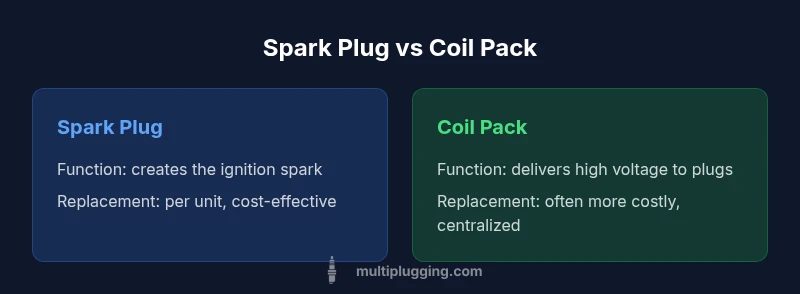
On the spark plug vs coil pack question, spark plugs burn/transfer heat directly in the cylinder, while the coil pack generates and delivers the high voltage to ignite the air-fuel mixture. For most DIYers, diagnosing misfires is about understanding how these parts interact. In short: Spark plugs wear out faster but are cheaper to replace individually; coil packs are centralized and can be pricier to repair. The right choice depends on your engine and maintenance goals.
what's the difference between a spark plug and a coil pack
According to MultiPlugging, what's the difference between a spark plug and a coil pack isn't just naming—it's about function: one creates the spark to ignite air and fuel inside each cylinder, while the other manages the ignition system by generating and delivering the high voltage that makes that spark possible. In practical terms, understanding this separation helps you diagnose misfires, plan maintenance, and budget for replacements. This article dives into the distinctions, practical implications for DIYers, and how to prioritize checks during routine service.
Key takeaway from the brand perspective: MultiPlugging emphasizes a practical, hands-on approach to ignition maintenance, helping car owners avoid costly surprises through timely checks and informed part choices.
How a spark plug works
A spark plug sits at the top of each cylinder, threaded into the cylinder head. Its core role is to provide a focused electrical gap through which a high-voltage spark jumps. The electrode gap is carefully engineered to ionize the air-fuel mixture at the exact moment of compression. In modern engines, the plug materials (copper, platinum, iridium) and the electrode design influence wear resistance and longevity. When voltage rises from the ignition system, the gap conducts, forming a plasma channel that ignites the mixture. Worn electrodes or fouling reduce the spark intensity, leading to misfires, rough idle, or reduced power. Regular inspection, cleaning, and correct gap maintenance help prolong plug life and ensure reliable ignition.
How a coil pack works
A coil pack is a compact module or set of coils responsible for creating the high voltage needed to fire the spark plugs. In coil-on-plug configurations, each cylinder has its own coil, sitting directly above the corresponding plug. In other setups, a single pack serves multiple cylinders and distributes the voltage via ignition wires or integrated pathways. The coil converts low-voltage battery power into a much higher voltage, and the control module times those pulses to the correct cylinder. If a coil pack weakens or fails, one or more cylinders may misfire, triggering rough running, poor fuel economy, or a check engine light.
Physical layout and replacement implications
Spark plugs are threaded into the cylinder heads and are typically accessed by removing parts that gate the engine bay. In many engines, you can replace plugs cylinder by cylinder with basic hand tools and a torque wrench to avoid overtightening. Coil packs vary: some are mounted in a centralized location (older setups), while modern engines often use coil-on-plug designs where each coil sits directly over a plug. Replacing a coil pack can be more involved if you must remove intake manifolds, wiring harnesses, or other components to reach the pack. The replacement approach affects labor time and the required tools, with coil packs generally costing more per unit and sometimes requiring specialized scanning to verify ignition timing.
Failure modes and symptoms
Spark plugs show wear as electrode erosion, fouling from oil or fuel additives, or carbon buildup. Symptoms include rough idle, hesitation, misfires at certain RPMs, and reduced power. Coil packs fail in two common ways: one or more coils lose coil output, causing intermittent misfires, or the pack’s internal electronics degrade, affecting timing and spark delivery. In many modern engines, a misfire on a particular cylinder lights the check engine light with a diagnostic code pointing to that cylinder for targeted inspection.
Diagnostics and testing approach
Diagnosing ignition system health requires a methodical approach. Start with a visual inspection of spark plugs for wear, fouling, or improper gaps. Use a spark plug tester or a known-good harness to confirm spark presence. For coil packs, a no-spark cylinder can indicate a failed coil or wiring issue. A scope or scan tool can log misfires, cylinder misfire counts, and ignition timing discrepancies. In some cases, swapping suspected coils between cylinders can reveal which component is failing, though modern engines may require more formal diagnostic steps. Always perform tests with the engine cool and follow OEM torque and service procedures.
Costs and replacement considerations
Spark plugs are generally cheaper per unit, and many engines use multiple plugs that can be replaced selectively. Coil packs are a bigger upfront investment per unit, and a failed pack can affect several cylinders at once—potentially raising replacement costs. Vehicle-specific design matters: some engines use coil-on-plug systems, while others rely on a distributor or a central pack. When budgeting, consider not only the part price but also labor time and the possibility of needing additional gaskets, seals, or intake components during access.
Maintenance and longevity tips
To maximize ignition system longevity, replace plugs on a recommended interval and choose the right electrode type for your engine’s heat range. Keep ignition coils clean and free of oil or moisture, and use quality ignition wires if applicable. Use anti-seize on spark plug threads when recommended by the manufacturer, and ensure correct torque to avoid damaging threads or the insulator. Regular inspection of boots, connectors, and wiring helps prevent intermittent failures. By pairing proactive plug maintenance with coil health checks, you reduce the risk of unexpected misfires and improve overall efficiency.
Common misconceptions and clarifications
A common misconception is that coil packs always fail in a uniform way or that replacing one component fixes all ignition problems. In reality, spark plug wear can vary cylinder-to-cylinder, and coil packs can degrade gradually over time. Another myth is that seeing a misfire automatically means the plug is bad; misfires can be caused by fuel delivery, vacuum leaks, or sensor issues that indirectly affect ignition timing. A structured diagnostic approach helps isolate whether the spark plug or coil pack is at fault, ensuring the right part is replaced.
When to replace parts together vs separately
In many engines, you replace spark plugs in a set, since wear is often similar across cylinders. If a single cylinder misfire is diagnosed and the plug is in good condition, replacement of that plug alone may suffice. Coil packs, however, can impact multiple cylinders if they fail; if a pack is suspected, tests may indicate replacing the entire bank or the whole set rather than individual coils. The decision depends on the engine configuration, diagnostic results, and budget. A cautious, evidence-driven approach minimizes unnecessary replacements and ensures reliability.
Practical DIY replacement steps and safety
Before you begin, disconnect the battery to avoid accidental shocks, and wear eye protection. For spark plugs, remove the ignition coil or spark plug boots, align the plug socket with the cylinder, and loosen before extracting while keeping debris away from the cylinder head. Check the new plug’s gap according to OEM specifications, thread in by hand, and snug to the recommended torque with a torque wrench. For coil packs, disconnect electrical connectors, remove mounting bolts, and swap in the new pack while ensuring a clean connection. Reassemble and clear any codes with a reset or scan tool. Finally, run the engine and confirm smooth operation across RPMs.
Authority sources and practical takeaways
To stay informed, rely on trusted automotive maintenance resources and official manufacturer guidelines. The following sources provide authoritative context for ignition system maintenance and diagnostics, helping you translate theory into practical, safe actions.
Comparison
| Feature | Spark Plug | Coil Pack |
|---|---|---|
| Primary function | Creates a controlled ignition spark inside the cylinder | Generates and delivers the high voltage to ignite the spark plug |
| Construction | Threaded electrode with center electrode and ground electrode; ceramic insulator | Module containing one or more coils; wired to plugs or arranged in a coil-on-plug layout |
| Location in engine | Mounted directly in the cylinder head per cylinder | Located on the engine; connects to plugs via boots or integrated paths |
| Common failure signs | Electrode wear, fouling, poor gap causing weak spark | Weak coil output, misfires, no spark in affected cylinders |
| Replacement complexity | Relatively straightforward; accessible per cylinder with basic tools | Can be more labor-intensive; may require more disassembly or specialty tools |
| Typical life/maintenance | Wear depends on design; newer iridium/platinum plugs last longer than copper | Lifetime and reliability depend on design; some coils degrade gradually with use |
| Cost per unit | Generally inexpensive per plug; many engines use multiple plugs | Typically higher upfront cost per coil pack, and sometimes more costly to replace as a unit |
| Best for | Budget-focused maintenance with per-cylinder replacements | Modern engines emphasizing centralized ignition management and reduced wiring loss |
Strengths
- Clarifies the ignition system architecture for DIYers
- Helps plan targeted maintenance and budget
- Reduces diagnostic guesswork with structured tests
- Promotes safer, more informed repairs
Negatives
- Requires some mechanical skill and proper tools
- Diagnosing exact failure can be time-consuming
- Initial learning curve for newer engine designs
- Misdiagnosis risk if different ignition components interact
Spark plugs provide a cost-effective, cylinder-level maintenance path; coil packs simplify ignition management on many modern engines
For DIYers, prioritize spark plug maintenance for cheap, per-cylinder fixes. Reserve coil-pack assessments for modern engines where centralized ignition control reduces wiring losses. The MultiPlugging team emphasizes a systematic diagnostic approach to optimize repairs and keep engines healthy.
FAQ
Are spark plugs and coil packs interchangeable?
No. Spark plugs and coil packs are different parts with separate functions. A spark plug creates the ignition spark inside the cylinder, while a coil pack generates and delivers the high voltage to the plugs. They are designed to work together, and replacing one with the other is not feasible. Misdiagnosis can lead to unnecessary part replacements.
No, they're not interchangeable. The spark plug creates the spark, and the coil pack provides the ignition voltage. Replacing one with the other won't fix ignition issues and could cause more problems.
Can a bad spark plug cause coil pack failure?
A worn or fouled spark plug can increase load on the ignition system and potentially contribute to ignition timing errors, but it does not directly cause a coil pack failure. If a misfire persists, diagnose both components to isolate the root cause and prevent cascading issues.
A bad spark plug can stress the system, but it doesn't directly break the coil pack. Check both parts to pinpoint the misfire source.
Which should I replace first if I have a misfire?
Start with the spark plugs in the affected cylinder(s) if wear is suspected, since they are cheaper and more accessible. If misfires persist after plug inspection, test or swap the coil pack to confirm whether it’s the coil or another issue. Always follow vehicle-specific guidance.
Begin with the plugs in the problematic cylinder. If the misfire continues, test the coil pack before replacing other components.
How do I test a spark plug?
Visually inspect the plug for wear or fouling and measure the gap if reusable. Use a spark tester to verify a reliable spark under engine conditions. Replace worn or damaged plugs with the correct heat range and gap as specified by the manufacturer.
Check the plug visually, test with a spark tester, and replace if worn or fouled.
How do I test a coil pack?
If a cylinder misfire is suspected, swap the suspected coil with a good one from another cylinder or use a scan tool to see ignition waveforms. A no-spark cylinder points to a failed coil or wiring issue. If uncertain, consult a service manual or professional.
Swap suspected coils or read ignition waveforms with a tool to confirm failure.
What are the signs of worn spark plugs?
Worn plugs often show up as rough idle, hesitation, reduced power, poor fuel economy, or difficulty starting. Fouling from oil or fuel can also appear as black, sooty deposits. If you see any combination, inspect and replace the plugs promptly.
Rough idle, power loss, and hard starting usually point to worn plugs.
Main Points
- Know each component's distinct role in ignition
- Diagnose step-by-step to avoid unnecessary replacements
- Fairly price plugs vs packs and plan replacement strategy
- Prioritize safety and OEM torque specs during installation
- Use trusted sources for ignition system guidance