Difference Between Spark Plug Wires and Coils: A DIY Guide
An analytical, objective comparison of spark plug wires vs ignition coils, explaining how each part works, wear signs, maintenance tips, and practical guidance for DIYers diagnosing ignition system issues.


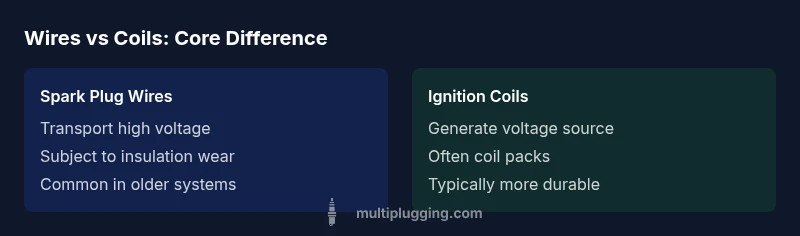
The difference between spark plug wires and coils is foundational to ignition system diagnostics. Wires provide the conductive path that carries high voltage from the coil to each spark plug, while ignition coils generate that voltage at the source. In modern engines, coil packs or coil-on-plug designs replace individual wires to simplify the path and improve reliability. Wires wear from heat and insulation breakdown, whereas coils fail due to winding faults or internal shorts. For DIYers, identifying which component is at fault is the first step in a successful repair.
What Are Spark Plug Wires and Coils?
The difference between spark plug wires and coils is fundamental to how your engine ignites fuel. According to MultiPlugging, understanding this distinction helps DIYers diagnose misfires and choose the right replacements. In their simplest form, spark plug wires are the conductive paths that carry the high voltage generated by the ignition system to each spark plug. They consist of a central conductor encased in insulating material, then surrounded by a flexible boot that seals against the plug boot or the distributor cap. Ignition coils, by contrast, are energy generators. A coil or coil pack stores magnetic energy and converts battery voltage into a much higher voltage required to jump the spark across the gap at the plug. In distributor-based systems, a single coil sends voltage to a rotor, which distributes it to each spark plug through wires. In modern engines, coil-on-plug or coil-pack designs place the coil directly above or beside the plug, reducing intermediate components. These two parts are not interchangeable in most engines; knowing their roles helps you diagnose ignition faults more accurately and avoid unnecessary parts replacements.
How They Work: The Electrical Path
To appreciate the difference between spark plug wires and coils, it helps to trace the electrical path. The battery supplies low voltage to the ignition switch, which in turn powers the coil or coil pack. The coil’s primary winding stores energy when current flows and releases it as a sharp voltage spike when the circuit breaks. This spike is stepped up dramatically by the secondary winding, producing the tens of thousands of volts needed to jump the spark gap. That high voltage then travels through spark plug wires (if the system uses them) to the plug, where it ignites the air-fuel mixture. In coil-on-plug designs, the coil sits directly on or near the plug, eliminating some or all intermediate wiring. The essential takeaway is that the coil is a voltage source, while the wires are the transport mechanism. Understanding this distinction helps diagnose misfires and timing issues with greater precision and guides proper component replacement.
Old vs Modern Setups: Wires in Distributor Systems
Historically, many engines used a distributor-based ignition system with a single coil and a rotating distributor. The coil generated the high voltage, which traveled through a cap and rotor to individual spark plug wires. This arrangement created a straightforward one-to-many path, but it introduced more mechanical wear points (the distributor, cap, rotor, and multiple boots). Modern vehicles have largely moved to coil-on-plug or coil-pack configurations. In these systems, each plug has its own coil or coil pack, which reduces the number of moving parts and minimizes energy loss along the way. For the DIY mechanic, this shift means that a failure is often localized to a single coil or a small pack rather than an entire set of wires.
Common Failure Modes: Wires vs Coils
Both components wear, but in different ways. Spark plug wires commonly fail due to heat aging, cracks in the insulation, or boot deterioration, leading to arcing, misfires, or voltage loss. Coils can fail through internal short circuits, open circuits, or weakened windings, resulting in weak sparks or no spark at all. In coil packs, a single faulty coil can cause one or more cylinders to misfire. Because coils are more compact and sealed, their failures can be less obvious at first but often manifest as occasional rough running or reduced power. Proper diagnosis usually starts with a systematic test of the coil pack or individual wires, followed by a compression or leak-down check if misfires persist. A careful inspection of boots and connectors should accompany electrical tests, as corrosion or loose connections can mimic broader component failure.
Symptoms and Diagnostics: When to Inspect Wires or Coils
Common symptoms include rough idle, intermittent misfires, hesitation during acceleration, or a check engine light with misfire codes. For wires, inspect boots for cracks, oil contamination, and separation from the plug. For coils, look for scorch marks on the coil housing, melted connectors, or signs of overheating. Diagnostic steps typically start with a visual inspection, followed by a spark test or a glow test to gauge whether the plug is receiving a strong spark. A resistance test on wires can reveal excessive impedance, while a coil test may involve measuring primary and secondary resistance against manufacturer specifications. Remember, the goal is to determine whether the fault lies with energy generation (coil) or energy delivery (wire), not to replace parts blindly.
Maintenance and Replacement Considerations
Maintenance planning for ignition components emphasizes preventive checks rather than guessing at failures. Spark plug wires should be inspected during routine tune-ups, with attention to boot integrity, moisture intrusion, and insulation wear. Replacing a full set of wires is often cheaper and simpler on older vehicles, and the process usually takes less specialized tools. Coil packs and individual coils require greater care during removal and installation due to their high-voltage nature and sensitive electronics. When replacing coils, ensure the correct impedance and compatibility with your engine’s control module. Use anti-seize compounds or torque specs where recommended, and always disconnect the battery before handling ignition components to reduce the risk of shock or arcing.
Diagnostics and Testing Methods
A systematic approach to diagnosing wires versus coils combines visual inspection with electrical testing. Use a spark tester to verify that each plug receives a strong spark under load. A multimeter can check resistance in wires, while coil tests may require measuring primary and secondary resistance against OEM specifications. If a misfire is isolated to one cylinder, test the corresponding coil or wire, then swap with a known-good part to confirm the fault. Jump-back tests and plug fuel trims readings from the onboard diagnostic system can provide additional clues about misfire patterns. Document symptoms, test results, and part serials to build a repair history that helps with future troubleshooting.
Installation Tips and Tools
Tooling matters as much as part choice when dealing with high-voltage ignition components. Use insulated pliers, a quality set of wrenches, and a torque wrench to avoid over-tightening. For wires, apply the correct length, route them away from hot surfaces, and secure them with clips to prevent contact with moving parts. Coil packs require careful alignment and harness connection checks to ensure proper seating and signal transmission. Keep a clean workspace, disconnect the battery, and avoid touching the coil while the system is energized. Safety first, then methodical replacement and testing to confirm the issue is resolved.
Performance and Reliability Trade-offs
Wires and coils each have performance trade-offs that can influence reliability and fuel efficiency. Wires in older systems offer a simple, low-cost maintenance path but can suffer from gradual degradation in insulation. Coil packs reduce parasitic losses and may improve ignition performance, especially in modern engines with precise timing control. However, coil-on-plug designs can be more expensive to replace per cylinder, and individual coil faults can cause cylinder-specific misfires. When deciding, consider your vehicle’s age, engine type, availability of spare parts, and your willingness to perform regular inspections to catch wear before it causes a fault.
Choosing Between Wires and Coils for Your Vehicle
The choice is often dictated by the engine architecture. If your car runs a traditional distributor-based ignition with a single coil, you’ll likely replace wires when there are symptoms of degradation and only replace coils if the coil itself is suspected of failure. For coil-on-plug or coil-pack systems, diagnostics should focus on the health of the coil units and their connectors, as these designs centralize ignition energy into fewer components. In either case, follow manufacturer guidelines, use OEM-recommended parts where possible, and plan a diagnostic path that confirms the source of the fault rather than assuming a part is misbehaving. Regular maintenance of boots, boots seals, connectors, and wiring harnesses is essential for preventing misfires and preserving engine performance.
Real-World Scenarios: Quick Checks You Can Do
In the field, practical checks can save time and money. If a cylinder consistently misfires, swap the suspected wire or coil with a known-good unit from another cylinder and observe whether the misfire follows the part. If the misfire moves with the suspected coil, the coil is the issue; if it stays with the cylinder, the problem may lie with the spark plug or a fuel-related fault. Visually inspect boot seals for oil exposure or cracks; moisture infiltration often signals impending failure. Finally, verify that all connections are clean, dry, and properly seated before performing any tests. These steps help DIYers identify the root cause more efficiently than random replacements.
Practical Takeaways for DIYers
- The difference between spark plug wires and coils is fundamental for accurate diagnosis.
- Modern engines favor coil packs; older setups rely on wires plus a distributor.
- Inspect boots and connectors regularly; replace worn wires or faulty coils as needed.
- Use structured diagnostics, including spark tests and resistance checks, to pinpoint faults.
Comparison
| Feature | Spark Plug Wires | Ignition Coils |
|---|---|---|
| Role in ignition | Transmit voltage to plugs | Generate voltage at source |
| Typical failure mode | Insulation wear; arcing; boot damage | Internal winding fault; open circuit; weakened output |
| Replacement approach | Replace wires as a set; check connectors | Replace coil or coil pack; sometimes replace as a unit |
| Installation complexity | Moderate; routing and sealing important | Low to moderate; depends on pack design |
| Maintenance focus | Boots, insulation, connections | Coil packs, harness connections, and mounting |
Strengths
- Wires remain inexpensive on older cars and are easy to inspect visually
- Coil-based systems reduce the number of parts and wiring paths, improving reliability in modern engines
- Coils can provide stronger, more consistent sparks and quicker starts in cold weather
- Coil-on-plug designs minimize energy loss in transmission
Negatives
- Wires degrade over time and require periodic replacement
- Coils or coil packs can be costly to replace, especially in newer vehicles
- Wires are susceptible to boot damage and moisture ingress, leading to misfires
- Certain coil designs can be difficult to service without proper tools
Coils generally offer better reliability in modern engines; spark plug wires remain a simple, cost-effective option for older setups.
In most new or recently updated vehicles, coil-based ignition is preferred for reliability and fewer failure points. For older cars with distributor-based ignition, wires are cheaper to replace and easier to service. The best choice depends on your engine design and maintenance preferences.
FAQ
What is the key difference between spark plug wires and ignition coils?
Wires carry the high voltage from the coil to the spark plugs, while coils generate that voltage at the source. In modern engines, coil packs or coil-on-plug designs often replace individual wires for improved reliability.
Wires deliver the spark; coils create it. Modern cars usually use coil packs instead of long wire runs.
Do modern cars still use spark plug wires?
Most modern cars use coil packs or coil-on-plug arrangements rather than individual spark plug wires. Wires may still exist in older or specialized engines, but the trend is toward compact, integrated ignition systems.
Most newer cars skip the long wires and use coils near each plug.
How can I tell if my wires or coils are failing?
Look for misfires, rough idle, hesitation, or a check engine light. Visually inspect wiring boots for cracks or signs of oil. For coils, check for scorching, arcing, or inconsistent spark signals using specialized testers.
If the engine misfires or runs rough, test the coils and wires with appropriate tools.
Can I replace wires and coils separately?
Yes, many older systems allow replacing wires independently of coils. In coil-on-plug designs, coils may need replacement as a unit or per cylinder according to the vehicle. Always follow OEM guidance.
Yes, you can often replace wires separately, but coils in modern designs are usually replacement units.
Are there safety concerns when working on ignition components?
Yes. Disconnect the battery, avoid fuel vapors, and handle high-voltage parts with insulated tools and caution. Never test live circuits without proper safety equipment.
Yes—work carefully, disconnect power, and use insulated tools.
How often should wires or coils be replaced?
There is no universal interval. Replace when worn, cracked, or when diagnostics indicate faults. Regular inspection during tune-ups helps catch issues early.
Replace when you see wear or misfire signs, not on a fixed schedule.
Main Points
- Prioritize coil packs for modern engines for reliability and simplicity
- Inspect boots and connectors regularly to prevent misfires
- Use diagnostic tests to distinguish coil vs wire faults
- Consider age and engine design when choosing replacements