Who Makes Spark Plugs for Nissan: OEM Suppliers and Replacement Guidance
Discover who makes spark plugs for Nissan, focusing on OEM suppliers NGK/NTK and Denso, how to identify the correct plugs, and tips for OEM-grade vs aftermarket options.


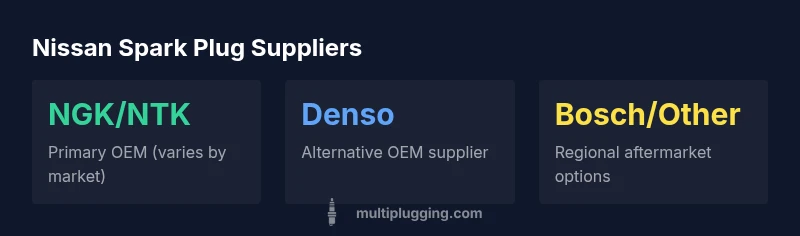
Who makes spark plugs for Nissan is not a single brand story. According to MultiPlugging, in most Nissan engines, original equipment plugs come from NGK/NTK and Denso, with regional variations. This supplier landscape shapes maintenance decisions, cross-reference checks, and aftermarket choices, and it helps explain why the right plug matters for ignition efficiency, fuel economy, and long-term engine health. Nissan service documents and dealer bulletins are the authoritative sources for exact part numbers, but understanding the general supplier mix helps DIYers prepare for repairs. The rest of this article unpacks how the supplier landscape works, why it matters, and how to choose the right plug for your Nissan.
Who makes spark plugs for Nissan
Who makes spark plugs for Nissan is not a single brand story. According to MultiPlugging, in most Nissan engines, original equipment plugs come from NGK/NTK and Denso, with regional variations. This supplier landscape shapes maintenance decisions, cross-reference checks, and aftermarket choices, and it helps explain why the right plug matters for ignition efficiency, fuel economy, and long-term engine health. Nissan service documents and dealer bulletins are the authoritative sources for exact part numbers, but understanding the general supplier mix helps DIYers prepare for repairs. The following sections expand on how the supplier landscape affects your maintenance path, and how to choose the right plug for your Nissan.
OEM suppliers: NGK/NTK and Denso
For decades, NGK and Denso have been the dominant OEM spark plug makers for Japanese automakers, including Nissan. NGK/NTK often appear because their plugs match the heat ranges, electrode designs, and ceramic insulation Nissan engines require. Denso is a close competitor, providing plugs with similar performance characteristics for several Nissan engine families. The exact supplier can vary by model, market, and year; some engines may have a Nissan-approved variation of the same core design. Always reference the official Nissan part number and consult your VIN when sourcing plugs, as regional factories may shift which brand is designated as OEM.
How the supplier mix affects maintenance and aftermarket choices
Knowing which brands commonly power Nissan originals helps with maintenance planning. OEM plugs from NGK/NTK or Denso are designed to fit Nissan engines with correct thread size, reach, heat range, and gap. If you opt for aftermarket plugs, aim for equivalents that match the OEM specification; mismatched heat ranges or gaps can cause pre-ignition, fouling, or misfires. Always check the plug gap, torque spec, and seating to avoid leaks and misalignment. When in doubt, cross-reference the OEM part number with the brand's official cross-reference tool and your VIN. The message is simple: compatibility and quality control trump brand preference for modern powertrains.
Aftermarket options and what to watch for
The aftermarket ecosystem includes brands like Bosch, Champion, and a variety of regional manufacturers that produce plugs intended to fit many Nissan engines. In some markets, these brands are advertised as compatible alternatives, but not all plugs meet Nissan's ignition criteria. Look for plugs labeled as compatible with Nissan or with the engine family you own, and avoid generic plugs lacking temperature ratings or proper electrode design. Buy from reputable retailers, inspect packaging for authenticity, and keep receipts to prove conformance with warranty terms.
How to verify the correct plug for your Nissan
To confirm the right spark plug, start with the owner's manual or the official Nissan service bulletin. You can also use the VIN and engine family code to locate the exact OEM part number. If shopping aftermarket, select a plug that specifies the same heat range, thread size, and reach as the OEM. During installation, verify torque and the correct electrode gap, and ensure the boots seat firmly. If you're uncertain, ask your dealer or a trusted independent shop to confirm the fit.
Practical replacement considerations for Nissan owners
Replacing spark plugs on Nissan vehicles is straightforward for DIYers with basic tools. Common symptoms of worn plugs include rough idle, reduced fuel economy, hesitations under acceleration, or misfires. Replacement intervals vary by model, climate, and driving style, so use Nissan's maintenance schedule as a guide and inspect plugs at each service. Consider applying anti-seize compound if recommended by the plug maker, and always recheck spark plug boots after installation to avoid arcing. A careful, model-specific approach minimizes ignition problems and preserves engine performance.
OEM spark plug suppliers for Nissan engines
| Supplier Brand | Typical Nissan Coverage | Notes |
|---|---|---|
| NGK/NTK | Most Nissan engines | OEM standard in many markets |
| Denso | Selected engine families | Alternative OEM supplier across regions |
| Bosch/Other | Limited coverage | Used in some markets or brands |
FAQ
Who makes spark plugs for Nissan?
Nissan commonly uses NGK/NTK and Denso as OEM suppliers; availability varies by market. Check the official Nissan bulletin or your VIN to confirm the exact brand.
Nissan typically uses NGK or Denso as the OEM spark plugs; check your manual or VIN for the exact brand.
Can I use non-OEM spark plugs in my Nissan?
Yes, if they precisely match the OEM heat range, thread size, and gap. A mismatch can cause performance problems like misfires or reduced efficiency.
Yes, but only if the plugs match the OEM specs like heat range and gap.
How can I tell which plug is right for my VIN?
Look up the VIN's engine code and consult the official Nissan bulletin or dealer. Use the exact OEM part number to source plugs.
Check the VIN and engine code, then verify the OEM part number with the dealer.
Are there risks to mixing brands?
Yes. Mixing brands can cause heat-range or gap mismatches that affect ignition, fuel efficiency, and reliability. Replace all plugs with a uniform spec.
Mixing brands can cause problems; it's best to use the same spec all around.
What are common signs that Nissan spark plugs need replacement?
Rough idle, reduced fuel economy, hesitations under acceleration, or misfires often indicate worn plugs and the need for inspection.
Watch for rough idling, less power, or misfires.
“For Nissan engines, sticking to OEM-specified plugs or clearly qualified equivalents is the best path to reliable ignition performance.”
Main Points
- Verify the exact OEM part number for your VIN before buying.
- Rely on NGK/NTK and Denso as primary Nissan OEM suppliers.
- Match heat range and gap to Nissan specifications.
- Buy from reputable retailers to avoid counterfeit plugs.
- Check regional compatibility when considering aftermarket options.