Denso vs NGK Spark Plug: A Thorough Comparison
A thorough, objective comparison of Denso and NGK spark plugs across materials, heat range, longevity, and value to help DIYers choose the right plug for their engine.


When evaluating denso vs ngk spark plug options, both brands offer high-quality plugs that fit a wide range of engines. In most applications, NGK provides broader model coverage and proven durability, while Denso emphasizes performance variants and competitive pricing. For a default fit, lean toward NGK; choose Denso when you prioritize performance-focused options or value.
Understanding the spark plug landscape
In the automotive aftermarket, two brands consistently rise to the top in terms of availability, reliability, and performance: Denso and NGK. For car owners and DIY enthusiasts, understanding the basic differences between denso vs ngk spark plug helps avoid misfires, fouling, and suboptimal combustion. According to MultiPlugging, the choice often comes down to engine design, heat range compatibility, and whether you prioritize long-term reliability or performance variants. This section lays the groundwork for how the two brands differ in approach, what that means for everyday driving, and how to translate that into a decision you feel confident making during a parts run. You’ll see how model coverage, heat-range breadth, and manufacturer recommendations influence real-world outcomes. The goal is not to pick a winner on instinct, but to map your engine’s needs to the right plug family from each brand.
Core Differences in Construction and Materials
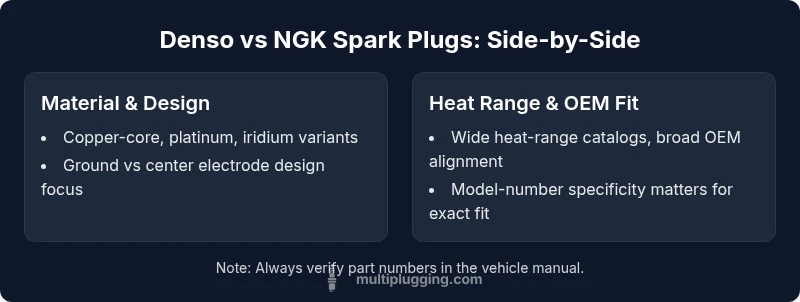
Denso and NGK both offer a range of plug core designs, including copper-core, platinum, and iridium variants. The core differences often lie in electrode geometry, ceramic insulator quality, and how each company designs the center electrode and ground electrode for durability under load. NGK tends to emphasize robust, widely compatible platinum and iridium options with strong OEM alignment across many makes. Denso frequently focuses on performance-oriented variants that optimize ignition, heat dissipation, and misfire resistance for high-demand conditions. For a typical daily driver, either brand provides solid options; the choice becomes more nuanced when you push the engine toward higher RPM, turbocharging, or frequent start-stop cycles.
Heat Range, Gap, and Engine Compatibility
Heat range is the single most important spec when matching a plug to an engine. Both brands publish broad heat-range catalogs, but regional availability and specific OEM recommendations can steer you toward one brand. NGK often has broader coverage in mainstream vehicles and well-documented compatibility across a wide variety of makes and models. Denso’s catalogs sometimes prioritize variants designed for performance-oriented setups or engines with tighter combustion spaces. In practice, you want a plug that reaches peak temperature reliably under your driving profile while avoiding both fouling (too cold) and pre-ignition (too hot). When in doubt, start with the OEM recommended heat range and verify the fit with the engine manual.
Performance Under Cold Starts, Acceleration, and High-Load Driving
Ignition performance boils down to ignition energy, electrode design, and heat management. NGK’s standard platinum and iridium options typically provide crisp starts and steady performance across a broad temperature range, making them a dependable choice for most drivers. Denso’s high-performance and iridium variants often emphasize quicker heat-up and stronger ignition energy, which can yield smoother throttle response in cold starts or high-load conditions. In practical terms, if you drive in cold climates or regularly push the engine hard, you might prefer a Denso variant tuned for brisk ignition; for routine commuting, NGK’s broad lineup generally covers you well.
Longevity, Fouling Resistance, and Maintenance Considerations
Longevity and fouling resistance depend heavily on heat range selection, gap setting, and driving style. Both brands offer long-life options (platinum/iridium) that resist fouling better than copper-core variants. NGK has a strong track record for durability in a wide range of vehicles, while Denso’s premium lines often balance longevity with strong ignition performance. Regular replacement at the service intervals recommended by the vehicle manufacturer remains the best way to prevent misfires and maintain engine efficiency. If you see fuel-related fouling or oil fouling, revisit the gap setting and consider whether heat range or fuel mixture adjustments are needed.
OEM Fitment, Availability, and Warranty Implications
OEM (original equipment manufacturer) fitment is a key factor in proper plug selection. Both Denso and NGK maintain extensive OEM partnerships, but certain makes may favor one brand for factory-installed plugs. Availability varies by region and dealer network, which can influence lead times and price. Warranty implications usually hinge on whether the replacement plug matches the engine’s recommended heat range and thread specification. Always verify the specified part number or part-family in your owner’s manual and confirm with a trusted parts supplier if you’re unsure.
Price-to-Value: When to Choose Which Brand
Price alone isn’t the sole determinant of value. NGK’s broad coverage and consistent performance make it a reliable default across many engines, which can translate to lower risk of compatibility issues. Denso often offers competitive pricing on performance variants and a handful of models designed for particular engines or climates. If your priority is guaranteed OEM compatibility with a robust service network, NGK is typically the safe bet. If you’re chasing a performance edge or budget-focused options for a specific engine, Denso may present better value.
How to Read Model Numbers and Verify Fitment
Both brands publish model-number schemes that encode the core design, heat range, and thread type. Learn to compare the OEM part number or the recommended heat-range category rather than relying solely on a brand name. Start with the vehicle’s manual or a reputable parts catalog, then confirm the selected plug’s thread size (e.g., M14 or 14mm), reach, heat range, and gasket type. If your vehicle uses a turbocharged engine or a high-performance variant, verify the plug’s suitability under boost and high-temperature operation. When you’re unsure, reach out to a professional or consult the brand’s official compatibility tools.
Practical Selection Guide and Installation Tips
To pick the right plug, identify the required heat range, confirm the thread size, and check for any OEM-recommended brands. For DIY installation, gather a torque wrench, a correct socket, and anti-seize or torque-seal as per manufacturer guidance (some modern engines do not require anti-seize). Remove the old plug with a plug socket, measure the gap if applicable, clean the threads, and install the new plug to the manufacturer’s torque specification. After installation, recheck the gap (if required) and test drive to confirm smooth operation. For precision work, consider crossing over to NGK or Denso’s more advanced variants if your engine demands low resistance and quick heat-up.
Final Practical Step: Create Your Personal Denso vs NGK Checklist
Before your next parts run, assemble a simple checklist: confirm OEM heat-range compatibility, verify thread size, assess your climate and driving style, and decide whether you prioritize reliability or performance. Keep a small note of your observations after each replacement—start-up behavior, idle stability, and throttle response—so you can refine your choice over time. A methodical approach helps you avoid the most common mistake: replacing with a plug that technically fits but doesn’t meet your engine’s design goals.
Comparison
| Feature | Denso spark plug | NGK spark plug |
|---|---|---|
| Material & design | Offers copper-core, platinum, and iridium variants with performance-focused options | Widely used platinum/iridium lineup with broad OEM alignment and dependable performance |
| Heat range options | Strong selection across performance-oriented to standard ranges | Very broad heat-range catalog with extensive model coverage |
| Longevity & fouling resistance | Premium lines emphasize long life; performance variants may resist fouling in demanding use | Durable designs with proven long life in many vehicles; standard options excel at baseline reliability |
| OEM fitment & availability | Good OEM coverage; regional availability varies by model | Excellent OEM alignment across a wide range of makes and regions |
| Price/value | Competitive pricing on select performance-focused variants; value depends on model | Typically strong value with broad availability; pricing parallels feature tier |
| Best for | Performance-oriented builds or cost-conscious variants for certain engines | Reliability, broad compatibility, and easy sourcing for most drivers |
Strengths
- Broad model coverage for both brands reduces fitment risks
- Strong reliability in everyday driving scenarios
- Wide availability of OEM-fit plugs simplifies sourcing
- Premium variants offer performance advantages without sacrificing reliability
Negatives
- Model-by-model variations can cause selection confusion
- Sometimes price differences are small and difficult to justify without testing
- Region-specific availability can affect lead times and stock
- Non-OEM variants may require careful verification of heat range for your engine
NGK is typically the safer default for broad compatibility and reliable performance; Denso serves niche performance variants and potential cost benefits
For most DIYers and OEM-replacement scenarios, NGK offers dependable coverage. Consider Denso when your engine leans toward performance variants or you’re seeking specific pricing advantages on select models.
FAQ
Are Denso and NGK spark plugs interchangeable?
In many cases they are interchangeable if the heat range, thread size, and reach match your engine’s specification. Using an incorrect heat range can cause misfires or fouling. Always verify the exact part number from the OEM guide or reputable catalog before swapping brands.
They can be interchangeable in many engines, but always check your manual for the exact heat range and fitment.
Which brand lasts longer in typical gasoline engines?
Longevity depends on the model and how you drive. Both brands offer long-life platinum and iridium options; durability is usually similar when heat range and gap are matched to the engine. Choose based on the recommended heat range and your driving conditions.
Both brands offer long-life options; select the heat range that matches your engine and driving style.
Do OEM manufacturers prefer NGK or Denso?
OEMs select plugs based on performance, emissions, and reliability requirements. NGK and Denso both appear in factory fits across various makes. Always follow the OEM specification for your vehicle instead of relying on brand alone.
OEMs pick plugs based on specifications; check your vehicle’s manual for the exact part.
Do these brands require anti-seize lubricant?
Many modern engines come with anti-seize considerations already accounted for in the installation torque. Some NGK and Denso plugs do not require anti-seize. If your manual suggests it, apply a light coating; otherwise, follow the manufacturer torque spec.
Follow the torque spec; anti-seize may not be needed for many modern engines.
Can I mix brands if replacing a single plug per bank?
Mixing brands within the same engine is generally not recommended because heat ranges, gap settings, and ignition energy differences can affect performance. If you must mix, do so only with the exact OEM heat range verified for your engine and replace all plugs at the next service.
Mixing brands is usually not advised; check heat range and aim to match OEM specs.
Which brand is best for cold-start performance?
For cold-start performance, select a plug with heat range appropriate for your climate and vehicle. Both brands offer cold-weather-oriented variants, with many users reporting robust starts from their preferred option when correctly matched to the engine.
For cold starts, pick a plug with the right heat range for your engine and climate.
Main Points
- NGK provides broad coverage and consistent reliability
- Denso delivers performance-oriented options and potential cost benefits
- Match heat range and OEM fitment before buying
- Refer to the vehicle manual and ensure correct thread size and reach