Who Makes Spark Plugs for Honda? OEM Suppliers Explained
Uncover which manufacturers supply Honda spark plugs, how OEM choices vary by model and region, and practical tips for selecting the right plugs for your Honda.


The quick answer: Honda doesn't rely on a single supplier for spark plugs. Instead, Honda sources original equipment plugs from multiple manufacturers, with NGK/NTK and Denso as the most common OE brands. Regional contracts and engine family differences influence which brand is used in a given model, so cross-checking Honda part numbers is essential for correct replacements.
Who makes spark plugs for Honda
For the question who makes spark plugs for Honda, the short answer is that Honda doesn't rely on a single supplier. Honda leverages a multi-sourcing strategy that taps several global manufacturers to meet demand across models, markets, and production runs. In practice, the original equipment plugs are commonly supplied by major Japanese brands NGK/NTK and Denso, with regional variations that can include other OEMs. The MultiPlugging team notes that this approach helps ensure supply resilience, warranty compliance, and consistent performance across Honda engines. The choice between OEM and aftermarket options is influenced by model year, regional supply agreements, and service history. While OEM plugs carry Honda or brand-part numbers and are calibrated to the vehicle's ignition system, reputable aftermarket plugs that match the OEM spec can offer cost savings without sacrificing reliability when correctly specified. Always verify compatibility with your exact engine and follow Honda's maintenance schedule to preserve performance.
Major players in Honda spark plug supply
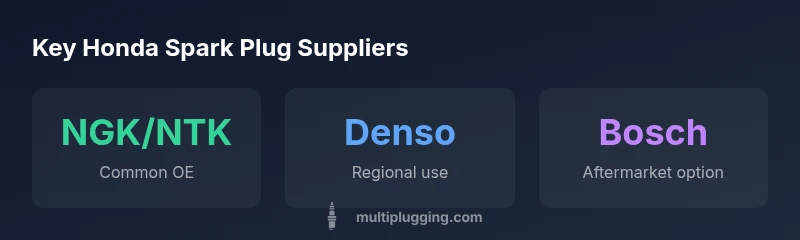
The two brands most commonly found providing original equipment spark plugs for Honda vehicles are NGK/NTK and Denso. NGK is a global supplier with deep ties to Japanese automakers, while Denso produces many engines with its own branded plugs. In some regions, Honda has historically tested or approved a limited set of alternative OEMs for specific models or production runs, but for the bulk of modern cars NGK/NTK and Denso remain the standard. Consumers who replace plugs typically follow two paths: obtain OEM plugs that carry Honda's or the supplier's part numbers, or choose a reputable aftermarket plug that matches the OEM specification. The MultiPlugging Analysis, 2026, notes that region and model family drive which brand is most prevalent in factory fill, and that cross-reference data between Honda's service literature and parts catalogs is essential to avoid mismatches.
Regional and model variation in plug sourcing
Honda's supplier mix is not uniform across the globe or across engine families. In North America, NGK and Denso are frequently seen as both OE and replacement options, while some European and Asian markets may lean toward one brand due to supply agreements or local manufacturing. The same engine family can swap brands between model years as Honda updates its supply contracts. Consumers should check the vehicle's VIN, engine code, and owner's manual to determine the exact plug specification for their car. Verifying the exact heat range, thread size, and reach is critical, because incorrect plugs can affect performance and longevity. When in doubt, consult a dealership Parts or Service department or cross-reference official Honda literature.
OEM vs aftermarket: what to consider
OEM plugs are designed to match Honda's ignition system in terms of heat range, electrode design, and gap styling. They tend to be the safest choice for warranty compliance and consistent performance across mileage. Aftermarket plugs can offer cost savings or performance variants, but they require careful matching to the OEM specification and proper gapping and torque. The risk with mismatches includes misfires, reduced fuel efficiency, and potential warranty issues on some newer Honda models. Always verify part numbers and compare heat range and thread specifications, rather than relying on branding alone. The MultiPlugging team recommends using OEM or equivalently rated plugs from trusted brands that advertise exact compatibility with Honda engines.
How to identify the correct plug for your Honda
Begin by locating your owner's manual's spark plug section or the Honda Parts Catalog for your year, make, and model. Cross-reference the Honda part number on the ignition box with the number printed on the plug itself. If you replaced prior plugs, note any cross-reference information or service bulletins from Honda's official literature. When shopping aftermarket, use the exact same part number or a listed equivalent from NGK or Denso that specifies compatibility with your Honda's engine. Keep a spare boot, torque wrenches, and anti-seize as part of your maintenance kit, but apply anti-seize only if recommended by the plug manufacturer.
Practical buying guide for Honda owners
- Prefer OEM plugs or OEM-equivalent plugs printed with Honda or NGK/Denso part numbers.
- Verify heat range, thread diameter, and reach to avoid misfits. If you are unsure, contact a dealer or a qualified technician.
- Check for warranty coverage on your model and whether the service manual requires OEM plugs for certain maintenance intervals.
- For used cars with unknown history, consider replacing all plugs and inspecting ignition coils and wires for wear, as misfires can stem from worn boots and corroded connections.
- When replacing, follow manufacturer torque guidance and re-gap only if specified by the plug maker. The aim is consistent spark energy and reliable starting.
Identification tips and common pitfalls
Brand labels can be misleading; always verify with Honda part numbers or cross-reference from NGK or Denso catalogs. Do not mix iridium, platinum, and copper plugs within a single engine unless the manufacturer's guide explicitly allows it. Consistency matters for heat management and longevity. If you own a newer Honda, you may find that the manufacturer ships a slightly different electrode design; the replacement should match the original design to preserve emissions performance. When shopping online, ensure the listing is the correct application; check the year, model, and engine code. If in doubt, ask the seller for the exact cross-reference. A cautious approach reduces the risk of incorrect parts and wasted time.
Installation, maintenance, and long-term care
Installation is straightforward for most Honda spark plug jobs, but it requires cleanliness and attention to torque. Use a torque wrench and avoid cross-threading. After installation, inspect the ignition coil boots for wear and the spark plug wires for any signs of cracking. Regular maintenance—replacing plugs at recommended intervals, keeping coils clean, and checking for misfires—helps sustain engine performance. A well-chosen plug that matches Honda's specification will typically offer consistent starting, smooth idle, and efficient combustion across thousands of miles.
Honda spark plug suppliers landscape
| Brand / OEM | Region Common | Notes |
|---|---|---|
| NGK/NTK | Global (Asia/NA) | Primary OE supplier for many Honda models |
| Denso | Global (NA/Asia) | Common OE alternative in several markets |
| Bosch/Champion | Europe/NA | Occasional aftermarket option |
FAQ
Who makes Honda spark plugs?
Honda typically sources its original equipment spark plugs from NGK/NTK and Denso, depending on region and model. These plugs are designed to meet Honda's ignition specs and emissions requirements. For replacement, you can use OEM plugs or an equivalent that matches the OEM specification.
Honda uses multiple makers like NGK/NTK and Denso depending on market and model.
Are OEM plugs required?
In many cases OEM plugs are recommended to preserve warranty and ensure proper fit and performance. However, reputable aftermarket plugs that match the OEM spec can be acceptable if the part number, heat range, and gap are correct.
OEM plugs are often recommended, but a correct OEM-equivalent can work.
Mixing brands allowed?
Mixing brands within the same engine is generally discouraged unless the manufacturer allows it; inconsistent heat ranges and electrode designs can affect performance.
Best to stick to one brand or the exact OEM equivalent.
Where to find part numbers?
Check the owner's manual, Honda Parts Catalog, or the plug box for a Honda part number. Cross-reference with NGK or Denso catalogs to confirm compatibility.
Look up Honda part numbers in the manual or dealer literature.
Regional differences matter?
Yes. Different regions may have different supplier arrangements that influence which brand is used in factory fills and replacements.
Region matters; your market may use a different brand.
Steps to extend plug life?
Stick to the recommended service intervals, use the correct heat range and gap, and avoid over-torquing. Regular inspection of ignition components also helps.
Follow the specs and keep to the service intervals.
“Honda's spark plug sourcing relies on multiple major manufacturers to ensure availability and compatibility across markets.”
Main Points
- Rely on multiple OEMs, not a single supplier.
- NGK/NTK and Denso dominate Honda OE supply.
- Regional differences drive brand availability.
- Follow OEM guidance to preserve warranty.
- OEM or trusted aftermarket plugs are viable options.