which spark plug is better iridium or platinum: A practical guide
Explore which spark plug is better iridium or platinum, weighing longevity, performance, and cost to help DIYers choose the right option for their engine.


which spark plug is better iridium or platinum is a question that depends on engine design, driving style, and budget. In general, iridium plugs offer longer life and stronger ignition in high-RPM or high-stress conditions, while platinum plugs provide solid performance at a lower upfront cost. This comparison walks through longevity, cost of ownership, and practical use cases to help you decide the best fit for your vehicle.
Which spark plug is better iridium or platinum
When you ask which spark plug is better iridium or platinum, the short answer is: it depends on your engine design, driving style, and budget. Iridium plugs use an iridium alloy for the center electrode, yielding exceptional wear resistance and hot-spot suppression; platinum plugs use platinum for a tougher center electrode than conventional copper plugs, offering solid performance at a lower price. According to MultiPlugging, the choice hinges on longevity, ignition reliability, and total cost of ownership rather than upfront price alone. In this guide, we’ll break down the practical differences, explain how each material behaves under common operating conditions, and give you a decision framework you can apply to almost any modern passenger car or light truck. We’ll also cover heat range compatibility, gap maintenance, and note where OEMs steer you toward one material over the other. By the end, you’ll know which option is most appropriate for your vehicle, your driving habits, and your wallet. Remember: the "right" plug for your engine isn’t always the priciest one—it’s the one that meets the manufacturer’s specs and your real-world needs.
bold: null],
Material science and design differences
Iridium and platinum spark plugs share the same basic role as sources of a reliable ignition, but the material on the center electrode matters. Iridium is harder and has a higher melting point than platinum, allowing for a finer electrode tip and a smaller, sharper spark kernel. The result is lower erosion and a longer service life in many engines, especially those with high compression or aggressive ignition timing. Platinum plugs have a robust center electrode as well, but their wear resistance is typically lower than iridium’s under the same duty cycle. Many manufacturers align platinum plugs with mid-range engines and vehicles that see steady, daily driving rather than aggressive throttle use. A few brands produce platinum alloy-tipped designs that narrow the gap in durability, but in broad terms iridium is favored for longevity and a slight edge in cold starts. Be aware: heat range and thread size vary by model and by brand, so you must consult the vehicle’s owner manual. In practice, the choice often reduces to a balance between upfront cost and replacement interval, not a single performance metric.
Performance and engine types: where the difference matters
The performance delta between iridium and platinum plugs shows up most clearly in engines that operate at higher RPMs, under load, or where ignition timing is critical. In high-revving gasoline engines, iridium’s narrow center electrode reduces the energy needed to ionize the air-fuel mix and produces a more stable spark under demanding conditions. In mild, naturally aspirated engines with steady throttle, platinum plugs can deliver nearly equivalent acceleration feel and smooth idling, especially when gapped correctly and maintained. For many modern direct-injection engines, the ignition system benefits from the stronger electrode in iridium when you’re chasing consistent misfire-free performance across many miles. However, for ordinary daily drivers who drive conservatively, the difference may be imperceptible in day-to-day driving. Brand variation matters, too; some automakers specify platinum for certain models, others require iridium for extended service intervals. If you’re uncertain, review the OEM specification and consider your typical driving profile before deciding. The practical rule: choose iridium if you regularly drive long trips, tow, or operate at high RPM; choose platinum if cost is a more important consideration and your engine is within its recommended plug type.
Wear, longevity, and heat management
Electrode wear is the primary reason spark plugs need replacement, and material choice affects wear rates. Iridium’s hardness reduces electrode erosion in many service conditions, extending interval lengths in engines with aggressive ignition. Platinum’s wear resistance is substantial compared to copper, but it generally won’t match iridium under heavy operation. The key is to follow the vehicle manufacturer’s recommended replacement interval, which is often stated in miles or years. The heat range—the plug’s ability to dissipate heat from the combustion chamber—also influences longevity. A plug that operates too hot can pre-ignite, while one too cold can foul; both conditions shorten life. Manufacturers typically tune heat range in a way that aligns with the intended material. In practical terms, if you own a modern car with a proven OEM recommendation for iridium, you’re likely to see longer service life and less frequent breather-type fouling compared to platinum in the same engine. However, real-world results vary with climate, fuel quality, and maintenance, which is why you should adhere to the manual and perform regular inspections.
Cost considerations and replacement intervals
The upfront cost delta between iridium and platinum plugs is the most obvious difference: iridium tends to cost more per unit. The bigger question is total cost of ownership, which factors in replacement intervals, maintenance time, and any potential fuel economy effects. In many everyday drivers, platinum plugs can offer adequate performance for a reasonable period, making them a practical choice when the budget is tight or when the engine manufacturer specifies platinum. For enthusiasts and commercial operators who rely on long-term reliability and consistent performance across long road trips or challenging conditions, iridium can reduce maintenance hassles by extending replacement intervals. MultiPlugging’s analysis for 2026 shows that the long-term value of iridium often depends on how you drive (high mileage, repeated high-load use, or frequent cold starts). A note for DIYers: regardless of material, using the correct torque during installation and ensuring proper gapping is essential to maximize life. If you plan to keep the vehicle for many years or miles, iridium can often be the smarter investment; if you swap cars frequently, platinum provides predictable, lower upfront costs.
Practical decision framework: when to pick which
To decide between iridium and platinum, deploy a simple framework: 1) check the OEM spec, 2) evaluate your driving pattern, 3) weigh the replacement interval and maintenance costs, 4) consider the climate and fuel quality, and 5) factor in the total cost of ownership. For engines with high compression or forced induction, iridium often yields better long-term reliability and smoother performance across seasons. For budget-minded owners or cars with modest performance needs, platinum can offer strong everyday performance at lower upfront cost. If you use a plug-in hybrid, a small efficiency gain may be worth your time; if you drive a classic or older vehicle, sticking to the OEM recommended plug is wise. Another practical tip: never mix plug types in the same engine unless the manufacturer explicitly allows it. Mix-and-match can lead to uneven firing and misfires. Always replace all spark plugs in the set at the same time to maintain consistency and engine efficiency.
Installation and maintenance tips for best results
No matter which material you choose, correct installation matters as much as model. Use the correct thread size and heat range, apply anti-seize screw-on if recommended, and torque to the manufacturer’s spec. Clean the threads in the bore, check for oil leaks, and ensure the ignition coils are healthy; misfires can masquerade as worn plugs. Gap the plugs according to the OEM spec rather than guessing, as proper gap is critical for consistent ignition and fuel economy. Finally, perform regular inspection during service intervals; look for fouling, carbon buildup, or oil coating, which can indicate ignition or engine issues. By keeping the ignition system clean and timely, you’ll maximize whichever material you choose and minimize the risk of misfires.
Common myths and misconceptions
Myth: Iridium always lasts forever. Reality: longevity depends on engine load, driving style, and maintenance. Myth: Platinum is universally worse under all conditions. Reality: platinum is a robust, cost-effective choice for many engines. Myth: Upgrading to a more expensive plug guarantees more power. Reality: most gains come from proper ignition timing, compression, and fuel quality, not from the electrode material alone. Myth: OEMs mandate a particular brand. Reality: many engines specify a material type rather than a specific brand; always verify the spec in your manual.
Decision factors recap and final alignment
Which spark plug is better iridium or platinum? The answer depends on your engine, drive style, and budget. If you frequently drive long distances, tow, or drive aggressively, iridium is typically the safer long-term choice. If you want to minimize upfront costs and keep maintenance simple for a commute-focused vehicle, platinum remains a solid option. Always rely on the official vehicle manual for the recommended material and heat range; after that, weigh replacement intervals and total cost of ownership to make the final decision.
Comparison
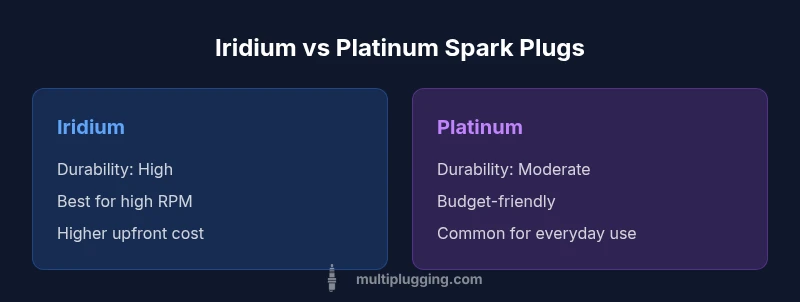
| Feature | Iridium spark plug | Platinum spark plug |
|---|---|---|
| Durability & wear resistance | High (long life under typical use) | Medium to high (good but lower than iridium) |
| Initial cost | Higher upfront cost | Lower upfront cost |
| Heat range compatibility | Supported by most modern designs; varies by brand | Supported by many brands; verify heat range |
| Best for | High-performance/high-RPM engines, longevity priority | Budget-friendly daily driving |
| Replacement interval (qualitative) | Typically longer in harsh duty cycles with iridium | Typically shorter intervals depending on model |
Strengths
- Longer life than platinum under typical operating conditions
- Better cold-start reliability in many engines
- Stronger resistance to electrode wear
- Good performance across high-RPM and performance-driven setups
Negatives
- Higher upfront cost compared to platinum
- Not always worth the extra for mild daily driving
- Availability can vary by region and model
- Some engines show negligible real-world gains
Iridium plugs are the more durable, higher-performing option for most engines, but platinum remains a cost-effective choice for budget-conscious drivers
For everyday drivers, iridium typically offers longer life and better ignition stability, especially at higher loads or RPMs. Platinum delivers solid performance with a lower initial price. Choose based on OEM specs, driving style, and total cost of ownership.
FAQ
Which is more durable, iridium or platinum spark plugs?
Iridium plugs generally resist wear longer than platinum under typical usage, especially in high-RPM or high-load conditions. Real-world results depend on engine design and maintenance.
Iridium usually lasts longer, especially under stress; results vary by engine.
Are iridium plugs worth the extra cost for a daily driver?
For many daily drivers, platinum offers acceptable performance at a lower upfront cost. If you clock high annual miles or drive aggressively, iridium can reduce replacement frequency and maintenance time.
If you drive a lot or push the engine hard, iridium can pay off over time.
Do iridium and platinum plugs have different heat ranges?
Heat range varies by model and brand. Always use the heat range recommended by the vehicle manufacturer, regardless of the material.
Check the manual for the right heat range for your engine.
Can I use iridium plugs in any engine?
Not all engines are compatible with iridium or platinum plugs. Always follow the OEM specification for material, heat range, and thread size.
Refer to the owner’s manual to ensure compatibility.
What maintenance practices extend spark plug life?
Maintain proper gap, torque, and fuel quality; inspect for fouling and oil leaks; keep the ignition system clean and properly timed.
Keep gaps correct and fuel clean to extend life.
Will switching from platinum to iridium affect fuel economy?
Switching materials may have a small impact, but most fuel economy gains come from proper ignition timing and engine maintenance rather than electrode material alone.
Gains are usually small; focus on timing and maintenance.
Main Points
- Check OEM specs before buying
- Consider your yearly mileage and drive style
- Weigh replacement interval against upfront cost
- Iridium suits high-stress or high-mileage use
- Avoid mixing plug types within one engine