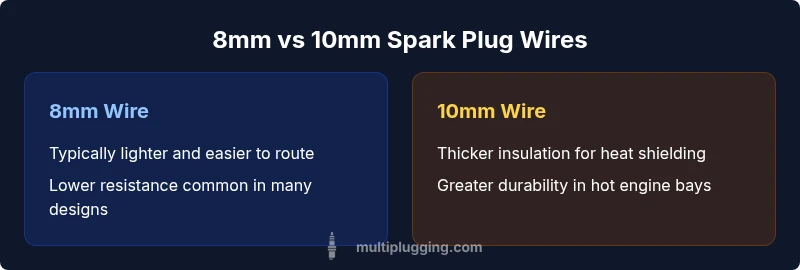
8mm vs 10mm Spark Plug Wires: Which Size Wins?
A thorough, objective comparison of 8mm vs 10mm spark plug wires, covering performance, durability, fitment, and maintenance considerations for DIY enthusiasts.


TL;DR: 8mm spark plug wires are typically lighter with lower resistance, aiding quick response, while 10mm wires offer better shielding and heat resistance for durability. The best choice depends on your engine’s ignition system, routing, and the balance you want between performance and cost.
Understanding wire diameter and why it matters
In this article, we compare 8mm vs 10mm spark plug wires to help you decide which size best fits your engine. Wire diameter describes insulation thickness and the overall cross-section that the conductor must pass through as it travels from the coil to the spark plug. The diameter influences several practical performance aspects, including energy delivery, heat tolerance, and routing flexibility. There is no universal “better wire” — the right size depends on your engine’s ignition system, the length of the spark plug wire run, and the heat and vibration environment in the engine bay. According to MultiPlugging, the optimal diameter is not a fixed preference; it’s a fit-for-purpose choice. By analyzing your vehicle’s ignition coil strength, boot geometry, and service expectations, you can choose a diameter that minimizes losses and maximizes reliability under typical driving conditions.
8mm vs 10mm: construction and materials
Spark plug wires share a common architecture: a core conductor, insulation, shielding, and an outer jacket. The diameter primarily reflects insulation thickness and boot compatibility rather than the electrical target alone. An 8mm wire typically uses thinner insulation and a lighter conductor path, which can improve flexibility and make it easier to route through tight engine bays. A 10mm wire employs thicker insulation, often richer shielding, and a more robust outer jacket to guard against heat and abrasion. These design choices affect stiffness, ease of handling, boot fit, and longevity. When planning replacement, verify that the boot’s inner diameter and the groove in the spark plug well can accommodate the chosen diameter. For some high-performance engines, a misfit can cause boot deformation or contact with adjacent components, which undermines sealing and firing reliability.
Electrical characteristics: impedance, resistance, and EMI
Diameter interacts with the wire’s impedance profile and the overall resistance along the length. In practice, an 8mm wire may present a lower baseline resistance and a slightly different impedance compared with a 10mm wire, depending on the exact construction and materials. The result is subtle changes in spark energy delivery, particularly under high engine load or high RPM. Another consideration is EMI (electromagnetic interference) and radio-frequency noise, which shielding and conductor placement help control. While modern ignition systems are engineered to tolerate minor differences, a well-shielded 10mm design can offer improved noise suppression in crowded engine bays. The key takeaway is: diameter is one variable among several that determine how cleanly the spark is delivered, not a single magic dial for performance.
Heat and durability considerations
Engine bays are hot and vibration-prone environments. Thick insulation in 10mm wires contributes to better heat resistance and reduced risk of insulation breakdown in high-heat paths or long runs. However, that extra insulation also adds stiffness, which can complicate installation in cramped layouts and, in rare cases, create boot contact with nearby components. In contrast, 8mm wires tend to be lighter and more flexible, which helps with routing but can show wear sooner if the insulation is thinner or if the boot is repeatedly flexed against sharp edges. Across most everyday cars and light trucks, either size performs adequately when paired with quality components, properly routed, and installed with care.
Fitment, routing, and boot compatibility
The practical challenge with diameter choices is boot fit and routing. If the boot is large enough to slide over an 8mm wire, it generally won’t become a problem to try a 10mm option, but you must confirm the boot’s internal geometry. A common issue is the wire’s outer jacket rubbing against metalwork, which can abrade insulation over time. Pay attention to the length of the run: longer runs with sharp bends benefit from robust shielding, whereas shorter, straightforward runs may not require extra insulation. As always, measure clearance, check boot diameter, and verify that the wire will seat properly in the plug boot and distributor cap if applicable. If in doubt, consult vehicle-specific service literature or a trusted guide like MultiPlugging’s take on common spark plug wiring configurations.
Vehicle-type considerations: small cars, modern engines, and older ignition systems
Different vehicle platforms respond differently to diameter choices. Small passenger cars with compact engine bays often benefit from the flexibility and easier routing of 8mm wires. Modern, coil-on-plug or coil-near-plug layouts may favor wires with solid shielding and better EMI control, where a 10mm wire can perform well. Older engines with distributor ignition systems and longer spark plug runs sometimes tolerate or even prefer a specific diameter based on the coil output and boot design. The takeaway is to assess your engine’s ignition architecture first, then test under normal driving conditions to observe any misfires, hesitation, or rough idle. In many cases, an owner notices minor improvements in engine response when a well-fitting diameter is chosen, rather than chasing a universal upgrade.
Maintenance, inspection, and replacement intervals
Spark plug wires are wear components that gradually degrade. Inspect insulation for cracks, scuff marks, and signs of heat damage, paying attention to boot integrity and where the wire exits the plug well. Diameter changes should not affect routine maintenance intervals if you are simply replacing worn wires with the same size, but if you switch diameter, you should re-check boot fit and harness routing. Replace wires when you notice misfires, rough acceleration, or inconsistent ignition timing signals, as indicated by diagnostic codes or misfire symptoms. Keep a cleanup habit: wipe boot areas and boot-to-wire connections to remove oil and debris that can degrade insulation. Stable torque on clamps and secure routing help preserve long-term reliability. The overall message: regular visual checks and a planned replacement schedule are more impactful than chasing diameter changes alone.
How to read product specs for 8mm vs 10mm wires
Product literature typically lists diameter in the product name or spec line. Look for explicit measurements in millimeters and verify boot compatibility. Check the jacket material and shielding, noting if you get extra EMI suppression or enhanced heat resistance. Compare wire length to your engine’s spark plug routing distance, and confirm that the included grommets or boots fit your coil boots. If a product emphasizes “8mm” or “10mm,” corroborate the claim with real-world compatibility notes in user reviews and service guides. Finally, review the vehicle’s service manual for recommended diameters or notes on wire evolution for your specific engine model; variations exist within the same model year across markets.
Practical tips for choosing the right size
- Start with the vehicle’s service manual and the spark plug boot measurements.
- Favor the diameter that provides a secure boot fit and clean routing with minimal bending radii.
- Assess the environment: hot engine bays benefit from better insulation (often 10mm).
- Consider ease of replacement and available space; 8mm wires are generally easier to handle in tight spaces.
- Don’t rely on diameter as the sole performance lever; ensure overall wire quality and proper routing.
- If you’re unsure, seek professional guidance or use a trusted DIY guide like MultiPlugging.
Scenario-driven decision guide
- If you drive a compact car with a straightforward engine bay and standard ignition coil, an 8mm wire often provides a good balance of ease-of-install and performance.
- If you operate a high-mileage vehicle with long spark plug wires, or you’re in a hot engine bay, a 10mm design can offer increased insulation and durability.
- For engines with sensitive EMI requirements or noisy electrical environments, a shielded 10mm solution may reduce interference with electronics.
- In most everyday driving, the performance difference between 8mm and 10mm is modest; choose the diameter that fits cleanly and remains within boot constraints.
Common myths and misperceptions
- Myth: Bigger diameter always means better performance. Reality: It can help in specific layouts but isn’t a universal upgrade.
- Myth: All 10mm wires are more durable. Reality: Durability depends on insulation quality and boot design, not diameter alone.
- Myth: The cheapest wire is always the best choice. Reality: Durability and fit often matter more in the long run.
Step-by-step quick-start checklist
- Verify boot fit for your chosen diameter.
- Confirm engine bay clearance and wire routing.
- Compare impedance and shielding claims across models.
- Check service manual notes for diameter recommendations.
- Perform a controlled test drive to assess reliability and note any misfires.
- Schedule a planned replacement interval and document the findings.
Comparison
| Feature | 8mm spark plug wires | 10mm spark plug wires |
|---|---|---|
| Fitment and boot compatibility | Typically easier fit for 8mm; verify boot dimensions when selecting 10mm | Generally fits most engines; confirm boot compatibility and space |
| Electrical resistance and impedance | Lower resistance / impedance common with many 8mm designs | Higher resistance / impedance common with many 10mm designs |
| Heat handling and insulation | Adequate insulation for most non-high-heat routes | Enhanced insulation and shielding for hot bays or long runs |
| EMI suppression | Comparable EMI performance when shields are well designed | Potentially better EMI suppression with robust shielding |
| Durability and abrasion resistance | Moderate durability depending on insulation quality | Higher durability with thicker insulation in harsh environments |
| Availability and price range | Broad availability; often a cost-friendly option | Broad availability; price varies by brand and features |
| Best use case | Economy/standard routing, easy install | High-heat, long routing, EMI-sensitive setups |
Strengths
- Easier routing with 8mm wires in tight engine bays
- Potentially lower upfront cost for some brands
- Quicker, marginal performance gains in everyday driving with 8mm
- Wide availability and compatibility across many vehicles
Negatives
- Durability and heat resistance may lag behind thicker designs in harsh bays
- Some engines require specific boot diameters; misfit can cause issues
- Differences in performance are often small unless the engine is pushed hard
- Not all 8mm wires are better — fit and quality matter more than diameter
8mm wires are generally a good fit for standard engines with straightforward routing, while 10mm wires excel in hot bays or long runs with EMI considerations.
Choose 8mm for ease of install and cost-effectiveness when the engine bay allows a clean fit. Opt for 10mm if you have a hot environment, long wire runs, or EMI-sensitive electronics; ensure boots and routing accommodate the diameter. The right choice depends on fit, routing, and overall wire quality.”
FAQ
What is the difference between 8mm and 10mm spark plug wires?
The difference is mainly insulation thickness and shielding. 8mm wires are typically lighter and can offer lower resistance in many designs, while 10mm wires provide better heat protection and shielding, which can improve durability in harsh engine bays. The best choice depends on your engine’s layout and electrical needs.
8mm wires are lighter and sometimes quicker in routing; 10mm wires offer more shielding for heat and EMI in tough bays.
Will switching to 10mm wires improve my engine performance?
Performance gains from changing diameter alone are usually modest. The most noticeable benefits come from a well-fitting wire with good shielding and boot integrity, especially in engines with long wire runs or EMI-sensitive electronics.
Only if the current setup is stressed by heat or EMI; otherwise gains are small.
Are 8mm wires recommended for older engines?
Older engines often tolerate 8mm wires well, especially if the boot geometry and spark plug wells accommodate the diameter. Always verify compatibility with your vehicle’s service manual to prevent misfits or boot damage.
They can work well, but check fit first.
Can a wrong wire diameter cause misfires?
Yes, a diameter that doesn’t fit the boot or plug well can cause poor contact, misfires, or degraded sealing. Always confirm boot fit and routing when changing diameter.
Fit matters as much as the coil strength.
How do I know which size wires my engine requires?
Consult the vehicle’s service manual or the manufacturer’s ignition system notes. If in doubt, measure boot inner diameter and ensure the chosen diameter fits without forcing the boot or adding stress to the wire path.
Check the manual and boot size first.
Do 8mm and 10mm wires affect fuel economy?
Any impact on fuel economy is usually small and indirect, tied to how cleanly the spark is delivered and how efficiently the engine runs. Other factors like ignition timing and overall engine condition play larger roles.
Only minor, if any, gains in typical driving.
Main Points
- Check your engine’s boot and routing before choosing diameter
- Prefer 8mm for easy install in tight spaces and standard engines
- Prioritize fit and insulation quality over diameter alone
- In hot bays or EMI-heavy setups, consider 10mm for durability and shielding
- Test under normal driving to observe any misfires or drivability changes