Do High-Performance Spark Plug Wires Make a Difference? A Practical Comparison
Analytical, side-by-side look at whether upgrading to high-performance spark plug wires improves ignition, throttle response, and efficiency across engine types.


First, do high performance spark plug wires make a difference? The short answer is: it depends on engine design and ignition system. In many modern setups, reduced resistance and improved EMI suppression can improve spark delivery and throttle response, but gains are often modest and engine-specific. This comparison explains when an upgrade pays off, what to expect in real-world driving, and how to choose the right wires for your vehicle.
What high-performance spark plug wires claim to do
High-performance spark plug wires are marketed with several claims: lower electrical resistance, stronger and more consistent spark, improved EMI suppression, and greater durability under heat. In practice, the key ideas are reducing energy loss along the wire path and preserving spark energy until it reaches the combustion chamber. The wire's construction—conductive core, insulation, shielding, and boot design—plays a central role in how much of the spark energy is delivered to the combustion chamber. While high-quality wires can help, the actual impact depends on the rest of the ignition system, fuel system, and engine state. In a healthy, modern engine using reliable coils and plugs, gains may be small; in poorly maintained systems, a good wire upgrade can deliver more noticeable improvements. For DIY enthusiasts, this means testing or comparing components with consistent instrumentation is essential to verify perceived gains.
How electrical resistance and EMI affect ignition
Ignition energy travels from the coil to the spark plug. Wire resistance drains part of that energy, which can translate into a slightly dimmer spark under heavy load or high RPM. EMI (electromagnetic interference) from long, poorly shielded wires can introduce noise that affects sensors and, in rare cases, ignition timing. A well-designed high-performance wire uses a thicker core with specialized insulation and shielding to minimize resistance and EMI. The result can be a crisper spark, quicker idle stabilization, and more consistent ignition under heat. However, the magnitude of these effects varies by vehicle architecture and the health of the ignition components. For some engines, resistance is already optimized by the OEM, leaving little room for measurable improvement. This means you should expect diminishing returns if the rest of the ignition chain is already robust.
When you’ll notice a gain: engine type and driving conditions
Do high performance spark plug wires make a difference? For modern coil-on-plug engines, the answer varies. In many cases, upgrades deliver noticeable gains under high load, high RPM, or when aging or damaged wires contribute to misfires or hesitation. In mild daily driving with a healthy ignition system, the perceived improvements are often modest. The degree of benefit depends on the overall health of the ignition chain—coil, plugs, and grounds—so the same wire upgrade can yield different results from one vehicle to another.
Debunking myths: common misconceptions
- Myth: All engines benefit equally. Reality: Gains are engine-specific; coil-on-plug and high-energy coil assemblies can respond differently than distributor-based systems.
- Myth: Lower impedance always helps. Reality: Some systems rely on impedance to control coil current and spark energy; mismatched wires can hurt performance or reliability.
- Myth: Upgrading wires will fix misfires caused by core problems. Reality: If misfires stem from faulty plugs, coils, seals, or vacuum leaks, wires won't fix them alone.
How to choose the right wires: key criteria
- Coil compatibility: Verify the wire set is rated for your ignition coil design (coil-on-plug vs distributor-based systems).
- Core material and impedance: Look for wires with a robust conductive core and appropriate impedance for your setup.
- Insulation and shielding: A thick, heat-resistant jacket and good EMI shielding reduce energy loss and noise.
- Boot quality and fit: Boots should seal well at both ends to prevent moisture ingress and misfires.
- Temperature rating and durability: Choose wires rated for under-hood heat and vibration.
Installation basics and best practices
- Disconnect the battery and start with a cool engine to avoid burns. Label each wire and replace them one at a time to preserve firing order. Use a dielectric grease on boots to ease installation and improve sealing. Do not force boots onto connectors; if a boot resists, check alignment and terminal cleanliness. After installation, visually inspect for cracks or moisture ingress and perform a careful idle and light load test before returning to full driving. If you have dual-channel or distributor-based systems, follow the OEM service manual, as some designs require specific boot lengths or spacing.
Real-world scenarios: street vs dyno testing
In street driving, the difference between standard and high-performance wires is often subtle and may be masked by weather, fuel quality, and driver behavior. On a dyno or controlled test, you can isolate ignition contributions by comparing consistent fuel maps, spark timing, and the same plugs. Look for changes in misfire events, throttle response, and ignition dwell under simulated load. Real-world benefits tend to correlate with restored or improved wiring integrity rather than a universal performance uplift.
Cost vs value: is it worth the upgrade?
Price ranges for aftermarket spark plug wire sets can vary widely based on brand, insulation, and boot design. In many cases, the up-front cost is a key consideration, but the value depends on your engine’s health and how you drive. If you regularly push your engine hard or own an older car with known ignition issues, a set of high-performance wires may offer a more noticeable return. For a well-maintained modern engine, the perceived gains might be small, but reliability can improve if worn components are part of the problem.
Maintenance and longevity
Inspect wires regularly for cracks, swelling, or stiff boots, especially after engine heat cycles. Replace wires as a system—if one wire shows deterioration, others may be nearing the end of their life. Keep connections clean and dry, and store spare sets in a cool, dry place. Gentle handling during installation reduces the risk of damaging conductive cores or boots, extending wire life. Worn plugs, dirty fuel systems, and oil or coolant leaks can degrade wire performance over time, so a holistic approach to ignition maintenance yields the best results.
Authoritative references and compatibility tips
This article cites authoritative references to help you dig deeper and apply best practices across engine designs. For more detailed standards and testing guidelines, consult professional sources and official publications.
- SAE International: https://www.sae.org/
- National Highway Traffic Safety Administration: https://www.nhtsa.gov/
- U.S. Department of Energy: https://www.energy.gov/
Compatibility and fitment tips for different engines
Compatibility hinges on ignition architecture, boot dimensions, and connector phrasing. Always verify the wire set's length, boot angle, and connector style against your engine’s coils or distributor caps. If in doubt, compare OEM part numbers or consult your vehicle’s service manual to ensure proper fitment and spark energy delivery. When upgrading, consider pairing wires with inspected plugs and coils to maximize the potential benefits.
Comparison
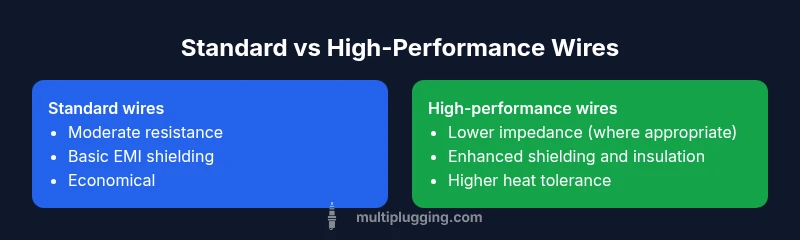
| Feature | Standard ignition wires | High-performance ignition wires |
|---|---|---|
| Resistance/Impedance | OEM or mid-range impedance | Lower impedance options designed for performance |
| EMI suppression | Adequate shielding | Enhanced shielding and grounding to reduce interference |
| Heat resistance | Standard insulation rated for typical under-hood temps | Advanced insulation with higher heat tolerance |
| Durability | Good durability under normal use | Improved durability and boot life in demanding conditions |
| Price range | $10-$40 | $40-$120 |
| Best for | Everyday commuting, reliable OEM performance | Performance-oriented builds, high-load or high-RPM use |
Strengths
- Potential for smoother idle and crisper acceleration in some engines
- Better EMI suppression can reduce sensor noise and timing issues
- Durable construction in high-heat environments
- Improved boot/connector design can enhance reliability
- Can extend service intervals when wear is a limiting factor
Negatives
- Higher upfront cost compared to basic OEM wires
- Gains are engine-specific and may be small on well-maintained modern engines
- Misleading marketing claims can overstate benefits without proper testing
- Not a cure for underlying ignition or fuel system problems
Upgrade only when the ignition chain shows weakness and the engine design supports it
High-performance wires offer potential gains in specific scenarios—older or struggling ignition systems, high-load conditions, and high-RPM operations. For healthy, modern engines with reliable coils and plugs, improvements are often limited. The upgrade makes sense when diagnostics point to wire-related resistance or EMI issues and when cost is justified by usage pattern.
FAQ
Do high-performance spark plug wires improve fuel efficiency?
In some cases, improved spark energy can reduce misfires and promote stable combustion, which may yield small efficiency gains. However, the overall fuel economy change is typically modest and depends on many factors, including driving style and engine health.
Possible small gains, but results vary widely.
Are high-performance wires compatible with all ignition systems?
Not all wires fit every system. Coil type, boot design, and ECU tuning influence compatibility, so verify part numbers and fitment for your specific engine.Using the wrong design can negate potential benefits.
Check coil type and OEM recommendations.
Will upgrading wires fix a misfiring engine?
If misfires stem from worn wires or loose connections, upgrading can help. If issues come from plugs, coils, or vacuum leaks, wires alone won’t resolve the problem. Treat wires as a component in a broader ignition diagnostic.
Wires can help if worn wires are the cause.
Do classic cars benefit from high-performance wires?
Older engines with degraded ignition components can benefit from upgraded wires, but compatibility with older coil designs and boot geometry matters. In many cases, the improvement depends on the overall ignition health and the design limits of the vintage system.
Yes, sometimes, but check compatibility.
How can I tell if my wires are worn?
Look for cracked insulation, stiff boots, or tracking along the wire. A simple resistance check can help, but visual wear and increased misfire events are often telltale signs. If in doubt, replace as part of a planned ignition service.
Inspect boots and insulation; test resistance if needed.
Do wires affect warranty status?
Aftermarket wires can affect warranties in some scenarios depending on the manufacturer terms. Always review your vehicle's warranty documentation or consult the dealer to understand coverage.
Check the warranty terms.
Main Points
- Assess engine health before upgrading
- Expect modest gains on modern engines
- Prioritize coil and plug condition alongside wires
- Choose wires matched to ignition architecture
- Inspect and maintain wires regularly