Do MSD Spark Plug Wires Make a Difference? An In-Depth Diagnostic
Explore whether MSD spark plug wires improve ignition performance, reliability, and value for DIYers. This diagnostic guide weighs benefits, costs, and real‑world results across engine types.


Do MSD spark plug wires make a difference? In many engines, upgrading to MSD wires can reduce resistance, deliver a stronger spark, and help ignition stay reliable at high RPM or hot temperatures. The actual benefit depends on the rest of the ignition system, coil, and plugs. For newer, well-maintained engines, the gain is usually modest, but diagnostics and long-term reliability can improve.
Do msd spark plug wires make a difference? A practical starting point
Understanding the ignition path helps answer whether do msd spark plug wires make a difference in real-world driving. The coil sends a high-voltage pulse through the ignition wires to the spark plugs, and resistance, heat, and EMI can degrade that signal over time. Upgrading to MSD wires is often pitched as lower resistance, thicker insulation, and better conductors. According to MultiPlugging, the benefits are typically most noticeable when the ignition system is aging or when a vehicle is pushed to its limits with high RPM or extreme temperatures. For a stock, well-maintained engine, the gains can be modest but not negligible, particularly when you’re chasing stable idle, cleaner emissions, or improved misfire resistance in demanding conditions. In everyday terms, if your current wires are old or cracked, the chance of a meaningful improvement is higher than if they’re new and healthy.
How ignition wires influence performance and why the difference matters
The ignition wires’ primary job is to deliver the spark from the coil to the spark plugs with minimal loss. Any resistance, leakage, or inductive noise can dull that spark, especially at high RPM or under heat soak. MSD wires claim to optimize that path with lower resistance and enhanced insulation. In practice, the difference you feel depends on the entire system: coil health, plug condition, ignition control strategy, and engine tuning. A high-quality set can reduce voltage drop during voltage spikes, raise peak spark energy momentarily, and help the coil recover faster between cycles. That can translate to crisper throttle response, more consistent idle, and easier start-up in challenging heat or altitude. For newer engines with sophisticated ignition controls, the incremental improvement may be subtle, because OEM wiring already meets strict specifications.
Real-world factors that shape the benefit you’ll see
While the theory is straightforward, practical gains hinge on several variables. The engine’s age matters: older engines with worn connectors, brittle boots, or cracked insulation tend to show more noticeable improvements after a wire upgrade. Driving style and climate also play a role: hot, humid days or sustained high-load driving (towing, hill climbs, or repeated WOT) stress ignition components more, potentially revealing improvements from lower resistance and better heat handling. The quality of the rest of the system matters too. If the coil, distributor (or COPs), and plugs are near their end of life, replacing wires alone may yield only partial benefit. Finally, installation quality matters: improper routing near hot exhaust components or sharp bends can negate any gains. In short, the wire swap is most valuable when the entire ignition path is capable of benefiting from cleaner signal delivery.
MSD wires vs OEM: identifying the real differences
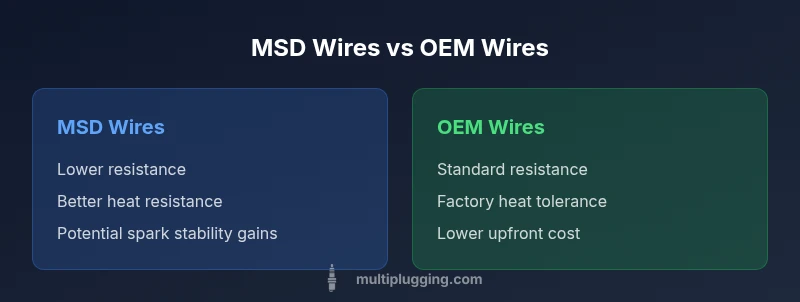
MSD wires are designed to deliver lower resistance and greater heat tolerance than many OEM wire sets. This combination aims to reduce energy loss and voltage collapse under demanding conditions. OEM wires, by contrast, are tuned for broad compatibility, cost, and manufacturing simplicity. The practical outcome often shows up as a more consistent spark in high-load scenarios and better resistance to performance-degrading heat. However, the difference is not uniformly dramatic across all vehicles. Some engines—especially modern, well-tuned ones with advanced ignition strategies—may see only marginal improvements. For performance builds, especially those relying on aftermarket coils or tuned ECMs, wires can be a meaningful part of the ignition package. For budget-minded DIYers working on older or high-mileage vehicles, the improvement may feel more tangible and justify the cost. In all cases, verify fitment and consider the overall condition of the ignition system.
How to quantify the gains without guessing
A practical approach to quantifying gains is to use objective diagnostics before and after a wire swap. Log baseline idle smoothness, misfire counts (via scan tools or software, if supported by the vehicle), and start-up behavior under hot and cold conditions. After installing the MSD wires, re-test under the same conditions to compare the results. If possible, measure cold-start cranking strength and determine whether peak voltage delivery to the plugs improves consistently. Remember that many gains are subtle and may appear as a reduction in misfires or a small improvement in smoothness rather than a dramatic horsepower increase. Keeping the rest of the system aligned—plugs, coils, and ignition timing—will help the wire change show its true potential.
Conditions that maximize the likelihood of improvement
Certain scenarios are more likely to exhibit noticeable improvements: aging ignition systems with cracked boots, engines that hover at high temperatures during daily usage, and vehicles used for towing or heavy load where ignition stress is higher. In such cases, MSD wires can help stabilize spark, reduce voltage leakage, and maintain coil energy under duress. If your vehicle experiences intermittent misfires only after the engine is hot or under heavy load, a wire upgrade may address the root cause more effectively than replacing other components alone. Conversely, if the coil is weak, plugs are fouled, or the ignition timing is off, addressing those issues first may yield bigger returns than switching wires alone.
Practical considerations: fitment, durability, and warranty
When choosing MSD wires, verify that the length, boot style, and connector geometry fit your engine bay and vehicle model. High-quality silicone insulation and robust boots can improve durability in heat-prone areas, reducing the risk of wire cracking. Some manufacturers offer lifetime warranties or endurance testing; read the fine print to understand coverage and exclusions. If you operate a vehicle in challenging climates—extreme heat, salt exposure, or frequent short trips—invest in wires with proven heat resistance and moisture sealing. Finally, ensure the wires are compatible with your ignition coil or COPs and that the firing order matches your engine’s configuration. A mismatch here can negate any theoretical gains.
Cost considerations: balancing price and perceived value
MSD wires sit in a mid-to-high price tier, especially when compared to generic OEM replacements. The value proposition rests on longer-term reliability, heat resilience, and resistance to performance degradation under load. If your goal is incremental improvement rather than a wholesale performance overhaul, budget for quality wiring and consider whether the rest of the ignition path is equally capable. In some cases, the cost of a premium wire set can be justified by fewer misfires, easier starts in hot weather, and ongoing maintenance savings from better insulation and longer wire life. Always compare warranty terms and confirm compatibility with your specific engine and model year.
The takeaway for DIYers: a structured decision path
For DIY enthusiasts, the decision to switch to MSD wires should follow a clear checklist: assess ignition health, confirm compatibility, consider climate and use, compare total cost including potential labor, and verify that the rest of the ignition components are in good condition. If the current wires show signs of wear or if the engine exhibits misfires under load, a wire upgrade can be a wise, targeted investment. If the system is already operating smoothly, the perceived gain may be incremental and may not justify the expense. With a methodical approach and careful measurement, you can decide whether do msd spark plug wires make a difference for your vehicle and driving style.
Comparison
| Feature | MSD wires | OEM wires |
|---|---|---|
| Resistance | Lower resistance with MSD wires | Higher resistance with OEM wires |
| Spark stability under load | More stable spark with MSD wires | Potentially less stable with OEM wires |
| Heat tolerance | Improved insulation and heat resistance | Standard insulation and heat handling |
| Price range | Mid-to-high up-front cost | Lower upfront cost |
| Best for | High-performance/aged ignition systems | Daily drivers or stock engines |
Strengths
- Potential for stronger, more consistent spark under load
- Improved compatibility with performance coils and packs
- Longer-term ignition reliability in aging systems
Negatives
- Higher upfront cost compared to OEM wires
- Benefits are engine-specific and may be modest on modern engines
- Risk of counterfeit or mis-sized products if shopping without specs
MSD wires offer tangible benefits for older or high-demand engines but are not universally transformative for all vehicles.
Choose MSD wires if you chase reliability under load or when diagnosing ignition faults in aging engines. For newer stock engines, the improvement is often modest.
FAQ
Do MSD spark plug wires improve performance on modern engines?
On modern engines with advanced ignition control, the performance gain from MSD wires is usually modest. The biggest benefits appear in older or high-load scenarios where resistance and heat stress affect spark delivery.
For modern engines, the gains are often limited; upgrading wires mainly helps when the ignition is aging or under heavy load.
Are MSD wires worth the extra cost for a daily driver?
If your daily driver is running reliably with current wires, the financial payoff is typically small. If you frequently drive in hot weather or tow heavy loads, you might notice steadier ignition and improved idle.
Not usually dramatic for routine driving; consider climate and load before upgrading.
How do MSD wires compare to OEM replacements?
MSD wires often feature lower resistance and higher heat tolerance, which can improve performance in aging systems, but OEM wires may be perfectly adequate for stock engines. The practical difference depends on engine condition and tuning.
They differ in resistance and heat handling; value depends on your setup.
What signs indicate ignition wires need replacement?
Common signs include misfires under load, rough idling as the engine heats, decreased fuel economy, and visible insulation damage. A diagnostic check can help confirm wiring as the culprit.
Watch for misfires, rough idle, and damaged insulation.
How do I install MSD wires safely?
Follow the manufacturer instructions, disconnect the battery, avoid bending terminals, and route wires away from heat or moving parts. If unsure, seek manual or professional help.
Power off, follow steps, and keep wires clear of heat and moving parts.
Main Points
- Test ignition health before replacing wires
- Expect modest gains on modern, well-maintained engines
- Choose wires with proper heat resistance for your climate
- Verify compatibility with your coil and plugs