Why Would a Spark Plug Stop Working? A DIY Troubleshooting Guide
An urgent, practical troubleshooting guide explaining why a spark plug stops working, how to diagnose the cause, and safe DIY fixes to get your engine running smoothly again.


Why would a spark plug stop working? The most common cause is fouling from oil, fuel, or carbon buildup, which prevents proper spark and creates misfires. Start troubleshooting with the simplest checks: inspect the plug gap, verify ignition wires, and test for spark. If problems persist, replace the worn plug to restore smooth performance.
Why a Spark Plug Stops Working: Urgent Context
If you ask 'why would a spark plug stop working' during a rough idle, you're not alone. In most cases, fouling from oil, fuel, or carbon buildup disrupts the electrical arc and reduces combustion. The quickest path to resolution is to verify the plug's condition before chasing ignition coils or sensors. This section explains symptoms, quick checks, and how to decide between cleaning and replacement. By focusing on the spark plug first, you can often restore smooth running without expensive diagnostics.
MultiPlugging emphasizes practical, step-by-step diagnosis that DIYers can perform safely. Start with visual inspection, then move to basic tests before committing to full disassembly. The aim is to confirm whether the plug is the culprit, and if so, address it promptly to minimize engine damage and fuel waste.
Start with the easiest checks (no tools required)
Before pulling boots or wires, perform simple checks:
- Ensure the ignition coil boot is seated firmly and the wire is intact.
- Look for obvious signs of damage, oil on the plug, or heavy carbon buildup.
- If the engine starts but runs rough, you may have one weak cylinder rather than a full set of problems.
If these checks don’t reveal a clear cause, move to a more thorough inspection. Always work in a well-lit area and disconnect the battery before touching any high-voltage components to avoid shocks.
Common symptoms that point to a spark plug problem
Rough idle, engine misfires, reduced power, hard starting, and increased fuel consumption are typical signs of a spark plug issue. Other clues include visible fouling, oil on the electrode, or a worn electrode tip. Each symptom helps narrow down whether the plug is fouled, damaged, or simply out of spec. Document when the problem occurs (cold vs. warm engine) to improve accuracy during diagnosis.
Fouling and wear: what’s happening under the hood
Fouling comes in several forms: oil fouling from burning oil, fuel fouling from rich mixtures, and carbon fouling from不 incomplete combustion. Carbon buildup can insulate the electrode and weaken the spark. Worn or eroded electrodes reduce spark efficiency and can cause misfires even when the plug is otherwise clean. Heat range and impedance also influence performance; incorrect plugs can fail prematurely under load.
The diagnostic flow: symptoms → diagnosis → fix
A structured flow helps avoid guesswork:
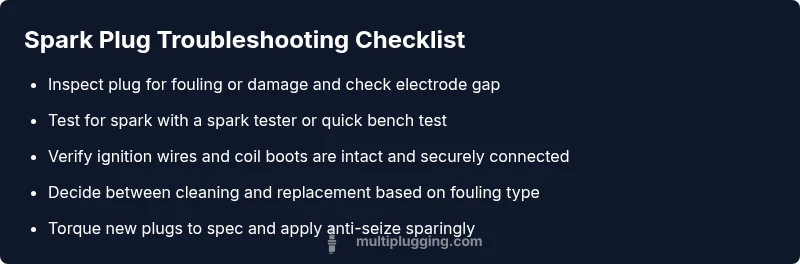
- Note symptoms and conditions (engine state, RPM, load). 2) Check for spark using a tester or a safe bench method. 3) Inspect the plug’s condition and gap. 4) Decide whether cleaning, gap adjustment, or replacement is needed. 5) Re-test to confirm the fix. If misfires persist after these steps, inspect related components (wires, coils, ignition module).
Following this flow reduces unnecessary parts replacement and speeds up repair.
Step-by-step fix: cleaning vs replacement (practical guide)
- Disconnect the negative battery and remove the ignition coil boot from the plug. 2) Inspect the plug—if fouling is present, decide on cleaning or replacement. 3) If cleaning, use a wire brush and authorized cleaner; do not soak in solvent. 4) Check the gap with a feeler gauge and adjust to the manufacturer’s spec. 5) If damage is visible or gap cannot be set, replace the plug. 6) Reinstall with proper torque and reconnect the boot. 7) Start the engine and observe smooth operation; listen for misfires and check for fault codes if available.
Pro tip: when in doubt, replace all plugs on the same bank to maintain even ignition and performance.
Tools, parts, and safety precautions
Tools you’ll need: spark plug wrench, feeler gauge, torque wrench, anti-seize (sparingly), and a spark tester if available. Safety first: wear eye protection, disconnect the battery, and avoid touching high-voltage components. Work in a dry environment; gasoline vapors are hazardous. Do not torque plugs over the recommended specification, as overtightening can strip threads and cause leaks.
Prevention: extending spark plug life and reliability
To maximize spark plug life, use correct spark plug type and heat range for your engine, keep the air and fuel systems clean, and replace plugs at the manufacturer’s suggested intervals or when signs of wear appear. A simple maintenance sprint—checking gap, wires, and boots at every major service—can prevent misfires and protect catalytic converter health. Regular diagnostics reduce roadside failures and fuel waste.
When to seek professional help
If you cannot reliably reproduce the problem, or if you observe repeated misfires after plug replacement, it’s wise to consult a professional. Complex ignition system faults, PCM-backed fuel control issues, or leaks in vacuum lines can mimic spark plug problems but require specialized tools and skills. A certified technician can perform advanced tests to prevent further engine damage.
Steps
Estimated time: 30-60 minutes
- 1
Power down and prepare
Park safely, disconnect the battery negative, and gather the right tools. Ensure the engine is cool before proceeding to prevent burns.
Tip: Lay out tools in a logical order to avoid reworking. - 2
Locate and inspect plugs
Identify the spark plug location and visually inspect each plug for fouling, oil, or carbon buildup. Note any differences between cylinders.
Tip: Take a photo of each plug position to help reinstallation. - 3
Remove plug wires/coils
Carefully detach the ignition boots; avoid pulling on the wire. Use a swivel socket if needed to reach tight ports.
Tip: Do not yank the boot; twist gently to free it. - 4
Check the gap
Measure the electrode gap with a feeler gauge and compare to the spec in your owner’s manual. Adjust if within safe tolerance using the gauge.
Tip: Only adjust by bending the center or ground electrode as instructed by plug type. - 5
Decide cleaning or replacement
If fouling is light and conductive, you may clean; otherwise replace with a new plug of the correct heat range.
Tip: Do not reuse heavily fouled plugs. - 6
Torque and reinstall
Thread plugs by hand to avoid cross-threading, then torque to spec with a torque wrench. Reconnect boots securely.
Tip: Avoid overtightening; aluminum heads can strip easily. - 7
Test and verify
Reconnect battery, start the engine, and listen for smooth running. If misfires persist, test ignition wiring or consult a professional.
Tip: Take note of any codes displayed by the ECU.
Diagnosis: Engine misfires, rough idle, or hard starting
Possible Causes
- highFouling from oil, fuel, or carbon buildup
- mediumWorn or damaged electrode
- lowIncorrect spark plug gap
- lowIgnition coil/wire issue or boot fault
Fixes
- easyInspect plug and remove fouling; clean or replace as needed
- easyCheck and adjust the plug gap to manufacturer spec
- mediumReplace worn plug and inspect ignition wires/coils for damage
- hardReplace wiring/coil if diagnosed as the fault
FAQ
What are the most common signs of a bad spark plug?
Rough idle, engine misfires, hard starts, decreased fuel efficiency, and visible fouling are typical signs of a failing spark plug. These symptoms help distinguish plugs from other ignition issues.
Common signs include rough idle, misfires, and hard starts. Look for visible fouling and consider testing the spark.
Can oil or coolant cause spark plugs to fail?
Yes. Oil leaks or coolant intrusion can foul plug electrodes and insulate them, reducing spark and causing misfires or reduced power.
Oil or coolant leaks can foul plugs and cause misfires.
Is it safe to drive with a faulty spark plug?
Driving with a suspected spark plug issue can damage the catalytic converter and engine components. It’s best to diagnose and fix promptly.
It’s risky to drive long with a bad plug; get it checked soon.
Should I gap spark plugs myself?
Yes, if you have the right tools and follow the manufacturer’s gap specification. Incorrect gap can cause misfires and poor ignition.
Gapping is doable with the right gauge if you follow spec.
Do I need to replace all plugs at once?
If one plug is faulty, inspect the rest; many prefer replacing all plugs on the same bank to ensure even ignition and performance.
Sometimes it’s best to replace them all for even performance.
What tools do I need to replace spark plugs?
You’ll need a spark plug wrench, feeler gauge, torque wrench, and optional spark tester. Always follow the engine manual for torque specs.
Common tools include a spark plug wrench and torque wrench.
Main Points
- Inspect plugs first when diagnosing misfires
- Differentiate fouling from wear to decide cleaning vs replacement
- Use correct torque and heat range for reliable ignition
- Test spark after reinstall to verify repair
- Seek professional help if misfires persist