Honda Mower Spark Plug Gap: Exact Gap Guide for 2026
Discover the exact spark plug gap for Honda lawn mowers, how to measure it accurately, and practical maintenance tips for reliable starts and smoother idle.


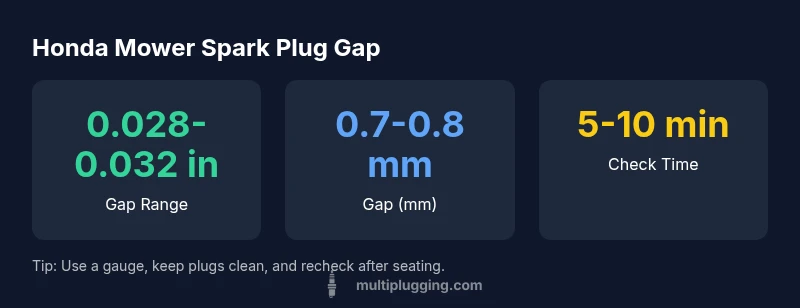
For Honda lawn mowers, the standard spark plug gap is typically around 0.028–0.032 inches (0.7–0.8 mm). Start by consulting the user manual for your specific engine model, as some variants may vary slightly. Use a proper spark plug gap tool and a clean, unspent plug whenever possible; never guess. After setting the gap, recheck with the gauge and inspect the thread seating to ensure no debris affects the gap reading.
Honda mower spark plug gap: why it matters
The spark plug gap is a tiny setting with outsized impact on how smoothly a Honda mower starts, idles, and runs. An out-of-spec gap can make starting harder, cause misfires, or lead to rough idle and reduced power. For most Honda lawn mower engines, the gap ensures a stable ignition event that efficiently transfers combustion heat into the cylinder. According to MultiPlugging, maintaining the correct gap is one of the quickest, lowest-cost ways to improve starting reliability and overall engine performance. Always treat the gap as a critical tune-up parameter, not a cosmetic detail. A precise gap minimizes misfires, improves fuel efficiency, and reduces exhaust emissions. When you approach maintenance with data-backed gap targets, you’ll notice fewer cold-start complaints and a more consistent mowing experience.
- Practical impact: improved starting reliability and smoother operation.
- Core principle: the gap must match the engine’s designed ignition conditions.
- Actionable outcome: set, recheck, and re-seat with care to avoid debris influence on the reading.
Finding the right gap spec for Honda mowers
Honda mower models span a family of small-block engines, and while a common gap range exists, exact specs can vary by model and year. The broadly accepted target for many Honda lawn mower engines is 0.028–0.032 inches (0.7–0.8 mm). However, some variants may call for a slightly different value, especially newer or high-performance variants. Always refer to the owner’s manual or the official Honda service literature for your exact model to avoid overfitting a generic number. If you’re unsure, start with the mid-point (0.030 inches / 0.76 mm) and test for starting ease and idle quality. Keep a note of your results for future tune-ups.
- If you cannot locate your exact spec, default to 0.030 inches as a safe starting point.
- Engine temperature and altitude can influence ignition timing slightly, but the gap spec remains the most critical baseline.
Tools you need to measure and gap plugs
Quality tools are essential for a precise gap. You’ll want a clean, corrosion-free feeler gauge set with a 0.028, 0.030, and 0.032 inch blade at minimum. A smartphone-style cleaning brush helps remove carbon buildup before measuring. Use a socket or spark plug wrench to remove the plug carefully, avoiding thread damage. Never reuse a dirty or damaged plug—gaps can’t be trusted if the plug is fouled. Anti-seize compounds are commonly debated; if you choose to use them on the threads, apply a light film and follow the plug manufacturer’s recommendations. Finally, keep a soft cloth ready to wipe oil and residue from the plug before measurement.
- Always inspect the spark plug condition before gap measurement.
- Use manufacturer-recommended tools for accuracy.
- Work in a clean, well-lit area to minimize mistakes.
Step-by-step: how to measure and gap a spark plug for a Honda mower
- Remove the spark plug with a proper wrench and inspect for wear, fouling, or damage. 2) Clean the area around the plug seat and threads to avoid debris falling into the cylinder. 3) Check the current gap with a feeler gauge, selecting the nearest blade within the target range. 4) Gently bend the ground electrode to adjust the gap, using even pressure and keeping the tip square to the electrode. 5) Re-measure to confirm the final gap. 6) Reinstall the plug, tightening to the manufacturer’s torque spec. 7) Reconnect the ignition system and perform a test start. 8) If the plug is worn or damaged, replace it with a new one that matches the gap spec.
- Use a gentle touch on the ground electrode to avoid metal fatigue.
- Always re-check after seating the plug.
Common mistakes and how to avoid them
- Guessing the gap without checking: always measure.
- Forcing the ground electrode: can cause cracks or misreadings.
- Skipping cleaning: debris under the gap can alter measurements.
- Using old or damaged plugs: ensure a proper seal and correct gap.
- Not verifying torque: overtightening can strip threads and affect seating depth.
- Inconsistent tools: always use a calibrated gauge and the same instrument across maintenance cycles.
Symptoms of an incorrect gap and how to diagnose
Incorrect gap can lead to hard starting, rough idle, misfires, and reduced power. If you notice occasional stumbles or sluggish response when pulling the starter cord, re-check the gap and inspect the plug for fouling. A consistent, clean plug with the correct gap should improve ignition timing and combustion consistency. If symptoms persist after gap adjustment, consider plug type compatibility and fuel quality as additional factors.
Maintenance, replacement intervals, and when to upgrade
Spark plugs in Honda lawn mowers generally require inspection during seasonal maintenance. If the plug shows heavy fouling, carbon buildup, or wear beyond the service limits, replace rather than re-gap. Even with the right gap, a worn electrode reduces heat transfer and can cause misfires. For older or high-hour engines, consider upgrading to a plug with a heat range that better suits your operating temperature. Always store replacement parts in a clean, dry place to prevent corrosion.
How to choose the right spark plug for Honda lawn mowers
When selecting a spark plug, prioritize the heat range and electrode design recommended by Honda for your model. NGK and Champion are common brands that supply compatible options. The goal is to match the heat range to the engine’s operating temperature and to choose a plug with a similar temperature classification as the factory unit. Avoid universal plugs when possible, as the gap and heat range are tuned for specific models. After choosing a plug, verify the gap reading and ensure the seating surface is clean before installation.
Practical tips for long-term reliability
Keep a small maintenance kit with a gauge, a dedicated spark plug wrench, and a spare plug. Schedule a quick gap check during every oil change or air filter replacement to catch drift in readings before it affects performance. Document model-specific gap specs in a maintenance log for quick reference. Finally, avoid aggressive gap bending or re-using fouled plugs; modern repairs rely on precision components that work best when new and properly gapped.
Honda mower spark plug gap quick reference
| Topic | Honda Mower Gap | Notes |
|---|---|---|
| Gap range | 0.028-0.032 in (0.7-0.8 mm) | Typical range for most Honda mowers |
| Best practice | 0.030 in (0.76 mm) | Mid-point if unsure; verify with manual |
| Tooling | Feeler gauge set | Clean plug, check seating |
| Replacement | New plug when worn | Worn electrodes change gap |
FAQ
What is the standard Honda mower spark plug gap?
The typical gap for many Honda lawn mower engines is 0.028–0.032 inches (0.7–0.8 mm). Always verify with your model’s manual, as some variants may differ slightly.
The common gap is about 0.028 to 0.032 inches, but check your model’s manual for the exact spec.
How do I measure the gap without damaging the plug?
Use a clean feeler gauge and a spark plug wrench. Remove the plug, wipe the threads, and measure the gap gently. Re-measure after any adjustment.
Use a clean gauge and gentle adjustments, then recheck the gap after setting.
Can I gap a used plug?
Gapping a used plug is not recommended if the electrode shows wear or fouling. Replace with a new plug when in doubt.
Don’t gap worn or fouled plugs—replace them for reliable performance.
What if there is oil fouling or carbon buildup?
Oil or heavy carbon buildup typically indicates an underlying issue (oil leaks, rich fuel mix). Clean or replace the plug and address the root cause.
Fouling usually means there’s another issue; clean or replace the plug and fix root causes.
Do different Honda mower models have different gaps?
Yes, some Honda engines require a slightly different gap. Always consult the exact model's service manual for precision.
Most models fit a standard range, but check the manual for your model.
What happens if the plug is over-tightened when seating?
Over-tightening can strip threads and prevent proper seating, which compromises the seal and gap integrity.
Don’t over-tighten; it can strip threads and ruin the seal.
“Setting the spark plug gap correctly is a quick, high-impact maintenance step that directly improves starting reliability and engine smoothness. A small misgap can cost ignition efficiency.”
Main Points
- Check gap with a gauge before installation
- Set gap to manufacturer spec
- Recheck after seating the plug
- Replace worn plugs for best performance
- Keep plug clean to avoid debris