Which Spark Plug Is Cylinder 4? A Practical Identification Guide
Learn how to identify which spark plug corresponds to cylinder 4 across common engine layouts. Step-by-step methods, diagrams, and safety tips from MultiPlugging for precise maintenance.


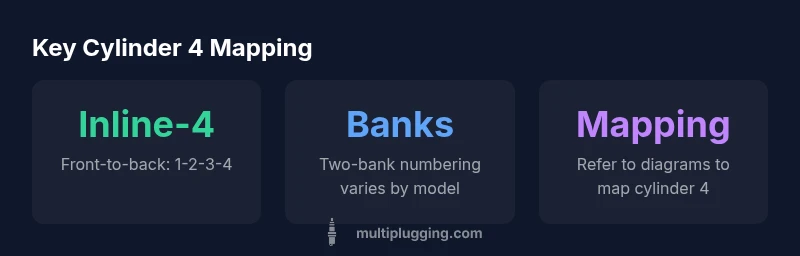
Which spark plug is cylinder 4 depends on engine layout and manufacturer numbering. In most inline-4s, cylinder 4 sits toward the firewall, with #1 at the front near the timing cover. On V-configurations, numbering varies by bank and model, so always verify with the factory diagram or service manual for your exact engine. This quick map helps you identify the correct plug location safely.
How cylinder numbering works in most engines
If you ask which spark plug is cylinder 4, you quickly learn that the answer depends on the engine layout and the manufacturer’s numbering scheme. In the vast majority of inline-4 engines, cylinder numbers run from the front of the engine toward the firewall. That means cylinder 1 sits nearest the timing belt or chain, while cylinder 4 sits toward the back. This front-to-back convention is documented in many owner manuals and service guides, and it helps technicians map locations quickly during maintenance. However, there are notable exceptions. Some brands define a different starting point, and on V-shaped engines the cylinders are divided into two banks with their own numbering, which can shift which plug is labeled as cylinder 4. For a DIYer or car owner, the practical takeaway is simple: never rely on memory alone. Always consult the official diagram for your exact model. The goal is to identify the correct plug before removal to avoid misalignment, misfiring, or accidental cross-threading.
Inline-4 engines: locating cylinder 4
In typical inline-4 configurations, cylinder 4 is the last cylinder in the line when counted from the front of the engine. The plug is usually tucked toward the back of the engine bay, nearest the firewall. To confirm visually, look for the spark plug boot routing and compare it to the diagram in your owner manual. If the model uses coil-on-plug ignition, each plug location corresponds to a specific coil location, which can simplify or complicate identification depending on the layout. By cross-referencing the firing order and the bank orientation, you can locate cylinder 4 without removing multiple components.
V-configurations: where cylinder 4 sits
V engines split cylinders into two banks. Cylinder numbering can be from each bank’s perspective or follow a global sequence, depending on the manufacturer. This means cylinder 4 could be on Bank A or Bank B, and its plug location will differ from inline-4 layouts. The safest approach is to locate the engine’s service diagram or the head casting map that labels each cylinder. In some cases, the rear bank will be labeled differently than the front bank, so a direct map is essential to avoid misidentification and potential misfire.
Reading diagrams and head markings
Most engines carry a diagram somewhere you can view with the hood up: a sticker on the radiator shroud, the underside of the hood, or inside the service manual. Look for a labeled cylinder map that shows the front-to-back sequence and bank designations. If you can’t find a sticker, search the manufacturer’s official PDF or trusted repair databases. For older vehicles, the casting on the cylinder head or the valve cover area may also depict a small map. Always corroborate with the firing order provided by the manufacturer.
Step-by-step: map cylinder 4 on your engine today
- Identify your engine type (inline-4, V6, V8, etc.). 2) Locate the official diagram in the service manual or online. 3) Note which bank or line corresponds to cylinder 4. 4) Trace the spark plug boots or coil positions on the head to locate the exact plug. 5) Compare with the firing order to ensure consistency. 6) If you’re working with a DOHC or DIS setup, ensure you’re mapping the correct plug across banks. 7) Mark the plug positions with a removable label to avoid confusion while replacing. 8) Recheck locations after finishing to prevent misidentification in the next maintenance cycle.
Tools and safety tips for identifying cylinder 4
Have a clean workspace, good lighting, and a clear labeling system. Use a spark plug socket and extension for access, a torque wrench for proper reinstallation, and a small marker to label plugs as you go. Before removing any plug, take a photo of the current layout and label the plugs. If your car has a coil-on-plug system, you may need to loosen the coil-to-boot connector to view the plug’s exact position. Always disconnect the battery when doing hands-on work and wear eye protection when working near moving parts.
Common ways manufacturers map cylinder numbers and how to verify cylinder 4
| Engine Configuration | Typical Front-to-Back Orientation | How to Confirm Cylinder 4 Location |
|---|---|---|
| Inline-4 (typical) | Front to back: 1 → 4 toward the rear | Consult the service manual or diagram for your model |
| V6/V8 (two-bank engine) | Banks numbered separately; overall sequence varies | Use the engine’s labeled diagram to map Bank A/B and cylinder 4 |
| DOHC / DIS layouts | Bank orientation varies by brand | Refer to factory diagrams for exact cylinder labeling |
FAQ
Why does cylinder 4 location vary between engines?
Cylinder numbering is engine-specific. Inline-4s typically label #1 at the front and count toward the back, but V-configurations split into banks with their own numbering. Always verify with the model's diagram.
Numbers vary by engine; always check the diagram.
How can I reliably identify cylinder 4 without guessing?
Consult the service manual or a labeled diagram under the hood. Map the cylinders to the firing order, then physically trace the plug boots to confirm which one is cylinder 4.
Use the manual and map the layout step by step.
What tools help map cylinder 4 quickly?
A good flashlight, a labeled diagram, a spark plug socket with extensions, and a marker to label plugs as you go.
Use a diagram and label as you go.
Does cylinder 4 always sit on the same bank in V engines?
Not always. It depends on the engine’s bank numbering and firing order. Always verify with the diagram for your exact model.
No—verify with the diagram.
Can I replace cylinder 4's plug if it’s misfiring?
Yes, but diagnose the root cause first. Check gap, condition, and torque, and ensure the misfire isn’t caused by wiring or ignition issues.
Yes, but check the cause first.
Is cylinder 4 location the same across all vehicles?
No. Locations vary by model and layout. Always confirm with the manufacturer’s diagram.
No—check the diagram for your model.
“Accurate cylinder identification is foundational to safe spark plug maintenance. Always verify the exact cylinder map in the manufacturer’s diagrams before removal or replacement.”
Main Points
- Identify the engine type before mapping
- Always verify cylinder 4 using a model-specific diagram
- Use firing order to cross-check the plug location
- Label plugs during inspection to avoid misplacement
- Consult the service manual for accuracy