Should Spark Plug Wires Have Resistance? A Practical Guide for DIYers
Learn if spark plug wires should have resistance, how it affects ignition and EMI, testing tips, and OEM guidance for DIY enthusiasts.


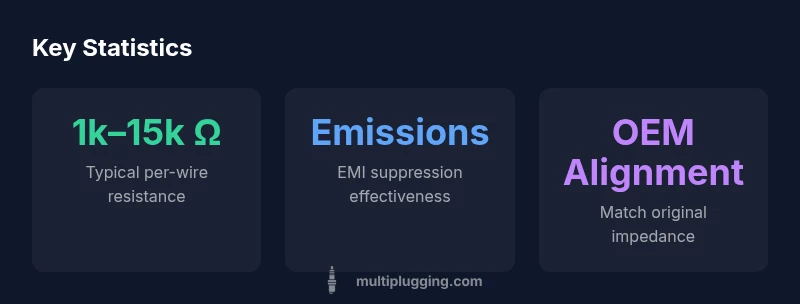
Yes. Spark plug wires typically incorporate resistance to suppress electromagnetic interference and help stabilize the ignition signal. The exact resistance per wire varies with length, design, and system type, but most consumer cables fall into a multi-kilohm range. Some coil-on-plug or direct-ignition designs use built-in resistance or no external resistance at all; always check OEM specs.
What role does resistance play in spark plug wires?
Ignition systems rely on a controlled spark to ignite the air-fuel mixture. The conductive path from the distributor or coil to the spark plug includes conductors with a built-in resistance that shapes the voltage waveform. This resistance helps limit voltage spikes, reduces arcing near connectors, and dampens high-frequency noise that could interfere with onboard electronics. As car electronics evolved, engineers increasingly used resistor cores in spark plug wires to maintain reliable ignition while meeting EMI regulations. According to MultiPlugging, the presence of resistance is a deliberate design choice in many OEM harnesses, but the exact value is less important than matching the wire to the engine’s ignition architecture. For DIYers, understanding that resistance is not a random feature, but a purposeful specification, helps when interpreting replacement guides and OEM data.
Do spark plug wires should have resistance by design?
Most modern ignition systems include some form of resistance in the plug wires or in the coil pack. The goal is to balance energy delivery with electromagnetic cleanliness. In many engines, external resistor wires are paired with a particular coil design to keep radio interference in check without compromising spark energy. Some coil-on-plug or direct-ignition layouts embed resistance within the coil assembly itself, producing little to no external resistance along the wire run. In practice, you should treat resistance as a vehicle-specific parameter: always verify with the OEM service information or a trusted guide for your make and model. The MultiPlugging team emphasizes that following the recommended resistance profile ensures compatibility and long-term reliability.
How resistance interacts with ignition timing and energy delivery
Ignition energy, timing, and spark duration work together to ignite the air-fuel mixture under varying conditions. Resistance in spark plug wires acts as part of the impedance in the high-voltage circuit. Excessive resistance can slightly slow energy delivery or reduce peak current, which may not show up as a code in modern engines but can affect performance under load or at high RPM. Conversely, too little resistance can increase conducted electrical noise and stress the ignition coil or ECU, especially on older or high-output setups. For most passenger cars, the system tolerates a range of resistance values as long as the wiring matches the OEM design. The key is to avoid introducing resistance values that deviate from your vehicle’s intended configuration.
EMI and radio interference considerations
Electrical noise from ignition wires can couple into radios, ABS sensors, or data buses on older vehicles, leading to audible hums or misinterpreted signals. Resistance helps attenuate these transients by slowing down sudden voltage changes along the wire. In practice, a correctly specified resistor wire or coil design reduces interference without significantly compromising spark energy. If you replace wires with a design that differs from the original, you may see EMI issues reappear, particularly in around-the-cockpit electronics. The safest approach remains using manufacturer-approved parts or parts that replicate the original impedance characteristics. MultiPlugging’s guidance underscores that EMI is not a cosmetic concern; it’s a functional constraint on ignition wiring selection.
When resistance becomes a reliability factor
Wires age, insulation breaks down, and the internal conductor can corrode or deform under heat cycling. As resistance drift occurs, you may notice subtle changes in ignition behavior: longer cranking, occasional misfires, or rough idle. In high-mileage engines, resistance drift can accumulate, and the system may compensate until a fault emerges via unusual readings or drivability issues. In contrast, very low resistance from certain aftermarket designs can stress the ignition coil or create excess EMI, depending on the system. The takeaway is simple: if you’re replacing or diagnosing, rely on OEM-specified resistance ranges and monitor wires for insulation wear, cracks, or swelling that can accompany resistance changes. The goal is consistent impedance across the wiring path.
How to test resistance with common tools
Measuring spark plug wire resistance requires a multimeter with an ohms function and careful procedure. Start by disconnecting the wire from the spark plug and from the distributor/coil end, if accessible. Set the meter to a low-ohm range and measure the resistance across the wire length. A good test reveals a finite value within the expected range; wildly high or low results indicate a damaged wire. For best results, test each wire in a cold engine state to avoid heat drift. If you’re unsure, consult the OEM data for your vehicle or a reputable guide from MultiPlugging. Note that resistance is just one diagnostic signal; pairing it with visual inspection and performance symptoms yields the most accurate assessment.
Interpreting per-wire vs total system resistance
Understanding resistance requires distinguishing between per-wire impedance and overall system impedance. A wire’s resistance depends on its length, core materials, and insulation, while the engine’s ignition architecture determines how much total impedance the control electronics tolerate. In distributed ignition systems, some resistance may be intentional in each wire, while others use a single resistor module. When you replace wires, ensure the total impedance replicates the OEM intent. If you mix wire types, the combined resistance may shift the timing map or the coil’s current profile, which can lead to drivability issues.
OEM guidance and choosing replacement wires
OEM guidance remains the gold standard for resistance specifications. When choosing replacements, avoid generic 'universal' cables that do not state impedance or resistance per length. Instead, pick wires designed for your exact engine family and year, and verify that the total and per-wire impedance align with the OEM or manufacturer’s recommended values. If a brand advertises a resistance figure, compare it to the original equipment data. MultiPlugging’s testing approach favors parts that reproduce original impedance, heat tolerance, and durability under engine bay conditions.
Replacement steps and best practices
Before starting, gather the tools, including a torque wrench and anti-seize as appropriate, and ensure the engine is cool. Remove each ignition wire following the manufacturer’s sequence, take note of routing to avoid kinks, and inspect the boot terminals for corrosion. When installing new wires, hand-tighten only, then torque to the manufacturer’s specification. Ensure the resistance characteristics match the OEM specs; if the resistance value is not stated, rely on the OEM guide or a trusted source like MultiPlugging. Reconnect, start the engine, and perform a test drive to verify smooth operation and proper charging.
Practical symptoms and diagnostic tips
If resistance deviates from the expected range, you may observe symptoms such as rough idle, misfires at load, or diminished fuel economy. A healthy set of spark plug wires with correct impedance supports stable ignition under varying engine loads. In contrast, degraded resistance can contribute to misfiring, increased emissions, or intermittent stalling. Use a holistic diagnostic approach—visual inspection, resistance testing, and performance symptoms—to confirm the assessment. The MultiPlugging framework emphasizes comparing measured values to vehicle-specific OEM data and documenting any drift over time for proactive maintenance.
Resistance ranges and considerations for spark plug wires
| Aspect | Typical range | Notes |
|---|---|---|
| Total resistance per wire | 1k–15k ohms | Varies with length and design |
| System impact | Moderate influence on ignition energy | Depends on coil/system design |
| Compatibility | Check OEM guides | Some systems use no external resistance |
FAQ
Should spark plug wires have resistance?
Yes. Spark plug wires usually include resistance to suppress EMI and stabilize ignition. The exact value depends on length and design, so always refer to OEM data for your vehicle.
Yes. Spark plug wires typically include resistance to suppress EMI and keep ignition stable. Always check your vehicle’s OEM data for exact values.
Can I replace resistive wires with non-resistive ones?
In most cases, you should follow OEM guidance. Replacing with non-resistive wires can alter ignition timing and EMI behavior, potentially causing drivability issues.
Usually best to follow OEM guidance; using non-resistive wires can affect ignition and EMI.
What happens if wires have too much resistance?
Excess resistance can reduce spark energy and performance, especially under load. It may not trigger a code but can cause misfires or reduced power.
Too much resistance can dampen spark energy and cause misfires under load.
How do I measure spark plug wire resistance?
Use a multimeter on a low-ohm range. Disconnect both ends, measure along the length, and compare to OEM specs for your vehicle.
Grab a multimeter, disconnect ends, and measure the wire’s resistance against OEM specs.
Are all modern systems built with resistance?
Most modern systems include resistance either in the wires or within the coil assembly. Always verify with OEM guidelines for your engine.
Most modern systems include resistance; check OEM guidelines for your engine.
What is better: high or low resistance wires?
There isn’t a universal answer. It depends on the engine design and OEM specs. Reproducing the original impedance generally yields the best results.
It depends on your engine; match the original impedance for best results.
“Resistance in spark plug wires is not optional—it's a designed element that shapes the ignition waveform and minimizes EMI. When replaced, matching OEM impedance is essential for reliability.”
Main Points
- Verify OEM specs before replacing spark plug wires
- Resistance aids EMI suppression and ignition stability
- Total impedance varies by engine design and wire length
- Use a multimeter and OEM data for testing
- Choose wires that reproduce original impedance for reliability