Spark Plug Replacement Labor Cost in 2026: A Practical Guide
Discover realistic spark plug replacement labor cost ranges, what drives the price, and how to estimate labor time for your vehicle in 2026. Learn practical tips to compare quotes and avoid surprises with MultiPlugging.


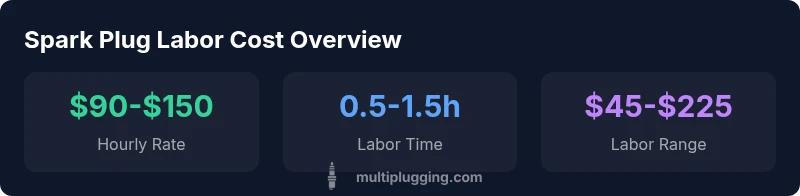
On average, spark plug replacement labor cost ranges from $90 to $150 per hour, depending on vehicle type, location, and shop. Most cars require 0.5 to 1.5 hours of labor, translating to about $45 to $225 in labor. Some shops add a diagnostic or disposal fee, and plug-assembly costs can vary by brand.
Understanding what drives labor costs for spark plug replacement
Labor pricing for spark plug replacement is not a fixed number. It reflects a mix of regional wage levels, shop operating costs, and the mechanical complexity of the job. According to MultiPlugging's analyses in 2026, the hourly rate commonly falls in a broad range, and the actual time required depends on access to the plugs, engine design, and whether additional services (like gapping the plugs or cleaning wells) are needed. For many vehicles, the task is straightforward: remove the old plugs, apply anti-seize if recommended by the manufacturer, install new plugs, and torque to spec. But in engines with tight spaces, variable valve covers, or turbocharging, a simple plug change becomes more labor-intensive. The conclusion is clear: if you want to estimate spark plug replacement labor cost accurately, you must consider both the shop’s hourly rate and the time the technician expects to spend, plus any diagnostic or disposal fees. This is why two nearby shops can quote noticeably different totals for the same vehicle.
The role of engine design and accessibility in pricing
Engine architecture is the primary driver of labor cost. Inline-four engines with accessible spark plugs typically take less time, while V6, V8, or twin-cam configurations can require removing components such as intake manifolds or coil packs. Direct-injected engines add another layer of complexity because their plugs may be located deeper and require special tools or procedures to avoid damage. When plugs are tucked under heavy wiring harnesses or under a high-mount intake system, technicians spend extra minutes or even hours to reach them safely. DIY enthusiasts often underestimate the time needed for a clean, torque-spec installation. In contrast, older vehicles with worn hardware or stubborn plugs may need extra care and penetrant treatment, increasing both the time and the risk of thread damage. MultiPlugging's cost data highlights that accessibility alone can swing labor estimates by 20-40% in some makes.
Regional pricing differences and shop pricing strategies
Pricing for spark plug replacement labor varies by region due to cost of living, competition, and demand. Urban areas often show higher hourly rates, while rural shops may offer lower rates to attract customers. Some shops bundle labor with diagnostic checks or offer flat-rate pricing for certain engine families; others bill strictly by the hour. Seasonal demand, dealer vs. independent shop reputation, and warranty coverage can also influence quotes. To prevent sticker shock, ask for a written estimate that includes the hourly rate, estimated hours, and any ancillary fees. MultiPlugging's 2026 analysis suggests that obtaining 3-4 quotes can reveal the range and help you identify the fairest option for your vehicle and location.
How to estimate labor time before you commit
Start by identifying your engine type and whether the plugs are easily accessible from the top or require disassembly. Then, check OEM torque specs and whether any extra steps (like coil removal or fuel rail loosening) are necessary. Use a rough calculation: multiply the expected hours by the shop's hourly rate, then add potential diagnostic fees, disposal costs, and a possible core charge. If you’re unsure, contact a few shops and request line-item quotes that separate labor, parts, and fees. Online forums and the OEM service manual are useful references for typical access scenarios. By planning ahead, you avoid surprises and can compare apples-to-apples quotes rather than rough ballparks.
DIY considerations: when to DIY vs. when to hire a pro
DIY spark plug replacement is feasible for many four-cylinder engines with accessible plugs, provided you have the right tools (ratchets, extensions, and torque wrench) and follow the OEM torque specs. However, engines with tight clearances, coil-on-plug configurations, or turbocharging can easily lead to stripped threads or damaged coil boots if you rush. Consider the cost of tools, the value of your time, and the risk of inadvertently causing misfires or engine damage. If you rely on professional service, you often benefit from a warranty on the labor and the plugs themselves. MultiPlugging emphasizes that the most cost-effective choice depends on your skill, the vehicle’s design, and how quickly you need the car back.
How to talk to your shop and optimize value
Ask for a detailed, written quote that separates labor, parts, and any diagnostics. Inquire about the expected time frame and whether there’s a flat-rate offer for common engines. If you provide the exact engine code, some shops can offer a more accurate estimate. Request a torque-spec sheet and confirmation that a thread-check is included, especially for older engines. If your car’s design requires extra steps, discuss whether the shop provides a bundled price for both the labor and the parts. A well-communicated plan can reduce both time and price variability, ensuring you pay for the actual service you receive.
Quick tips to avoid overpaying and ensure quality
- Get multiple quotes and compare line-item estimates.
- Verify OEM part numbers to avoid unnecessary marksups on plugs.
- Confirm whether diagnostic or disposal fees are included or extra.
- Ensure the mechanic uses the correct torque specification and anti-seize protocol if recommended.
- Check for any shop-specific guarantees on the workmanship and plugs.
- Consider timing when shops run promotions or bundled services to maximize value.
Estimated labor time by engine configuration
| Vehicle Type | Estimated Labor Time | Notes |
|---|---|---|
| Compact 4-cylinder inline | 0.5-1.0 hours | Most common engines; plugs are accessible from top |
| V6/V8 passenger cars | 1.0-1.5 hours | More components to remove; variable accessibility |
| Turbocharged or direct-injected | 1.0-1.75 hours | Plugs deeper; may require special tools |
| Pickup trucks / larger engines | 0.75-1.25 hours | Depends on cab/engine bay layout |
FAQ
What is the typical spark plug replacement labor cost?
Costs vary by region and vehicle, but hourly rates commonly fall in the $90-$150 range, with total labor often ranging from about $45 to $225 for many cars. Always request a line-item quote to see how the total breaks down.
Labor costs usually fall within 90 to 150 dollars per hour, so expect roughly 45 to 225 dollars for labor on many cars. Get a line-item quote to confirm.
Do specialty plugs increase labor costs?
Premium plugs themselves add a cost for parts, but labor impact depends on accessibility. Iridium or platinum plugs can be installed in the same time as standard plugs, though some engines need extra care.
Premium plugs can raise the parts price; labor time is mostly tied to accessibility, not the plug type.
Can I save money by providing my own plugs?
Bringing your own plugs can reduce parts markup, but many shops charge the same labor rate. Some shops restrict customer-supplied parts, so always ask first.
Bringing your own plugs can help if the shop allows it; otherwise, labor remains the main cost.
Are there extra costs beyond labor?
Yes. Watch for diagnostic fees, disposal fees, core charges, and any shop supplies. A written quote helps you see what’s included before you agree.
There can be diagnostic or disposal fees; a written quote helps you avoid surprises.
Is labor cost different for diesel vs gasoline engines?
Labor dynamics are similar, but diesel plugs and maintenance can be more involved due to engine complexity. Rates may be comparable, but expect potential differences in time.
Diesels can be more complex; similar hourly rates may apply, but expect longer service in some cases.
How can I ensure value without compromising quality?
Ask for a detailed estimate, compare quotes, and verify the OEM torque specs and plug type. Look for shops that offer warranties on labor and parts and avoid the cheapest option if it compromises quality.
Get a warranty-backed quote and compare details to ensure value and quality.
“Labor costs for spark plug replacement are driven by accessibility and engine design; expect higher quotes for engines with tight spaces or direct-injected plugs. Planning ahead saves time and money.”
Main Points
- Shop around for quotes to compare hourly rates.
- Expect 0.5–1.5 hours of labor on most engines.
- Accessibility and engine design are the main cost drivers.
- Ask for a detailed line-item estimate before service.
- DIY can save money if you have the right tools and time.