How Much Does a Spark Plug Job Cost in 2026?
Learn realistic spark plug replacement costs in 2026, including labor, parts, and tips to save. Get a transparent, itemized estimate with ranges and real-world scenarios.


What drives the spark plug service price in 2026
Spark plug service pricing is not a fixed number. The total cost depends on three main categories: the plugs themselves, labor, and any included diagnostics or ancillary services. According to MultiPlugging, the type of plug you choose can swing price per plug from a few dollars to over twenty dollars in premium configurations. More expensive plugs (iridium or platinum variants) are common in newer engines or performance cars and require specialized handling during installation.
Labor cost is driven by access. An engine with tight valve covers or a crowded engine bay may require more labor hours. The average labor time to replace a full set of plugs ranges from about 0.5 to 1.5 hours for typical passenger cars, but can extend beyond 2 hours for complex layouts or hybrid vehicles. Shop hourly rates vary widely by region; in urban markets, rates commonly sit near the higher end, while rural shops may be lower. In addition to straight replacement, some technicians perform a quick coil or wire inspection, sealant application, and torque checks, all of which add to the bill.
Finally, diagnostic checks or error code clearing can add modest fees if the check engine light is on or if a mechanic identifies a misfire before replacement. It's wise to request a bid that itemizes parts, labor, and any fees, and to confirm whether waste disposal or old plug packaging is included. This transparency helps avoid sticker shock and makes it easier to compare quotes across shops. For further reading and context, see NHTSA, Consumer Reports, and Popular Mechanics.
Source citations: https://www.nhtsa.gov/, https://www.consumerreports.org/, https://www.popularmechanics.com/cars/.
Labor costs and time estimates: what you should expect
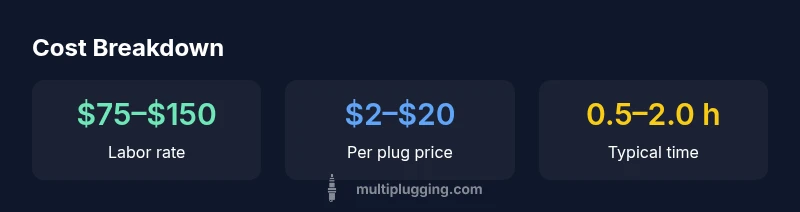
Labor charges are often the largest portion of a spark plug service. A typical shop will quote a labor rate in the range of 75 to 150 dollars per hour, with regional variations. The actual time to replace a full set of plugs hinges on engine design and accessibility. On a straightforward four-cylinder engine, you might complete the job in about 0.5 to 1 hour. A V6 or V8 with harder access can push the time toward 1 to 2 hours, especially if technicians perform ancillary tasks such as coil inspection or wire testing.
When budgeting, plan for the upper end if you’re working with a high-mileage vehicle or one with modern coil-on-plug arrangements. Some shops include diagnostic checks or misfire testing as part of the service if a fault is suspected, which can add 15–45 minutes of labor. If you’re unsure about the exact scope, ask for a detailed, itemized quote that lists labor hours, hourly rate, and any diagnostic fees. A clear quote helps you compare apples-to-apples across providers and minimizes surprise charges.
For DIY enthusiasts, knowing typical times helps you decide whether to tackle some steps yourself (like basic plug replacement) and leave tougher portions to a pro. Remember: the plug type, gap specification, and torque requirements must be correct to avoid misfires or damage. Always verify torque values per vehicle specification before tightening plugs.
Parts costs: plugs, wires, and additional consumables
Parts costs form a predictable portion of the total but vary widely by plug type and brand. A standard copper-core plug is usually the cheapest option, while platinum or iridium variants offer longer life and better performance, at a higher per-plug price. Expect per-plug prices in the single digits for basic options and up to the mid-teens or higher for premium variants. In many engines, you’ll replace all plugs at once, so multiplying the per-plug cost by the number of cylinders gives a rough parts subtotal.
Wires, coils, and boots can also factor in. If your vehicle uses coil-on-plug ignition, a single coil replacement can cost more than a single spark plug replacement, especially if additional wiring or boots are involved. Some vehicles require anti-seize compounds on the threads or silicone grease on the boots, which adds a small kit cost but can improve reliability. Don’t forget to budget for any gaskets or seals that might be disturbed during access. While doing the parts shopping yourself can save money, ensure you’re picking correct heat range and thread size for your engine to prevent misfires or fouling.
For best results, consider asking for a breakdown that lists plugs, wires (if applicable), any consumables, and installation hardware. A transparent quote makes it easier to see where costs are coming from and whether you’re paying a premium for premium parts.
How vehicle design and engine layout impact quotes
Engine layout has a direct impact on the time and complexity of spark plug replacement. Simpler, accessible engines (like many four-cylinders) often require minimal disassembly and can be completed quickly. More complex layouts—such as engines with tightly packed bays, turbochargers, or overhead cam configurations—typically require additional steps to remove components and re-seat seals. These extra steps translate into higher labor hours and, consequently, higher quotes.
Additionally, some engines use multiple plug types or have staggered firing orders, which can complicate replacement and require more parts and time. In high-end or performance vehicles, plugs may be more expensive and require more careful torquing to avoid thread damage or cross-threading. Because labor costs and time estimates are sensitive to access, always ask for a model-specific quote that reflects your engine’s accessibility. This approach helps you avoid paying for unnecessary labor in regions with higher rates.
When evaluating quotes, look for notes about whether the price includes coil inspection, misfire testing, anti-seize application, or thread cleaning. If the shop identifies potential coil or electrode issues, ask whether those inspections are billed separately or bundled with the plug replacement.
Smart ways to estimate and save: quotes, DIY, and scheduling tips
To minimize surprises, get multiple, itemized quotes from reputable shops. A good quote should separate parts costs, labor hours, hourly rate, diagnostic fees, and disposal or packaging charges. If you’re comfortable with DIY basics, you can save by providing your own plugs or performing the less-tedious steps (like removing a cover panel) before scheduling a professional for the final torque and sealing steps.
Shop around by calling several local garages and requesting a “parts plus labor” quote for your exact engine. If you’re unsure which plug type to buy, ask for the model’s recommended heat range and gap. Purchasing the plugs yourself can yield savings if you choose reputable brands and ensure compatibility, but confirm that the shop will install customer-supplied parts. Finally, consider scheduling during off-peak times or booking bundled maintenance to reduce labor costs.
Transparency matters: a clear, itemized quote helps you compare across providers, and asking about any potential add-ons upfront reduces the chance of sticker shock later.
Real-world examples and scenarios
In practice, costs vary by vehicle and region. A compact sedan with 4 plugs and standard copper plugs might land around $120–$180 total, with labor around 0.5–1 hour and plug costs near $2–$6 per plug. A mid-size SUV with 6 plugs and irregular access could run closer to $160–$250, driven by more labor time and higher plug prices. Luxury or performance vehicles, particularly those with timing chains or difficult access, may see quotes in the $250–$320 range or higher when premium plugs and additional checks are included. These scenarios illustrate why a quoted range is often more useful than a single number: the real price hinges on your specific engine layout, plug choice, and local labor rates.