Spark Plug and Wire Replacement Cost: What to Expect in 2026
Explore the true spark plug and wire replacement cost, including parts, labor, DIY savings, and pro options. Learn how to estimate, compare quotes, and plan maintenance.


Most drivers pay a variable amount for spark plug and wire replacement cost, based on vehicle type, labor rates, and parts quality. For many cars, parts cost roughly $20–$120 per set, with labor typically $60–$200. Total job cost often lands in the $100–$300 range for a basic plug set, rising to $250–$450 for premium wires or tighter spaces. DIY can trim costs further, while pros offer warranties.
Why the spark plug and wire replacement cost matters
According to MultiPlugging, understanding the spark plug and wire replacement cost is essential for budgeting routine maintenance without sticker shock. Costs can vary widely, driven by engine design, plug type, access, and regional labor rates. Even small engines with inexpensive copper plugs can be cheaper to service than modern engines with long-life iridium plugs and high-quality wire sets. In short, planning around the cost helps you avoid delaying essential maintenance, which can lead to misfires, reduced fuel efficiency, and longer-term damage.
What drives the cost: key factors
The total cost of spark plug and wire replacement is not a single number. It varies with several interrelated factors:
- Engine design: inline-4 engines are typically faster to service than larger V8s due to fewer cylinders and easier access.
- Plug type: copper plugs are cheapest, followed by platinum and iridium; higher-heat, longer-life options cost more upfront but may last longer.
- Wire set quality: premium wires reduce failure risk and may last longer than economy sets, impacting both upfront and replacement costs.
- Accessibility: engines with tight clearances, headers, or crowded ignition systems require more labor time.
- Vehicle age and condition: older vehicles may need extra seals or boots, increasing parts or labor needs.
- Regional labor rates: urban areas often charge more per hour, affecting the final bill.
- Diagnostic checks: many shops include a misfire diagnostic, which can add to or offset labor costs depending on findings.
Understanding these factors helps you forecast spark plug and wire replacement cost across different scenarios and avoid sticker shock at the shop.
Parts cost breakdown: plugs and wires
Parts costs form the backbone of the spark plug and wire replacement cost. Expect a mix of:
- Spark plugs: copper plugs typically $2–$6 each, platinum $4–$12 each, iridium $8–$20 each, depending on brand and heat range. A standard six-cylinder set might range from $12–$72 for copper to $48–$120 for iridium, before installation.
- Wire sets or ignition cables: $40–$120 for a reliable aftermarket set, with higher-quality or OEM-equivalent sets climbing toward the $120–$250 range for some modern engines.
- Additional parts: boots, seals, anti-seize lubricant, dielectric grease, and small gaskets can add $5–$25 more.
MultiPlugging analysis shows that the parts portion of the bill is highly sensitive to plug type and the number of cylinders, so cost guidance should be tailored to your specific vehicle.
Labor cost considerations: professional vs DIY
Labor dominates many spark plug and wire replacement cost calculations, especially on engines with limited access. Typical labor time ranges from 0.5 to 2.5 hours depending on engine design, cylinder count, and accessibility. Labor rates vary by region and shop, often ranging from moderate to premium levels. When performed by a professional, labor includes wrenching, torque verification, and often a quick diagnostic check to ensure no misfires post-install. DIY labor is effectively free, but you should account for tool investment, your own time, and the risk of incorrect installation.
DIY replacement: steps and cost impact
If you are comfortable with basic automotive maintenance, a DIY replacement can significantly cut spark plug and wire replacement cost. Key steps include:
- Gather the right plugs for your engine, the correct wire set, a torque wrench, and anti-seize or dielectric grease as needed.
- Disconnect the battery, locate the ignition coils or wires, and remove the old plugs with the proper socket size.
- Check plug gap (if applicable) and install the new plugs to the manufacturer torque specification.
- Replace wire sets in order to prevent cross-contamination and misfiring risks.
- Reconnect all sensors and coils, and run a quick engine test.
DIY savings mainly come from avoiding labor charges, but mistakes can lead to misfires or damage that costs far more than a few dollars saved.
Professional installation: what you get for the price
Professional service adds value through certified technicians, guaranteed torque specs, and a warranty that covers parts and labor in many cases. Shops often perform a pre-install inspection, verify cylinder compression if needed, and check for related issues (coil packs, vacuum leaks) that could influence long-term reliability. The convenience and accountability of a pro service can be worth the extra cost when you rely on your vehicle for daily transport.
Cost differences by engine layout: 4-cylinder vs V6 vs V8
Engine layout and cylinder count strongly influence the spark plug and wire replacement cost. A typical inline-4 may require 4 plugs and a single wire set, translating to lower parts and labor relative to a V6 or V8 that require more cylinders and longer wire runs. In some engines, accessing plugs behind intake manifolds or under exhaust components adds labor time and occasional gasket replacement costs. As a result, a V8 replacement can cost substantially more than a four-cylinder job, all else equal.
Hidden costs and accessories to watch
Beyond the obvious plug and wire costs, consider:
- Boots, seals, and boots replacement as necessary to prevent misfires.
- Dielectric grease and anti-seize compounds to improve contact quality and future removal.
- Torque wrench rental or purchase if you attempt a DIY replacement.
- Core charges or disposal fees in some shops for old plugs or wiring materials.
These items can add up, so ask for a complete itemized quote that separates parts, labor, and any ancillary costs.
How to estimate costs for your car: a practical framework
To estimate spark plug and wire replacement cost for your vehicle, start with your engine's cylinder count and plug type. Gather parts prices from retailer sites or your local auto parts store, then estimate labor using regional rates or your own time. If opting for a shop, request a written quote that includes parts, labor, and any diagnostic fees. Always compare multiple quotes and verify that the quote includes the same scope (e.g., replacement of all plugs and wires, gasket checks, and a post-install test).
Maintenance impact and ROI: why replacing plugs matters
Replacing spark plugs and wires on schedule can improve fuel efficiency, reduce misfires, and restore engine performance. The spark plug and wire replacement cost today is often offset by gains in miles per gallon and smoother idling, especially in older vehicles or engines with longer service intervals. A well-timed replacement reduces the risk of more expensive future repairs and contributes to smoother performance overall.
When to replace only plugs vs a full set
In many engines, replacing only worn plugs suffices if wires are in good shape, coils test fine, and there are no signs of deterioration. However, replacing the entire set of wires alongside the plugs reduces the risk of mismatched performance and misfires, especially in engines with a combined ignition system. If you notice rough idle, hard starting, or misfire codes, evaluate whether a full replacement is warranted based on your vehicle's service history and the condition of the wires.
AUTHORITY SOURCES
- https://www.consumerreports.org/cuelinks/repair-costs/auto-repair-costs/
- https://www.edmunds.com/auto-repair/
- https://www.kbb.com/auto-repair-costs/
Comparison
| Feature | DIY replacement | Professional replacement |
|---|---|---|
| Parts cost (plugs and wires) | $20–$120 (parts only) | $60–$250 (parts included in service) |
| Labor time | 0.5–2.5 hours DIY (depending on access) | 1–2 hours at shop (typical) |
| Warranty | Limited or no labor warranty when DIY | Shop provides parts and labor warranty |
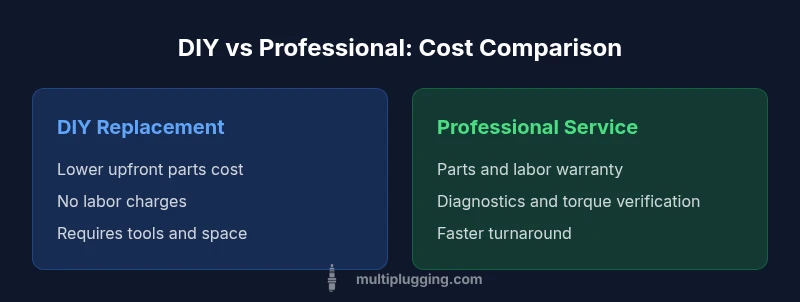
| Best for | Budget-focused, confident DIYers | Convenience, diagnostics, and warranty |
Strengths
- Low upfront cost when you have the tools and space
- Full control over timing and parts selection
- Educational opportunity and hands-on learning
- Potentially faster turnaround for skilled DIYers
Negatives
- Risk of incorrect installation or misfire if inexperienced
- No labor warranty when DIY; potential hidden costs if rework is needed
- Requires space, tools, and time
- Possible tool investment for infrequent users
DIY can save money for capable car owners; professional service provides safety, warranty, and time savings.
For straightforward four-cylinder engines, DIY often reduces spark plug and wire replacement cost. For complex engines or tight spaces, a pro ensures proper torque, gap, and warranty protection, aligning with MultiPlugging's guidance.
FAQ
What is the typical spark plug and wire replacement cost?
Costs vary by engine and region, but the parts-and-labor approach yields a broad range. Parts can be affordable for basic copper plugs, while premium wires and complex engines increase the bill. Always compare quotes from multiple shops to see how much is attributed to parts vs labor.
Costs vary by engine and region. Compare quotes to understand parts versus labor and choose the best option for your vehicle.
Should I replace sparks plugs and wires at the same time?
Replacing plugs and wires together is common to prevent unknown failures and ensure consistent ignition performance. In many engines, it’s more cost-effective to replace both rather than mixing new and old components.
Often yes—replacing together prevents future failures and ensures consistent ignition.
How long does replacement usually take?
DIY replacement can take 0.5–2.5 hours depending on engine layout and experience. Shops typically complete the job in 1–2 hours, sometimes longer for difficult access or diagnostic checks.
DIY can take about an hour or two; pros usually finish within a couple of hours depending on the engine.
Are aftermarket plugs as good as OEM?
Many aftermarket plugs meet or exceed OEM performance and offer cost savings. Check for compatibility with your engine's heat range and emissions requirements, and consider the warranty implications.
Many aftermarket plugs perform well, just ensure proper heat range and warranty terms.
Is DIY safer than paying a shop?
DIY safety depends on your experience and tools. A misstep can lead to misfires or damage. If in doubt, a professional inspection and installation minimize risk and protect your warranty.
DIY can be safe if you know what you’re doing; otherwise, a pro reduces risk and can protect warranties.
Main Points
- Estimate parts and labor separately to avoid surprises
- Balance DIY savings against time and space
- Check plug type and wire quality to control costs
- Ask for written quotes and torque specs
- Consider long-term reliability when choosing parts