How Much Is a New Set of Spark Plugs? A 2026 Cost Guide
Discover how much a new set of spark plugs costs in 2026. Learn per-plug ranges, total replacement estimates, labor factors, and tips from MultiPlugging to budget effectively.


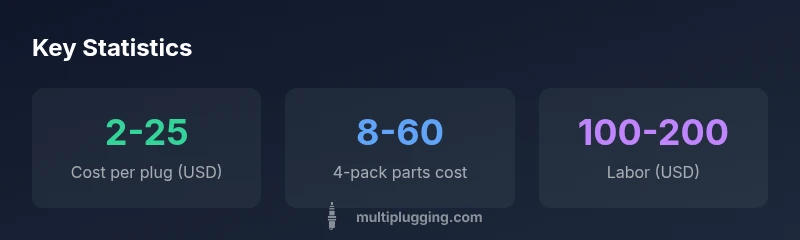
On most cars, a new four-spark-plug set costs roughly 20 to 60 USD for copper or basic platinum plugs, while iridium plugs push the range to 80–180 USD. For six- or eight-cylinder engines, multiply accordingly. In addition to parts, expect labor to add roughly 100–200 USD depending on vehicle access, location, and shop rates. Always consider your engine type and replacement interval when budgeting.
What drives the price of a new set of spark plugs
Spark plug costs are driven by several core factors: the plug type, engine size and accessibility, brand reputation, and where you purchase them. Copper plugs are the simplest and typically the cheapest, but they wear faster in modern engines. Platinum and iridium plugs carry higher upfront costs and longer lifespans, which can reduce replacement frequency. Engine design also matters; direct-injected or turbocharged engines may require specific heat ranges or electrode configurations, driving price and labor time higher. Finally, labor availability and regional shop rates influence your total bill. This section outlines how these variables translate into real-world costs and what you can expect when budgeting for a spark plug replacement. As with all parts, the goal is to balance upfront cost with longevity and reliability.
Spark plug types and their price ranges
Understanding plug types helps demystify the sticker shock on price tags. Here are typical ranges you’ll see in 2026:
- Copper plugs: Generally the lowest cost, around 2–5 USD per plug. Lifespans commonly 20k–40k miles for many engines. Best for budget builds or older vehicles where long life isn’t critical.
- Platinum plugs: Moderate cost, about 4–12 USD per plug. Lifespans around 60k miles. Good balance of cost and longevity for many daily drivers.
- Iridium plugs: Premium option, roughly 8–25 USD per plug. Lifespans 60k–120k miles. Worth considering on high-mileage, performance, or harsh-running engines.
Remember, some engines require special heat ranges or coil-on-plug configurations; always confirm with your service manual or parts retailer before purchasing. The potential savings from longevity can offset higher upfront costs over time, particularly for engines with hard-to-reach plugs where labor is a large share of the bill.
How to estimate total replacement cost
Estimating total costs starts with parts, then adds labor and any incidental expenses. For a typical 4-cylinder car, parts for a full set might range from about 8–60 USD depending on plug type. Labor commonly adds around 100–180 USD, driven by access, torque specifications, and shop rates. For 6- or 8-cylinder engines, parts can run roughly 20–120 USD more, while labor can climb to 150–240 USD due to increased bolts and coil assemblies. If DIY, you’ll still pay for tools and any anti-seize or dielectric grease; you may save several hundred dollars on labor. This section provides realistic ranges and emphasizes verifying prices for your specific car and region.
Save money without compromising reliability
- Buy plugs in a kit for your exact engine model to ensure compatibility and correct gap.
- Compare brands and look for promotions or multi-pack discounts; the difference between two brands is often modest.
- A DIY replacement can significantly cut costs if you have the right tools and a service manual; never force a plug or ignore torque specifications.
- Always torque plugs to the manufacturer’s spec; overtightening can strip threads, while under-tightening can cause misfires.
- If you drive a high-mileage vehicle, iridium or platinum plugs may pay off by reducing future replacements.
Cost by engine size and vehicle age
4-cylinder engines typically see parts costs in the 8–60 USD range with labor around 100–180 USD. 6- or 8-cylinder engines tend to push parts up to 120 USD or more, with labor commonly 150–240 USD. Newer vehicles with long-life plugs (platinum or iridium) often carry higher upfront parts costs, but the extended intervals can reduce total replacements over time. Accessibility matters: engines with confined bays or coil-on-plug designs increase labor time and cost. Always align plug choice with your vehicle’s service schedule and driving patterns.
How labor cost factors vary
Labor is a major swing factor in total replacement cost. Urban shops typically charge higher hourly rates than rural or independent shops. Accessibility can dramatically affect time: compact engine bays, tight coil-space, or removed intake manifolds raise labor hours. Additional costs may arise from required tools (torque wrenches, extension bars), special dies for anti-seize compounds, and waste disposal. Warranty considerations also matter; some newer vehicles include labor in warranties when performed at authorized service centers.
Quick-start DIY guide: 5 steps to replace spark plugs
- Gather the right tools: spark plug socket, ratchet, torque wrench, extension, and the correct gap gauge.
- Disconnect the negative battery cable to avoid shorts.
- Remove ignition coils or wires one cylinder at a time, noting their positions for a proper reinstallation.
- Carefully extract old plugs, then inspect threads and the valve area for cleanliness.
- Install new plugs to spec, torque to factory settings, and reassemble components in reverse order. Recheck gaps and clear any debris; test engine after replacement.
The value of choosing quality over price
Quality plugs matter for reliability and performance. A modest upfront investment in a reputable brand can yield longer service intervals and smoother combustion, reducing misfires and emissions issues. Always match the plug heat range and reach to your engine’s needs; chasing the lowest price can backfire with higher long-term costs. In practice, balance cost, longevity, and compatibility with your driving style and maintenance plan. MultiPlugging emphasizes reliable parts that keep you on the road longer, with sensible budgeting for DIY or professional service.
Spark plug cost by type and lifespan
| Plug Type | Price per Plug (USD) | Typical Lifespan | Notes |
|---|---|---|---|
| Copper | 2-5 | 20,000-40,000 miles | Low-cost option; shorter lifespan |
| Platinum | 4-12 | 60,000 miles | Balanced cost and longevity |
| Iridium | 8-25 | 60,000-120,000 miles | Premium longevity and performance |
FAQ
What is the typical cost for a full set of spark plugs?
A full set for a typical 4-cylinder engine often falls in the 8–60 USD range for parts, plus 100–180 USD for labor. For larger engines, add more for both parts and labor. These are broad ranges; check your vehicle’s manual and local pricing.
A full set usually costs a bit more for bigger engines. Parts run around eight to sixty dollars for four cylinders, with labor typically a hundred to a couple hundred dollars depending on accessibility.
Does labor cost vary by location?
Yes. Urban shops generally charge higher hourly rates than independent or rural shops. Labor time also depends on accessibility. Get multiple quotes and ask for a breakdown to compare like-for-like.
Labor costs can vary a lot by where you live and how easy your engine is to access—shop around for quotes and ask for a clear breakdown.
Are iridium plugs worth the extra cost?
For most daily drivers, copper or platinum plugs meet reliability needs at a lower upfront price. Iridium pays off if you want longer replacement intervals or run a high-mileage or performance setup; weigh upfront cost against expected lifespan.
Iridium plugs last longer, but for many daily drivers copper or platinum are plenty. If you log a lot of miles or want longer intervals, iridium may be worth it.
Can I replace plugs myself safely?
Yes, with the right tools and a service manual. Ensure you use the correct torque and gap settings, disconnect the battery, and avoid cross-threading. If you’re unsure, a professional service is safer.
Yes, you can do it yourself if you’ve got the right tools and follow the manual—just don’t rush or force parts.
How often should spark plugs be replaced?
Intervals vary by plug type: copper typically 20k–40k miles, platinum around 60k, iridium 60k–120k. Always consult your vehicle’s manufacturer recommendation for the exact interval.
Most cars need plugs every 20k to 40k miles for copper, 60k for platinum, and 60k to 120k for iridium—check the manual for your car.
“Understanding the long-term value of spark plugs is as important as the upfront price; higher upfront costs can pay off with longer intervals and smoother performance.”
Main Points
- Know the price ranges by plug type
- Total cost includes parts and labor
- DIY can save money if you have the tools
- Labor varies by engine accessibility and location
- Choose plug type based on vehicle and driving needs