Where is Spark Plug in Bike: Locate, Inspect, and Replace
Learn where the spark plug sits on motorcycles, how to access it safely, and what to check during inspection or replacement. A practical, hands-on guide by MultiPlugging.


By the end of this quick guide, you’ll know exactly where the spark plug lives on most bikes, how to access it without removing essential components, and the steps to inspect or replace it. You’ll also spot fouling indicators and know when to replace. This primer sets expectations for common engine layouts and the basic tools you’ll need to get started safely.
Where the spark plug lives on bikes
If you’ve asked yourself, where is spark plug in bike, you’re not alone. The spark plug sits inside the engine, typically on the cylinder head, where it can ignite the air-fuel mix. For many riders, the question isn’t just about location but accessibility: some bikes tuck the plug behind covers, while others place it beneath the airbox or on the side of the engine. According to MultiPlugging, understanding the general layout first makes future maintenance safer and faster. In practice, you’ll often spot a thick black boot or coil lead running from the ignition coil to a metal threaded tube—the spark plug itself—threaded into the head. Recognizing these landmarks will save you time and reduce the risk of damaging nearby components while you work. The goal is to locate the plug without disturbing the cooling fins, hoses, or fuel lines essential to engine operation.
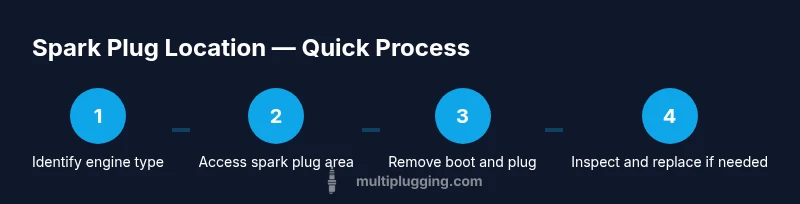
The exact spot varies by model and engine family, but this guide covers the most common configurations found on sport bikes, commuters, and small-displacement motorcycles. Start by identifying the engine type on your bike’s label or owner’s manual; this will guide you to the probable plug location and the access path you’ll take.
Engine types and typical locations
Motorcycles come in several engine configurations, and spark plug placement follows those patterns. In four-stroke inline engines, the plugs are usually visible on the cylinder head’s side or top, sometimes beneath a valve cover. V-twin engines often have plugs on the side of each cylinder head, occasionally covered by a chrome cap. Single-cylinder engines tend to place the plug close to the cylinder, sometimes behind an air filter box. Two-stroke bikes may differ, with plugs sometimes positioned near the crankcase area. Regardless of layout, the plug is always threaded into a metal seat in the head and connected to a boot or coil wire. Knowing the typical location by your bike’s engine family helps you anticipate access challenges, such as tight spaces or heat shields that require removing a protective cover. When in doubt, consult the service manual for exact torque specs, boot routing, and any model-specific quirks.
Visual clues to spot the spark plug and its boot
Spotting the spark plug involves more than finding a metal plug in a hole. Look for the rubber boot or coil wire leading to a small metal cylinder with a threaded end. The boot is usually colored black or gray and will cap the plug to keep moisture out of the ignition system. On many bikes, the boot attaches to a metal connector on the plug; you may feel a slight click when it seats properly. Some engines feature a tube or boss near the exhaust side—this is a common cue for the spark plug’s position. If you can see a thin metal tube with a hexagonal base protruding slightly from the head, you’re likely near the plug. Remember to handle the boot gently to avoid tearing the seal, which can introduce moisture and fouling.
With practice, you’ll distinguish genuine spark plug components from nearby sensors or coolant hoses by their shape, size, and placement.
Tools and safety basics
Before you touch the bike, gather essential tools and review safety basics. You’ll typically need a spark plug socket (6-point) with a ratchet, an extension bar for reach, a torque wrench, a gap tool or feeler gauge, and clean rags. Optional but helpful items include anti-seize compound, dielectric grease, and a replacement spark plug to suit your engine’s specifications. Safety comes first: ensure the bike is on a stable stand or padded surface, the engine is cool, and you disconnect the battery if you will be removing wiring near the coil. Keep the work area clean to avoid dropping parts into the engine bay. If you’re unsure of the exact plug size, check your owner’s manual or a parts diagram; using the wrong socket can strip the plug’s hex and complicate removal.
Step-by-step: locating the spark plug (high-level overview)
Access is usually the biggest hurdle. Start by parking the bike on a level surface and allowing the engine to cool. Remove any obvious covers or airbox components that block access to the cylinder head. Trace the ignition coil wire or spark plug boot toward the engine; the plug itself threads into the head with a small hex or square shape at the base. Use a spark plug socket with a ratchet and, if needed, a short extension to reach the plug. Loosen the boot carefully before turning the plug counterclockwise to unthread it. Inspect the plug’s electrode and gap if you have a gap gauge; if replacement is necessary, match the thread size and heat range to your bike’s specification. Reinstall with proper torque and reattach the boot and any covers.
How to confirm you’re at the spark plug
To confirm, verify the plug’s position by checking the hole’s threads and the boot’s seating. A spark plug’s head will have a hex-shaped base that fits the socket wrench; if you’re unsure, compare with the service diagram for your model. A misidentified plug can result in cross-threading or damage to the cylinder head. If you see a metal threaded sleeve in the engine, with a wire boot connected, you’re likely at the right component. Always ensure you’re not removing fuel lines, coolant hoses, or sensors while searching for the plug. If in doubt, pause and consult the motorcycle’s manual or service guide to prevent accidental damage.
Safety, gasket seals, and reassembly notes
After inspection or replacement, reassemble in reverse order. Clean threads with a dry rag, apply a light coat of anti-seize if recommended by your manual, and tighten to the manufacturer’s torque spec with a torque wrench. Replace any gaskets or sealants if the head cover was removed; loosely reassemble to avoid overtightening. Reconnect the ignition boot firmly, ensuring there’s no play or looseness in the connection. Finally, reinstall covers or airbox components and perform a quick engine check. A brief idle test after reinstall helps confirm there are no leaks or misfires and that the new plug seats correctly.
Common mistakes and how to avoid them
Common mistakes include cross-threading the plug, using the wrong socket size, or over-tightening which can strip the head or damage threads. Avoid forcing the plug into a stubborn seat; instead, use penetrating oil and take a break if the space is tight. Never ignore wiring safety: disconnect the battery if you’re near electrical components, and keep the coil and boot clean and dry. Finally, don’t mix up spark plugs across cylinders; always use the correct model, heat range, and gap for each position as specified by the manufacturer.
Tools & Materials
- Spark plug socket (6-point)(Match the plug size (commonly 5/8" or 13/16").)
- Ratchet wrench(Prefer long handle for leverage.)
- Extension bar(Helps reach recessed plugs.)
- Torque wrench(Torque to manufacturer's spec.)
- Feeler gauge / gap tool(Check plug gap if replacing or seating.)
- Rags or shop towels(Keep area clean to avoid debris.)
- Anti-seize compound(Only if recommended by manual.)
- Dielectric grease(Optional for boot connector contact.)
- Replacement spark plug(s)(Carry a spare of the correct type.)
- Owner’s manual / service manual(Torque specs and gap values vary by model.)
Steps
Estimated time: 30-60 minutes
- 1
Prepare workspace and Power Down
Park the bike on a level surface, engage the stand, and allow the engine to cool completely before starting. Remove any jewelry or loose clothing. Disconnect the battery if you’ll be near electrical connections to avoid shocks.
Tip: Cooling is essential to prevent burns and to avoid bending metal parts when loosening the plug. - 2
Identify engine type and plug location
Consult the service manual for your model to locate the cylinder head and the spark plug. Look for a thick rubber boot connected to a small metal plug threaded into the head.
Tip: If you’re unsure, photograph the area before disassembly to reference later. - 3
Gain access to the plug area
Remove any covers, airbox components, or shields that block access. Keep track of screws and gaskets so you can reassemble correctly.
Tip: Take note of routing for the boot; incorrect routing can lead to boot damage or misfires. - 4
Loosen the plug boot and remove the plug
Twist the boot to break the seal, then use the spark plug socket to loosen the plug counterclockwise. Avoid yanking on the boot; lift it away gently once loose.
Tip: If the plug is stubborn, apply a small amount of penetrating oil and wait a few minutes. - 5
Inspect the plug and measure gap
With the plug free, inspect electrode wear, soot, or oil fouling. Use a gap gauge to measure the electrode gap to the specification in the manual.
Tip: Replace if the electrode is worn or the gap is out of spec. - 6
Install new or inspected plug and torque
Thread the plug by hand to avoid cross-threading, then torque to the manufacturer’s specification using a torque wrench.
Tip: Apply anti-seize only if the manual prescribes; over-torquing can crack the head. - 7
Reconnect boot and reassemble
Reattach the spark plug boot firmly and reinstall any shields or covers you removed. Reconnect the battery if you had disconnected it.
Tip: Double-check boot seating to prevent misfires. - 8
Test the engine
Start the engine and listen for smooth idle. Look for signs of misfire or rough running. If issues persist, re-check plug seating or gap.
Tip: A short test ride confirms stability beyond idle.
FAQ
Where is the spark plug located on most motorcycles?
Most bikes place the spark plug in the cylinder head, often under a cover or near the airbox. The boot and coil wire connect to a small threaded metal plug in the head. Model-specific diagrams in the service manual confirm exact location.
On most bikes, the spark plug sits in the cylinder head under a cover. Check the service manual for your exact model to confirm the spot.
Do I need to remove the airbox to access the spark plug?
Many bikes require removing the airbox or a side cover to access the plug, especially in compact engine bays. Some models allow access through a side panel without full airbox removal.
Often you’ll need to remove part of the airbox or a side cover to reach the plug.
What tools are essential to locate and inspect the plug?
A spark plug socket, ratchet, extension, torque wrench, and a gap tool are essential. Have clean rags and a manual nearby for torque specs and gap values.
Grab a spark plug socket, a ratchet, a torque wrench, and a gap gauge, plus a clean rag.
How can I tell if a spark plug needs replacement?
If the electrode is worn, fouled, or the gap is out of specification, replacement is recommended. Fouling with oil or carbon buildup is a clear sign of failure.
Look for wear or fouling and check the gap; replace if out of spec.
Can I reuse an old spark plug after inspection?
Reusing is generally not recommended if the gap is out of spec or the electrode shows wear. If within spec, some riders save a plug, but replacing is safer for reliability.
Usually better to replace; reuse can lead to misfires.
What are common mistakes when locating the plug?
Cross-threading, over-tightening, or damaging the plug boot are frequent mistakes. Also, working around hot components without cooling can cause burns.
Be careful with threads, torque, and hot engine parts.
Watch Video
Main Points
- Identify the plug location using model-specific diagrams
- Use the correct socket and torque to avoid damage
- Check plug condition and gap before replacement
- Reassemble carefully and test run the engine