What Spark Plug for Honda GX200: A Practical Guide
Discover the ideal spark plug approach for Honda GX200 engines, including heat range, gap, maintenance, and troubleshooting to maximize reliability and performance.


For the Honda GX200, the best starting point is a standard mid-heat range spark plug with a clean gap of 0.028–0.032 inches. This aligns with typical GX-series recommendations and minimizes fouling, misfire, and starting issues. Always verify gap after installation and adjust for altitude or fuel quality as needed.
Honda GX200 spark plug basics
The Honda GX200 is a versatile, air-cooled engine widely used in portable generators, pressure washers, and small vehicles. Its ignition relies on a spark plug to ignite the air-fuel mixture in each cylinder. For the GX200 family, the spark plug is a 14mm-thread unit with a ceramic insulator and a copper-core center electrode, designed to withstand heat and vibration. While many DIYers fixate on a single brand, the practical performance comes from selecting a plug with a suitable heat range, a correct gap, and proper maintenance. A plug that runs too hot can cause pre-ignition and burned electrodes, while a plug that runs too cold may foul with carbon deposits. In real-world use, most GX200 owners benefit from a standard, mid-range plug and a gap within about 0.028-0.032 inches, adjusted for altitude and fuel quality. According to MultiPlugging, following a simple rule—start with a mid-range plug and verify gap after installation—significantly reduces fouling and misfires across a wide range of fuels and conditions.
Key factors: heat range, gap, and electrode type
Choosing the right spark plug for the GX200 isn't about chasing a brand; it's about matching heat range, gap, and electrode design to how you use the engine. The heat range determines how quickly the plug reaches operating temperature and how well it sheds heat under load; for most GX200 applications, a mid-range heat plug provides a balance between hot-start reliability and resistance to fouling. The electrode material affects durability and gap retention; copper-core plugs are affordable and easy to re-gap, while long-life designs with nickel or platinum alloys resist wear longer but can be less forgiving if the fuel or oil quality is marginal. Gap size is critical: a small deviation can shift ignition timing and idle quality. The guideline 0.028-0.032 inches works for many GX200 setups, but altitude, air temperature, and fuel quality can push you toward the lower or upper end of that range. Always re-check the gap after cleaning or installation, and consider adjusting if you use ethanol-rich fuels or operate at high elevation.
Copper-core vs long-life plugs: what to choose
Copper-core plugs offer inexpensive, forgiving performance and are easy to re-gap for DIY tune-ups. They heat and cool relatively quickly, which is beneficial for cold starts and transient loads. Long-life plugs, often with nickel or platinum alloys, resist electrode wear and maintain gap longer, which can be advantageous in engines with harsh operating conditions or frequent stop-and-go use. For most GX200 applications that see intermittent use or lightweight loads, copper-core options are perfectly adequate. If you run your equipment daily under heavy load or in challenging environments (dusty, humid, or high-temperature climates), consider a long-life option to reduce maintenance frequency, while keeping an eye on gap retention and fouling tendencies.
How to select the right gap and verify
Start with the standard gap range of 0.028-0.032 inches for the GX200. Use a precise feeler gauge to measure the gap and adjust as needed. After installing a new plug, torque it to the manufacturer’s recommended specification using a spark-plug wrench, then re-check the gap to ensure it hasn’t shifted during seating. When checking gap, remove the plug carefully to avoid electrode damage. If you perform regular maintenance or operate in environments with fuel quality concerns, verify the gap after the first few hours of operation and re-gap if necessary. This process helps prevent misfires and ensures smooth idling and reliable starts.
Replacement procedure: step-by-step
Tools you’ll need: spark plug socket, a torque wrench or a hand-tight approach with a few extra turns, and a gap gauge. Steps:
- Disconnect the spark plug boot to avoid accidental ignition. 2) Remove the old plug with the correct socket. 3) Inspect the plug for fouling, oil, or worn electrodes. If needed, clean carefully or replace. 4) Check and adjust the gap to 0.028-0.032 inches. 5) Reinstall the plug, ensuring it’s snug but not over-tightened. 6) Reconnect the spark plug boot and start the engine to verify proper ignition. 7) If starting is difficult, re-check the gap and fuel mixture as part of a broader diagnostic check.
Diagnosing plug-related issues
If the GX200 runs rough, lacks power, or misfires, a fouled or gapped plug is a common culprit. Signs of fouling include black, oily, or wet deposits around the electrode; a white or tan center electrode indicates overheating. A gap that has widened due to wear can cause misfires or rough idle. Remember to inspect as part of a wider diagnostic routine that checks carburetion, ignition coils, and air filtration.
Maintenance schedule and best practices
Develop a routine that includes inspecting the spark plug at every major service interval and replacing it on a regular schedule based on hours of operation, fuel quality, and operating conditions. In general, inspect every 25-50 hours and replace between 100-150 hours, depending on load and environment. Keep fuel clean and use fresh fuel, as stale fuel accelerates deposit formation and plug fouling.
Common mistakes to avoid
Avoid over-tightening the plug, which can strip threads or crack the ceramic insulator. Don’t rely on a single plug type for all conditions; adapt heat range and gap to altitude, temperature, and fuel quality. Finally, don’t neglect air and fuel system maintenance; a dirty carburetor or clogged air filter can mimic plug problems by causing misfires or weak ignition.
GX200 spark plug quick-reference
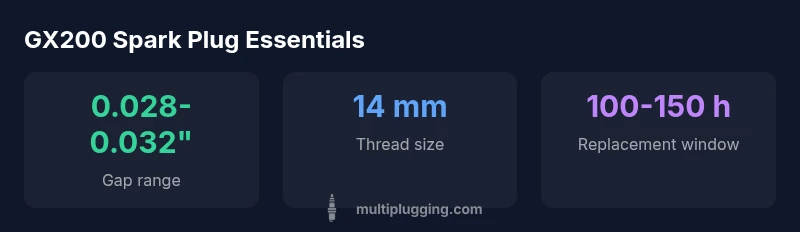
| Aspect | GX200 guideline | Notes |
|---|---|---|
| Thread size | 14 mm | Common across GX engines |
| Recommended gap | 0.028-0.032 inches | Check OEM spec; adjust with fuel quality |
| Replacement interval | 100-150 hours | Depends on usage and fuel quality |
FAQ
What spark plug should I use for Honda GX200?
There is no single brand that is universally best. Aim for a mid-range heat plug with a gap of 0.028-0.032 inches, and ensure proper gap after installation. The key is matching heat range and gap to your operating conditions.
Use a mid-range heat plug with a 0.028-0.032 inch gap and verify the gap after installation.
Copper-core or long-life plugs for GX200?
Copper-core plugs are affordable and easy to re-gap, which suits DIY maintenance. Long-life plugs resist wear but may require careful matching to fuel quality and engine load.
Copper-core is common for DIY tuning; long-life options exist if you need less frequent replacements.
Can I reuse a plug after cleaning?
If the plug is within tolerance, shows no damage, and the gap is correct after cleaning, you can reuse it. Otherwise, replace to avoid misfires.
You can reuse if it’s clean and properly gapped; otherwise replace.
What are signs the GX200 needs a new spark plug?
Hard starting, rough idle, loss of power, misfires, or visible fouling indicate replacement is due. Check related ignition and fuel-system components as part of diagnosis.
If the engine is hard to start or misfires, check the plug and fuel system.
How often should I inspect or replace the plug?
Inspect every 25-50 hours of operation and replace roughly every 100-150 hours, depending on load and fuel quality. Adjust based on performance observations.
Check every 25 to 50 hours; replace around 100 to 150 hours.
“A clean, correctly gapped plug is the simplest path to reliable ignition in small engines like the GX200.”
Main Points
- Start with a mid-range heat plug for GX200
- Set gap to 0.028-0.032 inches
- Inspect plug every 25-50 hours
- Replace every 100-150 hours under typical use
- Always verify gap after cleaning or replacement