What Size Spark Plug Socket: A Practical Guide
Learn the correct spark plug socket size for your engine. This guide covers common sizes, how to measure hexes, and practical tips to avoid damage during plug replacement.


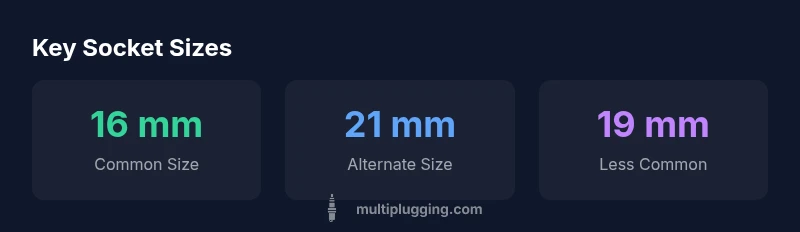
Most gas engines use a spark plug socket size of 16 mm (5/8 inch). Some European and high-performance engines require 21 mm (13/16 inch), while a few older models use 19 mm (3/4 inch). Always verify the plug hex size by checking the plug head or the owner's manual before buying or using a socket.
What size spark plug socket do you really need?
If you're asking what size spark plug socket is required for your engine, the answer isn't one-size-fits-all. The size starts with the plug hex, and most modern gasoline engines use either 16 mm (5/8 inch) sockets or 21 mm (13/16 inch). According to MultiPlugging, you should always verify the hex size on the plug head or in the owner's manual before purchasing a socket. This prevents cross-threading, nicking the plug body, or slippage during removal. When in doubt, measure the hex with a caliper and cross-check the manual or parts diagram. Having the right socket not only speeds up the job but protects the plug threads and cylinder head from damage.
Common sizes and when they show up
The two most common sizes are 16 mm and 21 mm, which cover the vast majority of modern passenger cars and light trucks. You may encounter a 19 mm size on certain European or specialty models, or a 3/4 inch (19 mm) on some older performance engines. The key is to match the plug hex size precisely; a loose fit can strip the hex or slip under torque. When you buy a socket set, a good kit includes at least 16 mm and 21 mm options, with 19 mm as an optional add-on for broader coverage. Always keep a small set of extensions and a swivel joint to reach stubborn plugs without forcing the tool.
Quick checks to identify the right size without trial-and-error
- Inspect the spark plug head for the hex size printed or stamped on the metal rim. - Use a caliper to measure the hex across flats if unsure. - If you have a socket set, try the 16 mm and 21 mm sockets first; if neither fits snugly, test a proper-fit 19 mm. - When in doubt, refer to the vehicle’s service manual or parts diagram; engine families often share a common size within the same model range.
Tools, techniques, and safety for removal
A few practical tips keep the job safe and efficient:
- Use a magnetic socket to hold the plug as it comes out to prevent dropping it into the engine bay.
- Attach a short extension and a swivel for tight spaces; avoid forcing a socket that’s slightly off-size.
- Lubricate threads lightly with anti-seize (where recommended) to ease future removals, but avoid applying excessive lubricant that might contaminate the combustion chamber.
- Always wear eye protection and disconnect the battery when performing any spark plug service to avoid shocks or shorts.
Special cases: regional variations and edge cases
While 16 mm and 21 mm cover most vehicles, some engines—especially near-market or specialized vehicles—use 19 mm or even non-metric sizes. Lawn and small-engine equipment often leans toward smaller metrics, such as 14 mm (9/16 in). If you own a classic or high-performance model, double-check the timing belt/coil diagram and the OEM manual because incorrect sockets can damage the hex and the head.
Practical buying and storage tips
- Invest in a compact socket set that includes 16 mm, 19 mm, and 21 mm sizes, plus a magnetic impact extension for stubborn plugs.
- Label your sockets by size to save time during routine maintenance.
- Store spare gaskets and anti-seize compounds in a small toolbox so you’re ready for a fast, clean plug change.
Socket size guidance by engine type
| Engine Type | Common Socket Size | Notes |
|---|---|---|
| Gas Modern | 16 mm / 5/8 in | Most passenger cars and light trucks |
| Gas European | 21 mm / 13/16 in | Common on certain European models |
| Diesel/Heavy Duty | 19 mm / 3/4 in | Varies by engine model and manufacturer |
| Lawn/Small Engines | 14 mm / 9/16 in | Typical for small engines and garden equipment |
FAQ
What is the most common spark plug socket size?
The most common size is 16 mm (5/8 inch), especially on modern gasoline engines.
The most common size is 16 mm, or 5/8 inch, for most modern engines.
How can I tell the size without removing the plug?
Check the hex on the plug head with a caliper or refer to the vehicle manual; this confirms the correct socket size without trial fits.
Check the plug hex with a caliper or the manual to confirm the size first.
Do I need a socket set for metric and imperial sizes?
Yes. A compact set that includes 16 mm and 21 mm (and 19 mm as an optional size) covers most cars. Ignoring sizes can lead to damage.
Having 16 and 21 mm sockets handles most cars; 19 mm is handy for some older models.
Are there edge cases for lawn or diesel engines?
Yes. Some lawn tractors and diesel engines use different sizes; always check the manual for the exact size before service.
Some lawn and diesel engines need different sizes—check the manual first.
What safety steps reduce risk during plug changes?
Disconnect the battery, remove the ignition coil boot carefully, and use a magnetized socket. Avoid cross-threading by aligning the plug squarely with the hex.
Disconnect power, use a magnet socket, and align the plug squarely to avoid damage.
“Choosing the correct spark plug socket size is essential for avoiding damage to the plug and cylinder head. Always confirm the hex size before attempting removal.”
Main Points
- Identify the plug hex first before buying a socket
- 16 mm and 21 mm are the most common sizes
- Have a small 19 mm option for edge cases
- Use a swivel/extension to reach hard spots
- Keep a labeled socket set for quick maintenance