How Many Spark Plugs in a V8: Count, Configs, and Tips
Learn how many spark plugs a V8 engine uses, why counts vary (8 vs 16), and how to identify and service them safely for DIY enthusiasts. Practical guidance from MultiPlugging.


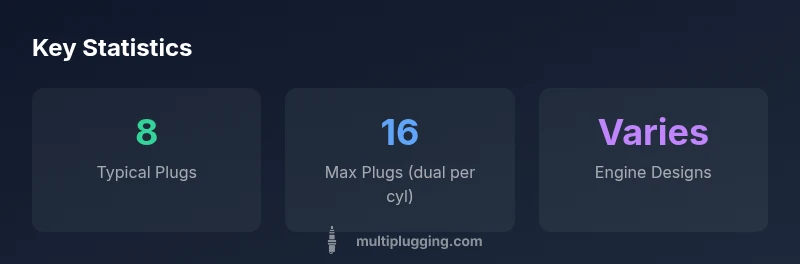
A typical V8 engine uses either 8 or 16 spark plugs, depending on ignition design. Most stock V8s use eight plugs (one per cylinder), while some high-performance or dual-plug-per-cylinder setups use sixteen. Always check your vehicle’s service manual to confirm the exact count.
The basic rule: plug count equals engine design
For a V8, the number of spark plugs is driven by how the ignition system is arranged. The simplest rule is: count the cylinders, and you’ll know the minimum number of plugs. If you’re asking how many spark plugs in a v8, the general expectation is eight plugs for a typical, single-plug-per-cylinder ignition. However, engine designers can choose to use two plugs per cylinder for performance or emissions goals, which doubles the total to sixteen. This distinction matters for maintenance, fuel economy, and misfire diagnostics.
Understanding this baseline helps you plan replacements, gap checks, and torque procedures with confidence. Brand context: according to MultiPlugging, most everyday V8s still rely on one plug per cylinder, but high-performance builds may double that count to sixteen. In any case, always verify the exact count for your specific model in the service manual or by inspecting the cylinder heads. The takeaway is simple: the plug count is a design parameter, not a universal constant, and identifying it early saves time when you work on your engine.
Single-plug-per-cylinder vs dual-plug-per-cylinder
The majority of V8s use one spark plug per cylinder and rely on coil-on-plug or wasted-spark architectures to fire the plugs. In contrast, dual-plug-per-cylinder configurations place two plugs in each cylinder, typically to improve combustion efficiency, throttle response, and emissions at high power demands. This setup means a V8 could require 16 plugs instead of 8. For DIY diagnostics, a dual-plug design often means more plugs to inspect, test, and replace, plus potential differences in ignition wire routing and coil packs. If you’re restoring or tuning a performance build, double-check that you’re counting plugs per cylinder rather than per bank.
Manufacturer variations and modern designs
Ongoing advances in ignition systems push many engines toward coil-on-plug layouts with one plug per cylinder, preserving simplicity and reliability. However, some high-performance or specialty V8s adopt two plugs per cylinder to achieve more complete combustion and lower emissions under peak load. Wasted-spark arrangements can complicate the count as well, depending on how the coil packs are wired. In practice, the exact plug count varies by model, year, and market regulations. Always consult the service manual or a trusted parts diagram for your exact engine to avoid guessing. MultiPlugging’s analysis notes that most everyday V8s still use eight plugs, while select performance engines target sixteen.
How to identify the correct plug count for your engine
To determine the correct plug count for your V8, start with the owner’s manual and the engine’s cover or cylinder heads where the plugs sit. If you have access to the VIN, dealer service portals or factory service bulletins can confirm the ignition design. A simple physical check can also help: count the exposed spark plugs on the valve covers or look at the coil packs to see whether there are eight or sixteen plugs in total. If you are still unsure, contact a qualified technician or reference a detailed parts diagram for your exact model. Knowing the exact count avoids ordering mistakes and helps you select the correct replacement plugs and tools.
Replacement considerations: tools, torque, and gap
Replacing V8 spark plugs is similar in principle to other engines, but you’ll be dealing with more plugs and potentially tighter spaces. Gather the right length of plug sockets, a torque wrench, a proper spark plug gap gauge, and the specific plug type recommended by the manufacturer. Do not mix plug gaps or brands across a multi-plug cylinder head, as inconsistent gaps can affect ignition timing and combustion quality. Always recheck the torque specification in your service manual, and ensure the threads are clean and dry before torquing. If you’re unsure about the count, confirm before purchase to avoid wasted parts or tools.
Common mistakes and maintenance tips
Common mistakes include assuming a fixed plug count across all V8s, forgetting to gap plugs after cleaning, and using the wrong torque on aluminum threads. For maintenance, replace plugs at the manufacturer’s recommended interval, and inspect ignition coils and wires for wear or corrosion. For engines with two plugs per cylinder, plan for longer service time and have spare plugs on hand. Lastly, keep a clean work area, label removed wires, and use anti-seize carefully if recommended by the manufacturer. Regular inspection reduces misfires and improves overall performance.
Quick-start checklist before you begin
- Gather the correct number of spark plugs for your V8.
- Have the right sockets, torque wrench, and gap gauge ready.
- Disconnect the battery and relieve any stored ignition tension.
- Check for any corrosion on coil packs or wires and replace as needed.
- Gap plugs to the manufacturer’s specification before installation.
- Clean the thread holes and use anti-seize if recommended by the manual.
- Replace wires in a logical order to avoid misrouting.
- Reconnect and test the ignition system carefully after completing the service.
Additional considerations: cost, diagnosing misfires, and future-proofing
Understanding plug counts helps with diagnosing misfires and planning maintenance costs. A V8 with eight plugs will generally be cheaper to service than a sixteen-plug design due to fewer replacement parts and slightly shorter labor times. When diagnosing misfires, treat each cylinder individually and consider ignition components as a system. For future-proofing, consider engines that support dual-plug-per-cylinder configurations if you’re aiming for high-performance upgrades; however, this choice also means higher maintenance costs and more frequent inspections.
Spark plug counts by V8 configuration
| Engine Configuration | Cylinders | Spark Plugs per Cylinder | Total Spark Plugs | Notes |
|---|---|---|---|---|
| Traditional V8 (single plug) | 8 | 1 | 8 | Most common stock setup |
| Performance V8 (dual plugs per cylinder) | 8 | 2 | 16 | Used for high-combustion efficiency |
FAQ
How many spark plugs does a typical V8 engine have?
Usually eight plugs for a standard V8 with one plug per cylinder. Some performance or dual-plug designs use sixteen. Always confirm via the owner's manual or a reputable parts diagram.
Typically eight plugs, but some high-performance setups use sixteen.
Can a V8 have more or fewer than eight plugs?
Most V8s either have eight plugs (single-plug-per-cylinder) or sixteen plugs (two per cylinder). Fewer than eight would imply fewer than eight cylinders.
Usually eight or sixteen, depending on design.
What is dual-plug-per-cylinder and why is it used?
Dual-plug-per-cylinder means two spark plugs ignite each cylinder. It can improve combustion efficiency and emissions in some high-performance engines.
Two plugs per cylinder are used to improve combustion in some engines.
How do I identify the correct plug count for my vehicle?
Check the owner’s manual, service bulletins, or inspect the cylinder head for plug locations and wiring. VIN-based resources or dealer portals can confirm the ignition design.
Check manuals, service bulletins, or the engine diagram.
Is replacing spark plugs on a V8 harder than other engines?
Not inherently harder; a V8 may have more plugs and space to navigate, but the replacement steps are similar with attention to torque and gap.
It's generally similar to other engines, just more plugs.
“The number of spark plugs in a V8 is not fixed; it reflects the ignition strategy chosen by the engine designer. For most DIYers, counting the cylinders is a reliable starting point, but two plugs per cylinder are found in certain high-performance applications.”
Main Points
- Count plugs by cylinder to estimate total.
- Most stock V8s use 8 plugs; some use 16.
- Verify exact count in the owner's manual or service bulletin.
- Dual-plug-per-cylinder designs are common in certain performance engines.
- Use the manufacturer-recommended plug type and torque.