How Many Spark Plugs in a V6: Count, Variations, and DIY Tips
Discover how many spark plugs a typical V6 uses, when you might see 12 plugs, and how to verify the count on your engine. Practical DIY guidance from MultiPlugging for reliable maintenance.


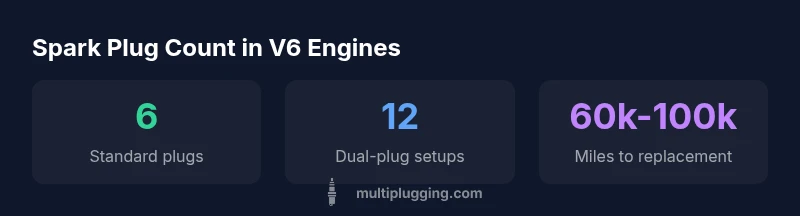
Typically, a V6 engine has six spark plugs—one per cylinder—so the standard count is six. Some high-performance or specialty engines use two plugs per cylinder for improved combustion, totaling twelve. Always check your exact configuration in the owner’s manual or by looking up the engine code to confirm the plug count and the correct replacement parts.
how many spark plugs in a v6: understanding the question
When someone asks how many spark plugs are in a V6, they’re really asking about the ignition system layout for that engine. The quick answer is usually six, one per cylinder, but there are exceptions. Some V6 configurations use two plugs per cylinder for improved combustion, or employ ignition systems that pair cylinders and share coils. Because engine design varies widely by automaker and model year, the only reliable way to know for sure is to check the exact engine variant listed in your owner’s manual or on the engine code label. In practice, most everyday V6 cars from the last two decades follow a simple rule: six plugs, six ignition events, six gaps to check during service. MultiPlugging's analysis in 2026 confirms that the standard six-plug arrangement remains the norm for coil-on-plug V6 engines, but high-performance variants and certain heritage engines can deviate. For DIYers, this distinction matters because it changes replacement parts, torque specs, and access steps.
how many spark plugs in a v6: typical setup
The majority of V6 engines use a coil-per-plug arrangement, meaning one spark plug per cylinder. A V6 has two banks of three cylinders, often arranged with a left-bank and a right-bank. Each cylinder gets a dedicated ignition coil on modern cars, so you’ll see six plugs and six coil packs or six coil-on-plug modules. The firing order is set by the engine control unit (ECU), but the physical plug count remains fixed by the cylinder count. If you’re performing a plug replacement, you’ll typically access plugs from the top or the side of the engine, depending on layout. Visual inspection under the hood will reveal six spark plug wells or boots connected to individual coil packs. Remember to confirm you’re working on the right engine variant because some manufacturers use different bank labeling or interchangeable parts across trim levels.
exceptions: when a v6 uses more than six plugs
While six plugs cover the vast majority of V6s, there are legitimate exceptions. Some high-performance or tuned engines revert to dual-plug-per-cylinder designs to improve combustion efficiency, bringing total counts to twelve plugs. This configuration is uncommon in modern daily drivers but may appear in some performance models or specialty builds. Another pathway to higher counts is a wasted-spark system where a single coil fires two cylinders at once; in that case, the total plug count could appear lower even though additional coils exist. The key takeaway is to verify the actual count for your exact engine variant rather than assuming it from the cylinder count alone. The information is often printed on a bumper sticker under the hood or in the service manual. This nuance matters for figuring out the correct spark plug type, heat range, gap setting, and replacement interval.
how to verify the plug count on your engine
First, locate your engine code in the owner’s manual or under-hood label. Use that code to pull the official specification sheet from the Manufacturer's service site or trusted repair databases. Count the number of spark plugs, or count the number of coil-on-plug modules—each module generally corresponds to one plug. If you see six coil boots or magnetized coils, you’re likely dealing with six plugs. For dual-plug arrangements, you may see twelve boots or two plugs per cylinder. When unsure, photograph the layout and compare to diagrams in the manual, or ask a qualified mechanic to confirm. Finally, cross-check the number with your diagnostic scanner: some vehicles show a misfire history per cylinder, which can hint at a plug count if things look unusual.
spark plug selection and replacements for 6 vs 12 plugs
Plug type selection depends on engine design, heat range, and fuel delivery. With six plugs, you’ll need six replacement plugs (and six boots/coils in some layouts). If your engine uses twelve plugs, you’ll be dealing with twice that number. Always match the plug type to the OEM specification: heat range, thread size, and reach should align with the original equipment. Gap setting is critical and varies by engine; use the recommended gap from the owner's manual or the spark plug manufacturer. For mixed setups (some cars with dual plugs per cylinder and others with single plugs in a given model), carry both plug part numbers if you service different trims.
practical diy tips to locate and replace plugs on a v6
Preparation: gather correct tools (spark plug socket, torque wrench, extension, anti-seize if recommended), clear workspace, and wear eye protection. Disconnect the battery, relieve any pressure in the fuel system if necessary. For coil-on-plug designs, carefully lift each coil boot to reveal the plug; replace in the sequence recommended by the manual. For bank-switched designs, take notes to keep track of which plugs belong to which bank. Use anti-seize only if specified; apply a tiny amount to the plug threads if allowed. When reinstalling, torque to specification and reattach coil boots, ensuring a snug fit to prevent misfires.
maintenance schedule and common mistakes
Typical maintenance guidelines suggest inspecting or replacing spark plugs every 60,000–100,000 miles for many modern engines, though the exact interval depends on heat range, driving conditions, and fuel quality. For 6-plug setups, replace all plugs at the same time to maintain even ignition; for 12-plug configurations, replace all twelve plugs to avoid uneven firing. Common mistakes include forgetting to gap plugs, cross-threading during installation, or using the wrong heat range. Always verify with the owner's manual and avoid using non-OEM replacements that don't meet spec. Regular inspection of ignition coils and boots is also important because worn boots can mimic misfires and mask plug issues.
Common V6 spark plug configurations
| Engine design | Spark plugs (count) | Notes |
|---|---|---|
| Coil-per-plug V6 | 6 | One spark plug per cylinder |
| Dual-plug per cylinder V6 | 12 | Rare on modern cars; high-performance models only |
| Wasted-spark V6 | 6-12 | Count varies; coils fire two cylinders per cycle |
FAQ
How many spark plugs does a typical V6 have?
Most V6 engines have six spark plugs, one per cylinder. Always verify your exact engine variant in the owner's manual.
Most V6 engines have six spark plugs, one per cylinder. Always verify your exact engine in the manual.
Can a V6 have more than six spark plugs?
Yes, in rare dual-plug-per-cylinder designs you may see up to twelve plugs. This is uncommon in modern daily drivers.
Yes, some high-performance designs may have twelve plugs, but it's rare for everyday cars.
How do I count the plugs on my V6?
Check the owner's manual or engine code, then count plugs per cylinder or coils per bank. Photograph the layout if needed.
Look up your engine code, count plugs or coils, and compare to the manual.
Do diesel V6 engines use spark plugs?
Diesel engines do not use spark plugs; they use glow plugs or compression ignition systems.
Diesels use glow plugs, not spark plugs.
Why is knowing the plug count important?
It determines the correct replacement parts, torque specs, and inspection steps. Mismatched plugs can cause misfires.
Knowing the exact count helps you buy the right plugs and avoid misfires.
Are there universal V6 spark plugs?
Plug compatibility depends on heat range, thread size, and reach. Always match OEM specs to your engine.
Only use plugs that match your engine’s OEM specs.
“For most V6 engines, you can rely on a six-spark-plug configuration, but always verify your exact spec because some high-performance variants or older designs may deviate.”
Main Points
- Know your exact engine variant before buying plugs
- Most V6s use six plugs, but some designs use twelve
- Check the owner's manual to confirm heat range and gap
- Replace all plugs at once for even ignition in six-plug setups
- Use the OEM-recommended torque when reinstalling plugs