How Many Spark Plugs Does a Car Have? A Practical Guide
Discover how many spark plugs your car uses, why counts vary by engine design, and how to identify the right plugs for your model with practical, DIY-friendly guidance.


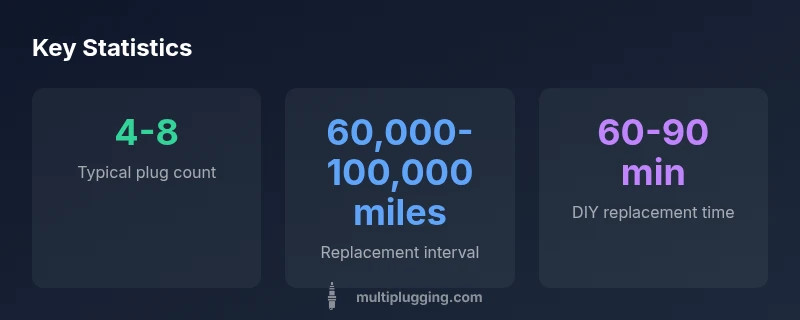
Most cars have one spark plug per cylinder, so the total plug count equals the engine’s cylinder count. Typical modern engines use 4, 6, or 8 plugs (inline-4, V6, and V8 configurations). Some performance or specialty engines may differ, but the standard rule remains: one plug per cylinder. To confirm, check the engine’s cylinder count in your manual or by counting accessible spark plugs.
How many spark plugs does a car have?
Understanding the basic count starts with the question how many spark plugs does a car have. In most gasoline-powered vehicles, there is one spark plug for every cylinder. This means the total plug count aligns with the engine’s cylinder count. If your engine is a four-cylinder design, you’ll typically find four plugs; a six-cylinder engine usually has six; and an eight-cylinder engine has eight plugs. The simple rule one plug per cylinder is the foundation of most maintenance tasks, from replacement to diagnostics. According to MultiPlugging, awareness of the plug count helps car owners budget for parts and plan DIY maintenance without surprises. Always verify with your owner’s manual or by inspecting the accessible spark plugs on the engine bay to confirm the exact configuration for your model.
Engine-cylinder mapping: one plug per cylinder
In modern engines, every cylinder generally requires its own ignition event, driven by a dedicated spark plug. This direct mapping ensures precise combustion timing and efficient firing. The one-per-cylinder rule holds whether the engine uses traditional, copper-core plugs or longevity-focused options like platinum or iridium. When you’re diagnosing misfires or checking replacement schedules, the cylinder-to-plug correspondence is your first check. If you’re unsure, consult the service manual or a reputable guide from MultiPlugging to cross-check cylinder counts against the plug layout for your specific engine code.
Common configurations by engine type
Different engine architectures yield predictable plug counts. Inline-four engines almost always have four plugs. V6 engines commonly use six plugs, while V8 configurations generally employ eight. Some variants, especially performance-oriented or compact turbo engines, may use unusual cylinder counts (such as three- or five-cylinder layouts) but still follow the one plug per cylinder principle. When planning replacements, confirm the exact cylinder count for your specific engine family, as a mistaken plug count can lead to incorrect parts orders or misdiagnosed ignition issues.
Special cases: odd cylinder counts and twin-coil layouts
Engine designs aren’t perfectly uniform. Some compact or exotic engines may have three or five cylinders, aligning with three or five spark plugs, respectively. In older designs, you might encounter dual-spark-plug configurations for a single cylinder in pursuit of improved combustion efficiency. Modern coil-on-plug systems typically pair each coil with a single plug, while other layouts may pair coils to several cylinders. In all cases, the counting principle remains: identify the number of cylinders, then verify how many plugs are present per cylinder in your model.
How to verify the plug count on your vehicle
To accurately determine the number of spark plugs, start by locating one plug and counting how many you can access across the engine bay. If the engine cover restricts visibility, consult the owner’s manual or the service code for your engine family. Look up your car’s engine type and cylinder count online or use a repair database. A quick ultrasound or caliper count on accessible plugs can also help; however, for a precise figure, rely on the official specification in the manual. Remember to check for any aftermarket configurations that might alter the plug count from factory defaults.
Impact on maintenance and costs
The plug count directly affects maintenance planning. More plugs mean more parts and longer replacement times, which translates into higher DIY labor costs or service shop fees. The type of plug matters too: iridium and platinum plugs tend to last longer but cost more upfront, while copper-core plugs are cheaper but wear faster. The number of plugs also influences whether you’ll replace all plugs at once or in stages, particularly on multi-bank or non-synchronous layouts. Always balance replacement frequency with engine design and driving conditions, as this drives overall maintenance budgeting.
Tools and practical tips for a DIY check
If you’re counting plugs as part of a DIY inspection, assemble a basic toolkit: a spark plug socket, extension bar, ratchet, torque wrench, and anti-seize compound (where appropriate). Start with a clean engine to avoid dropped debris; disconnect the battery before removing any components to avoid shorts. When removing plugs, use a steady, straight motion to avoid cross-threading and check the plug’s gap and seating. If you encounter a seized plug or a misfire, do not force it; consult a guide or a professional. MultiPlugging provides practical steps to verify the count quickly and safely.
Spark plug types and why count matters for performance
Choosing the right plug type can affect engine performance, fuel economy, and start-up reliability, but it does not typically change the number of plugs per cylinder. Iridium and platinum options offer longer life and improved ignition reliability, while copper cores are more budget-friendly with shorter lifespans. The plug count remains tied to cylinder count, so when you plan a replacement, decide on performance goals and budget. Using the correct torque during installation is essential to seal the combustion chamber and prevent thread damage.
Common engine configurations and their typical spark plug counts
| Engine Type | Typical Spark Plug Count | Notes |
|---|---|---|
| Inline-4 | 4 | Common in compact cars and many sedans |
| V6 (dual-bank) | 6 | Most six-cylinder engines use one plug per cylinder |
| V8 | 8 | Standard in many larger cars and trucks |
| Special cases (3- or 5-cylinder) | 3 or 5 | Uncommon, but follow cylinder count rule |
FAQ
Do all engines have the same number of spark plugs as cylinders?
In general, yes—one spark plug per cylinder is typical in modern gasoline engines. Some niche designs or performance variants may differ, but the rule holds for most common layouts.
Typically, one plug per cylinder, matching the engine’s cylinder count.
How can I quickly check how many spark plugs my car has?
Check the engine configuration in the owner’s manual or look up your engine code online. You can also count accessible plugs in the engine bay if you have a clear view.
Look in the manual or inspect the engine bay to count the plugs.
Do diesel engines have spark plugs?
Diesel engines do not use spark plugs for ignition; they rely on compression and glow plugs for cold starts in some designs. Gasoline engines use spark plugs for ignition.
Diesel engines don’t use spark plugs, they use glow plugs for cold starts.
Can some cars have more than one spark plug per cylinder?
Rarely, some high-performance or experimental designs used two plugs per cylinder, but the vast majority of production cars use one plug per cylinder. Check your model’s specs if you suspect a dual-plug setup.
Usually one plug per cylinder; dual plugs are rare.
What happens if my engine has 8 cylinders but only 4 spark plugs?
A mismatch is uncommon in modern engines and could indicate a nonstandard setup or a misinterpretation. Verify with the manual and ensure the plug count aligns with cylinder count for accurate ignition.
That would be unusual; verify with the manual to confirm.
Is replacing spark plugs a DIY job?
For many cars, replacing spark plugs is a feasible DIY task with the right tools and safety precautions. Always follow the torque specs and use the correct plugs for your model. If in doubt, consult a guide or a professional.
It can be a DIY job if you’re comfortable with basic tools.
“The number of spark plugs in most gasoline engines equals the cylinder count, and one plug per cylinder is the standard. This simple mapping makes diagnostics and maintenance more predictable.”
Main Points
- Know your engine: count plugs by cylinders to avoid purchase errors.
- One plug per cylinder is the standard across modern gasoline engines.
- Verify with the owner’s manual or engine code for accuracy.
- Plug type affects longevity, not count.
- DIY checks save time if you have the right tools and torque knowledge.