How Many Spark Plugs Come in a Pack: A Practical DIY Guide
Discover how many spark plugs come in a pack, typical pack sizes for cars and lawn equipment, and how to choose the right quantity. A practical, data-driven guide by MultiPlugging for DIY enthusiasts.


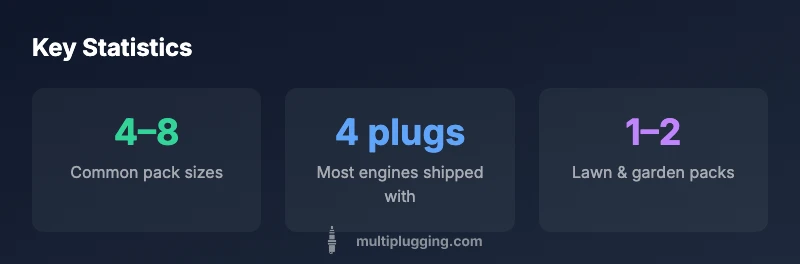
The typical spark plug pack sizes are 4, 6, or 8 plugs. For most four-cylinder cars, a 4-pack is standard; six- and eight-cylinder engines usually require 6-pack or 8-pack sets, respectively. Some lawn and small engines may be sold in 1- or 2-plug packs. Always verify the exact count from your vehicle’s service manual or OEM part diagram.
Understanding why spark plug packs vary across engines
If you're exploring how many spark plugs come in a pack, you’ll quickly learn that there isn’t a universal answer. Pack counts reflect engine design, ignition architecture, and how manufacturers package replacement parts for service intervals. In practice, you’ll see common pack sizes of four, six, or eight plugs, with occasional 1- or 2-plug packs for smaller engines or specialized tools. The Four-cylinder layout naturally calls for four plugs, while inline six and V6 or V8 configurations align with six- or eight-plug packs. The MultiPlugging team notes that these patterns help technicians plan inventory and maintenance schedules across most mainstream vehicles. To avoid buying the wrong quantity, confirm the engine’s cylinder count and check the OEM diagram before placing an order.
Common pack sizes you’ll encounter
When you shop for spark plugs, you’ll notice several standard pack counts. The most common are 4-pack, 6-pack, and 8-pack, which roughly map to 4-, 6-, and 8-cylinder engines. For lawn mowers, snow blowers, and other small engines, it’s not unusual to find 1- or 2-plug packs. There are occasional specialty packs in odd counts (such as 5- or 7-plug sets) sold by particular retailers or for unique engine configurations, but these are comparatively rare. If you own multiple vehicles or engines, stocking a few 4-packs as a baseline is a practical approach; for larger engines, keep packs that align with the cylinder count to streamline replacements and avoid overbuying. Always compare the exact count on the product label with your vehicle’s service manual to ensure you’re purchasing the correct quantity.
Engine-by-engine guide: matching packs to cylinder counts
The simplest rule of thumb is to match the pack count to the engine’s cylinder count. A 4-cylinder car commonly uses a 4-pack, a 6-cylinder sedan or SUV often requires a 6-pack, and an 8-cylinder powerhouse typically uses an 8-pack. Some performance or longitudinally mounted engines use staggered configurations where service procedures prefer two identical 4-plug packs, replacing half at a time. Always verify: (1) the cylinder count, (2) the ignition system design, and (3) the OEM part diagram. In rare cases, some engines may require special plug gaps or wire configurations, which can influence packaging, so consult the service manual or a trusted parts retailer. By following these checks, you’ll avoid returning unopened packs or paying for plugs you won’t use.
Special cases: irregular engines and unusual configurations
Not every engine follows a neat 4/6/8 pattern. Some compact cars use 5-feature engines with a mixed cylinder layout, and certain enthusiasts or race kits may use odd pack counts. More importantly, diesel engines typically do not use spark plugs; they rely on glow plugs or other ignition methods. If you’re shopping for a diesel, the pack size you need may be different or the product category may be glow plug-specific. In any case, always check the exact OEM specification for your engine, because even within a single model year, there can be variations in plug type, gap, and packaging. Don’t guess—verify against the parts diagram and consult the retailer’s compatibility tool.
How to verify the correct pack size before you buy
A quick, reliable verification process helps you avoid costly misorders. Start with these steps: (1) identify the engine’s cylinder count from the owner’s manual or under-hood label; (2) locate the OEM spark plug diagram for your exact model; (3) examine the product packaging to confirm the number of plugs per pack; (4) cross-check the replacement part number on the packaging with the OEM part number; (5) if you’re unsure, ask a parts specialist for confirmation. Taking 5 minutes to confirm the pack size saves time and money, especially for cars with multiple engines or older configurations.
Spark plug types and how they relate to pack counts
The pack count you buy doesn’t usually depend on plug material—iridium, platinum, copper, or a nickel alloy, the count is driven by engine design and maintenance practices. Iridium and platinum plugs may offer longer service intervals, but they come in the same typical pack sizes as copper variants. When planning replacements, remember that higher-performance plugs can be pricier per plug, which may influence how many you want to stock. If you’re stocking a workshop or preparing for a multi-vehicle maintenance day, a mix of 4-, 6-, and 8-pack options will cover most scenarios without tying up too much capital.
Shopping tips: reading labels, part numbers, and warranties
Read product labels carefully to verify the pack count and plug size. Look for the exact engine compatibility note and cross-reference with the OEM part number in your vehicle’s manual. Some retailers list multiple variants; ensure the pack you select matches both the engine cylinder count and the plug type (heat range, thread size, and gap). Check warranty terms—plugs are typically covered for manufacturing defects, but consumer misuse can void coverage. If you’re replacing plugs across multiple vehicles, a small assortment of 4-, 6-, and 8-pack packs is a practical baseline, paired with a clear labeling system.
Maintenance planning: budgeting for plugs and future replacements
Budgeting for spark plug replacement involves more than the per-plug price. If you replace all plugs at once, total costs scale with the pack size you choose. Stocking standard packs (4, 6, 8) makes future replacements predictable and reduces last-minute trips to the parts store. Consider your driving style and maintenance cadence; vehicles with high-mileage or performance-oriented usage may warrant more frequent changes, which makes an efficient pack strategy valuable. For DIY beginners, starting with a few 4-packs and a couple of 6-packs can cover most scenarios, then expand as you service additional vehicles.
Practical checklist: avoid common mistakes when buying spark plug packs
- Verify cylinder count and engine type before ordering
- Read the product label to confirm the number of plugs per pack
- Cross-check OEM part numbers against your vehicle’s diagram
- Don’t mix plug types or heat ranges within the same engine
- Keep a small stock of 4-, 6-, and 8-pack packs for multi-vehicle service
- Remember that lawn and garden engines often use smaller packs than cars
Pack sizes by engine configuration
| Engine Type | Typical Pack Size | Notes |
|---|---|---|
| 4-cylinder car | 4 plugs | Most common |
| 6-cylinder car | 6 plugs | Common in mid-size |
| 8-cylinder car | 8 plugs | Classic V8 |
| Lawn mower/small engine | 1-2 plugs | Rare to have more |
FAQ
What is the typical pack size for a 4-cylinder car?
For most four-cylinder cars, a 4-pack is standard. Always confirm with the owner's manual or OEM diagram.
Most four-cylinder cars use four plugs per pack.
Are 5- or 7-pack options common?
Five- or seven-pack options are uncommon and usually offered by niche retailers for specific engine configurations. The standard counts remain 4, 6, and 8.
Five and seven packs are rare; stick to 4, 6, or 8 when possible.
Should I replace all plugs at once or stagger replacements?
If the engine is due for replacement based on age or mileage, replacing all plugs at once maintains performance balance and simplifies maintenance.
Replacing all plugs at once keeps performance balanced.
Do lawn mowers use the same pack sizes as cars?
Lawn mowers and small engines typically use 1–2 plug packs, though some models may differ. Always check the OEM diagram for your specific model.
Most small engines use 1–2 plugs per pack.
How can I quickly confirm the pack size for my vehicle?
Check the engine’s cylinder count in the manual, locate the OEM spark plug diagram, and verify the number of plugs per pack on the product label.
Check the manual and product label to confirm pack size.
Do different spark plug materials affect pack size?
No. Iridium, platinum, or copper plugs come in the same standard pack sizes; the engine dictates the count, not the material.
Plug material doesn’t change how many you need per pack.
“Choosing the right pack size is about aligning replacement cadence with your engine’s cylinder count and service schedule.”
Main Points
- Pack sizes cluster around 4, 6, or 8 plugs
- Always verify pack size before purchase
- Lawn equipment often uses smaller packs
- Diesel engines may differ from spark plug pack norms