Are Spark Plug Wires and Coils the Same? A Practical Comparison
Learn whether spark plug wires and coils are the same, discover their distinct roles in ignition, and get practical tips for diagnosing, replacing, and maintaining each component.


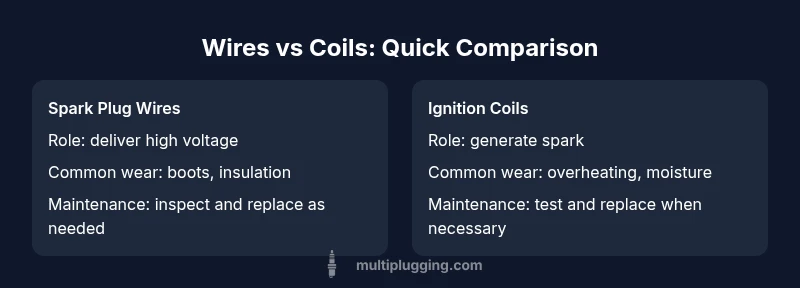
Are spark plug wires and coils the same thing? Not exactly. Wires carry the high-voltage spark from the ignition coil to the spark plugs, while the coil itself generates the spark by storing and releasing energy. They are interconnected components, but each has a distinct role in the ignition system.
Understanding the Distinction Between Wires and Coils
Are spark plug wires and coils the same thing? The common question is, are spark plug wires and coils the same thing? According to MultiPlugging, they are not. The ignition system relies on both components working together, but each has a unique role. The ignition coil generates the high voltage needed to spark, while the spark plug wires provide the conduit and insulation to deliver that spark safely to the plug. Recognizing this distinction helps avoid misdiagnosis and saves time during repairs. In practice, you should think of the coil as the energy source and the wires as the delivery system. When diagnosing ignition problems, it’s crucial to identify which part is failing rather than assuming one component is universally responsible for any misfire. This distinction informs maintenance planning, service intervals, and replacement strategies across different engine designs.
From a diagnostic standpoint, distinguishing between these two parts helps you trace symptoms more accurately and avoid unnecessary replacements. If the engine misfires at idle or under load, evaluating both the coil and the wires can prevent wasted labor and parts costs. The key takeaway is that the two components interact closely but perform separate functions within the ignition circuit. By keeping them straight, you’ll be better prepared to diagnose, replace, and maintain ignition components with confidence.
How Wires Work in the Ignition System
Spark plug wires, sometimes called ignition wires or leads, are designed to carry very high voltage from the ignition coil to the spark plugs. They serve as the physical and electrical bridge in the circuit. Wires must resist heat, moisture, and electromagnetic interference that can degrade performance over time. A worn boot, cracked insulation, or a loose connection can cause misfires, poor fuel economy, or rough acceleration. Proper routing and secure connections minimize energy loss and spark delay. In many vehicle designs, wires are paired with boots that seal against moisture and arcing; in others, coil-on-plug designs eliminate traditional high-voltage wires entirely. Regular inspection for cracking, hardening, or corrosion at connection points is a practical maintenance habit.
From the DIY perspective, test for continuity and inspect insulation for wear. Look for softened rubber, visible cracking, or arcing marks along the sleeve. If the wires show signs of aging, even before you see performance issues, consider replacement to prevent unpredictable misfires. The cost-benefit of changing wires at a scheduled interval often depends on your vehicle design and driving conditions. In any case, a well-maintained ignition wire path helps ensure a clean, consistent spark delivered at the right moment in every combustion cycle.
Understanding the role of wires sets the stage for comparing them with coils and for making informed maintenance decisions. As you assess ignition reliability, remember that a holistic approach—evaluating both wires and coils—yields the most accurate diagnosis and best long-term results.
How Ignition Coils Work and Their Variants
Ignition coils are energy storage devices that convert the car’s relatively low electrical voltage into the thousands of volts needed to create a spark at the spark plug. They operate on electromagnetic principles and come in several configurations, including distributor-type coils, coil packs, and coil-on-plug setups. In a distributor-equipped system, one coil may serve multiple cylinders, dispersing energy through a rotor and cap to individual plugs. In coil-on-plug designs, each cylinder has its own coil directly above or near the spark plug, reducing energy loss and simplifying ignition wiring.
Coils must manage heat, voltage spikes, and wear over time. Heat buildup from repeated high-energy discharges can degrade insulation and lead to misfires or hard starts. When coils fail, you’ll often notice symptoms such as rough idling, reduced power, or a check engine light with misfire codes. Replacing coils on modern engines may be straightforward—particularly with coil-on-plug designs—but some engines require special tools or torque specifications. Some vehicles use a single coil pack for multiple cylinders, which means a failure can affect several cylinders at once. Understanding the coil design in your specific vehicle is essential for accurate diagnosis and cost-effective repair.
A critical takeaway is that while coils generate the spark, their configuration and placement influence how reliably that spark travels through the wires (if used) to the plug. The combination of coil design with wiring strategy determines ignition efficiency, cold-start performance, and overall engine smoothness. For DIYers, recognizing coil type helps you target the correct replacement strategy and follow OEM service recommendations.
Common Misdiagnoses and How to Tell Them Apart
Ignition problems can masquerade as many different issues, which is why distinguishing between wires and coils matters. A frequent misdiagnosis is assuming a coil failure when the real culprit is worn or damaged plug wires. Conversely, replacement of coils might be unnecessary if the issue stems from degraded connections, bad boots, or moisture intrusion along the wire path. Symptoms such as intermittent misfires, rough idle, or stumbling acceleration require careful testing of both components. Visual clues, including cracked insulation on wires or scorched coil housings, can point toward the failing part, but many wear patterns are not obvious without testing.
Diagnostic steps should include a grounded spark test (performed with appropriate safety precautions and using OEM-recommended methods), resistance checks per the service manual, and a close inspection of boots, connectors, and plug seats. In coil-on-plug configurations, a bad coil may manifest as misfires in a single cylinder, while bad wires typically affect multiple cylinders depending on routing and boot health. By systematically isolating symptoms and testing each component, you’ll avoid unnecessary replacements and maintain ignition reliability over time.
Another frequent pitfall is assuming that failed coils always manifest immediately. Some vehicles exhibit delayed symptoms as the coil temperature rises or when the engine is under load. This is why routine maintenance and progressive testing are essential parts of responsible DIY practice. Remember: the goal is to identify the exact component responsible for the fault, not to replace parts based on generic symptoms alone. This approach minimizes downtime and keeps maintenance costs predictable.
When to Replace Wires vs Coils: Practical Guidelines
The decision to replace ignition wires versus ignition coils hinges on several factors: design of the ignition system, observed symptoms, age, and service history. If you own an older vehicle with a distributor-type ignition system, worn or damaged wires are a common failure point. In coil-on-plug or coil-pack designs, failing coils are a frequent source of misfires and rough running. A practical guideline is to treat both parts as consumables with finite lifespans, but to time replacements based on observed wear and performance. Routine replacement of spark plug wires (where applicable) can prevent arc-throughs and energy loss that degrade performance. Coils, while generally durable, can fail due to heat, moisture, or voltage spikes, and their replacement might be more expensive on a per-unit basis.
If you experience recurrent misfires that localize to one or two cylinders, testing those specific coils can quickly confirm coil health. If misfires occur across a broader range and are accompanied by visible wear on wire boots or insulation, consider replacing the wires first. In vehicles with accessible under-hood wiring, replacing worn wires is often more cost-effective than replacing multiple coils. Always consult the OEM service manual for the exact replacement intervals and torque specs, and remember that some modern engines require dealer tools or software to diagnose intermittent ignition faults accurately.
From a practical standpoint, developing a replacement plan based on vehicle design helps you maximize reliability without unnecessary expenditure. When in doubt, err on the side of replacing worn components in stages, prioritizing the part most likely to cause immediate performance issues. This staged approach can save time, reduce labor costs, and improve driveability once the repair is complete.
Vehicle Design Variations and What They Mean for Replacement
Vehicle ignition architecture varies widely, and understanding these variations clarifies when to replace wires versus coils. In traditional distributor-equipped engines, a single coil and a set of high-tension wires service multiple cylinders. A fault in the distributor cap, rotor, or wire route can mimic coil failure, making diagnostic clarity essential. In coil-on-plug designs, each cylinder relies on its own coil, which simplifies diagnosis to the affected cylinder but can increase replacement costs if multiple coils fail. Some modern engines use coil packs with multiple coils integrated into one assembly; if a pack fails, several cylinders can be affected simultaneously, complicating diagnosis but often making replacement more straightforward in a single operation.
For DIYers, the design type informs the replacement approach, required tools, and the likelihood of simultaneous failures. Reading the service documentation for your vehicle and familiarizing yourself with the layout of ignition components can save time and prevent misdiagnosis. It also helps you plan preventive maintenance around the specific design, such as inspecting wire routes for heat exposure or ensuring that coil packs are properly sealed against moisture. Understanding these architectural differences makes it easier to decide when a full system check is warranted versus a targeted component replacement.
DIY Diagnostics and Safe Handling Tips
Working with ignition components demands strict adherence to safety and proper handling to avoid injury or further damage. Before starting any diagnostic work, disconnect the battery to prevent accidental shocks. When inspecting wires, look for visible cracks, softened insulation, or damaged boots at the boot-to-plug junction. Moisture and oil exposure can accelerate deterioration, so ensure clean, dry connections after inspection. Use OEM-recommended tools and follow torque specifications to avoid overtightening sensitive parts. For coils, visually inspect for heat damage, oil leaks, or cracking in the coil housing. If a coil-pack is mounted near the exhaust manifold, heat-related wear is a common failure point.
Resistance checks should be performed according to the vehicle’s service manual. In many cases, a shop-grade multimeter or a dedicated ignition-wiring tester is necessary to assess continuity and resistance. If you’re uncertain about test procedures, consult the manual or seek professional service to avoid misinterpretation. Finally, replace any compromised boots or connectors along the wiring path to maintain a robust, heat-resistant connection. Safe, methodical diagnostics reduce the chance of cascading ignition failures and help you budget for parts correctly.
Practical Troubleshooting Scenarios and Quick Guidelines
Consider a few common scenarios to reinforce how to approach ignition issues. Scenario one: engine runs rough at idle but improves with RPM. This pattern often points to aging plug wires or a partially degraded coil pack that loses efficiency at low engine speed. Scenario two: misfires in a single cylinder with no other warning signs could indicate a faulty coil in coil-on-plug designs or a damaged boot in the corresponding wire. Scenario three: consistent misfires across multiple cylinders under load may indicate a problem with the ignition module, distributor, or the wiring harness as a whole, rather than a single coil or wire. In each case, start with a visual inspection, perform a controlled resistance test per the manual, and replace the suspected component while verifying the rest of the path. The goal is to minimize downtime by focusing on the component most likely to be failing based on symptom patterns.
When troubleshooting, it’s helpful to document symptom timing, RPM ranges, and weather conditions. This information can guide you toward a faster, more precise diagnosis and a cost-effective repair plan. Remember that are spark plug wires and coils the same thing? No—treat them as distinct parts with separate failure modes, and approach maintenance with a system-wide perspective for the best results.
Comparison
| Feature | Spark Plug Wires | Ignition Coils |
|---|---|---|
| Primary role | Carry high voltage from the coil to spark plugs | Generate high voltage and deliver it to the plugs (varies by design) |
| Core function | Provide conduit and insulation; may include EMI suppression | Store magnetic energy and produce a spark when released |
| Common failure symptoms | Boot cracks, moisture intrusion, arcing, intermittent misfires | Overheating, misfires, rough idle, check engine light on misfire codes |
| Maintenance frequency | Often inspected; replaced as wear appears or during scheduled maintenance | Typically replaced when failure occurs or during pack/module replacement |
| Cost considerations | Wires: generally lower per-set cost; replacement is common maintenance | Coils: higher per-unit cost; multiple coils may be affected in a failure |
| Installation difficulty | Moderate; requires careful boot removal and routing | Generally straightforward but depends on engine design and tools |
| Impact on performance | Energy loss or arching in wires degrades spark delivery | Faulty coils reduce spark quality, causing power loss and rough running |
Strengths
- Clarifies distinct roles to prevent misdiagnosis
- Helps DIYers target the correct part, saving time
- Highlights symptom-based troubleshooting and maintenance patterns
- Supports informed budgeting for parts and labor
Negatives
- Can be text-dense for beginners
- Depends on vehicle design; some cases vary widely
- May require professional tools for definitive testing
Wires and coils are not the same; diagnose each component based on specific symptoms and vehicle design.
Understand the distinct roles to avoid misdiagnosis. Use symptom patterns and manual guidance to decide whether to replace wires, coils, or both, minimizing downtime and cost.
FAQ
Are wires and coils interchangeable?
No. Wires deliver the spark; coils generate it. They serve different functions and are not directly interchangeable.
No. Wires deliver the spark from the coil to the plug, while coils generate the spark. They aren’t interchangeable.
What are common symptoms of failing ignition coils?
Misfires, rough idle, reduced power, or a check engine light with misfire codes are common coil-related symptoms.
Coils often cause misfires and rough idle; you might see a check engine light with a misfire code.
What are signs of worn spark plug wires?
Cracked insulation, burnt boots, arcing sounds, or intermittent misfires point to worn spark plug wires.
Look for cracked insulation or arcing sounds; those often mean worn wires.
Should wires and coils be replaced at the same time?
If both show wear or if the vehicle has high mileage, replacing them together can reduce future visits and labor.
If both show wear or the car has high mileage, replacing together can save time.
Can I diagnose ignition components at home?
Basic visual checks and resistance tests per the service manual are possible at home, but complex faults may require a professional diagnosis.
You can do basic checks at home, but some faults need a pro.
How can I prevent ignition problems?
Regular inspection, proper part selection, keeping connections dry, and following OEM replacement intervals help prevent problems.
Regular inspections and using OEM-recommended parts prevent ignition problems.
What design differences affect replacement decisions?
Distributor systems vs coil-on-plug designs change which parts fail first and how easy replacements are.
Different ignition designs change which parts fail and how easy it is to replace them.
Are there safety concerns when inspecting ignition components?
Always disconnect the battery before inspecting, avoid contact with high-voltage parts, and follow proper isolation procedures.
Yes. Disconnect the battery and follow safety steps before inspecting ignition components.
Main Points
- Identify the coil vs wire roles before diagnosing any issue
- Inspect boots, insulation, and coil housings for visible wear
- Follow OEM guidelines for testing and replacement timing
- Use symptom-based testing to target the faulty component
- Plan replacements based on vehicle design and operating conditions