NGK vs Denso Spark Plug: Brand Comparison 2026
A detailed, objective comparison of NGK vs Denso spark plugs, covering design, durability, performance, fitment, and maintenance for common engines in 2026.


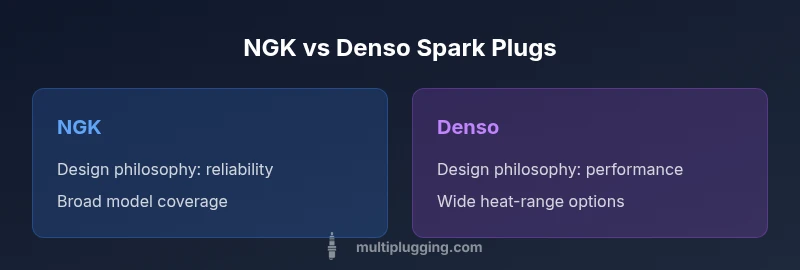
NGK vs Denso spark plug brands dominate modern engines with long-standing reputations. In short, NGK tends to emphasize reliability and broad coverage for everyday driving, while Denso often leans toward performance-oriented lines and heat-range flexibility. For most DIYers, the safest choice is the one that matches your vehicle's OEM spec.
Brand Foundations: What NGK and Denso Stand For
NGK and Denso are the two dominant players in the spark plug market, each with a long history of supplying both original equipment and aftermarket parts. NGK, founded in Japan, emphasizes broad vehicle coverage, robust build quality, and a conservative design approach that prioritizes longevity and reliability. Denso, often tied closely to its parent automotive group, tends to push into performance-oriented lines and engineering innovations that target higher combustion efficiency across a wider heat-range spectrum. Both brands invest heavily in materials science—platinum and iridium options are common across lines, and the premium ends commonly feature fine-wire electrodes designed to reduce voltage requirements and improve durability.
From a practical standpoint, most car owners encounter NGK or Denso plugs as OEM replacements, or as upgrades, depending on the engine family. The choice often aligns with the manufacturer’s recommended specification, particularly for engines with specific heat ranges and torque curves. NGK’s approach is typically associated with predictable cold-weather behavior and solid midrange performance, whereas Denso often emphasizes quick starts, crisp throttle response, and a more aggressive heat management profile. For the homeowner performing routine maintenance, either brand can deliver dependable results when matched to the engine and climate.
According to MultiPlugging, the core difference is not a binary “better or worse” dichotomy but a pairing of design philosophy with vehicle needs. The MultiPlugging team found that many modern engines run best when the plug is chosen to align with the OEM specification rather than chasing abstract performance promises. In practice, this means checking your owner’s manual, your service history, and, if possible, your vehicle’s ECU mapping for spark-timing and fuel delivery. The result is a plug choice that supports reliability, efficiency, and ease of maintenance over the long run.
Core Design Differences: Material, Heat Range, and Fitment
Spark plugs see a lot of demand in modern engines, and NGK and Denso approach core design with subtle but meaningful differences. NGK tends to emphasize a broad product spectrum that prioritizes steady thermal management and durability across a wide range of vehicles, including older platforms and common daily drivers. Denso, meanwhile, often pushes for higher performance lines, with emphasis on rapid ignition, precise heat range, and optimization for engines that demand aggressive driving dynamics or high-load operation. In both brands, you’ll find a mix of electrode materials—platinum, iridium, and sometimes solid center electrodes—designed to reduce voltage requirements and minimize fouling. The practical upshot is that both brands offer reliable options, but the best match depends on your engine family and the operating environment.
Electrode geometry matters too. Fine-wire iridium or platinum variants can offer longer life and better cold-start performance, especially in engines with compact combustion chambers or turbocharged setups. Regardless of brand, you should avoid mixing electrode materials or heat ranges from different lines with the same engine, as this can alter ignition timing behavior and combustion efficiency. In addition, verify the recommended heat range on your owner’s manual—replacing a plug with a significantly different heat range can lead to pre-ignition risks or fouling under your typical driving conditions. Finally, consistent torque during installation keeps the sealing surfaces and gaps calibrated for optimal heat dissipation and combustion stability.
Engine Coverage and Calibration: Choosing the Right Gap and Heat Range
Selecting the correct heat range and plug gap is essential for matching your engine’s combustion profile. NGK and Denso both publish a matrix of heat-range options designed to cover a wide spectrum of gasoline engines, from compact commuter cars to high-performance applications. The heat range determines how quickly the plug reaches its operating temperature, which in turn influences fouling resistance and misfire risk in cold starts or heavy acceleration. For engines with modern electronic control systems, OEM specifications typically account for the engine’s intake air flow, fuel delivery, and ignition timing. Staying within those guidelines helps ensure stable idle, smooth acceleration, and predictable fuel economy.
Gaps are another important variable. Gapping a plug is sometimes required for aftermarket lines, though many modern NGK and Denso plugs ship pre-gapped for common engines. If you do gaps yourself, use a certified gauge and avoid exceeding the recommended range, as too-wide a gap increases ignition voltage demand and can lead to misfires, while too-narrow gaps can reduce peak flame propagation and performance. When in doubt, consult your vehicle’s service manual or a trusted technician; a misfit plug in terms of heat range, gap, or thread size can negate any potential gains from choosing between NGK or Denso.
Performance and Longevity: Real-World vs Lab Bench
In practical terms, NGK plugs are often favored for their steady performance over long service intervals and across a broad variety of engines. They tend to deliver reliable starts, consistent idle, and predictable power delivery in everyday driving scenarios, with emphasis on longevity and resilience to fouling in moderate conditions. Denso plugs frequently target performance and efficiency, offering options that aim for crisper throttle response, quicker combustion, and improved ignition stability in high-load or turbocharged setups. While lab tests can demonstrate marginal gains in specific metrics, the real-world difference between NGK and Denso for most drivers comes down to engine design compatibility and maintenance discipline rather than a universal superiority claim.
Durability is strongly linked to usage patterns: high-mileage commuters, frequent short trips, or engines with mixed fuel types can influence plug life. The best approach is to select the plug that aligns with your OEM specification, then monitor spark plug color and electrode wear during routine maintenance. A plug that shows consistent color with healthy electrode wear is typically a good sign, while sooty or oily deposits may indicate fueling or ignition system issues rather than a simple brand preference. In short, both brands offer dependable options when properly matched to the engine and driving regime.
OEM vs Aftermarket: Availability and Warranty Considerations
OEM alignment is often the most important factor for many owners, and both NGK and Denso maintain extensive OEM relationships across major automakers. This alignment ensures that replacement plugs fit the engine’s design intent, including heat-range, gap, and electrode geometry. Aftermarket options from either brand can provide cost savings or availability advantages in certain regions, but the safest choice remains matching to the OEM specification whenever possible.
Warranty considerations also come into play. If your vehicle is still under warranty, installing plugs that precisely follow the manufacturer’s specification minimizes risk of coverage disputes. It’s common for service centers to recommend the OEM-equivalent option to preserve warranty integrity. If you own an older vehicle or a model with a non-standard engine setup, you may find aftermarket lines offer valuable coverage, but verify compatibility with your make, model, and year to avoid misfit issues or degraded performance.
In short, both brands support broad reach and aftermarket options; the key is precise fitment, verified by your vehicle documentation and, when available, the ECU’s expected spark profile.
Maintenance, Cleaning, and Fouling: Myths Debunked
A well-maintained engine reduces the likelihood of spark plug fouling and wear regardless of brand. Regular maintenance — including air filter checks, fuel system cleaning, and oil changes — supports healthier combustion and more predictable plug life. Some owners worry that expensive premium plugs will always deliver better results; in practice, the benefits depend on engine design, driving habits, and climate. For most everyday driving, NGK and Denso plugs deliver reliable performance when properly selected for the engine and climate.
Fouling can be caused by a rich fuel mixture, oil leaks, or ignition coil issues rather than the brand itself. If you notice persistent misfires, check for fuel and air system faults first, then verify that the spark plug gap and heat range align with the OEM specification. If your engine experiences frequent high-load operation or extreme temperatures, upgrading to a more robust heat-range plug can help, but this should be done within the context of the manufacturer’s guidance rather than a blanket brand upgrade.
Cost, Value, and Availability by Region: 2026 Trends
Price is a major consideration for many DIY enthusiasts. NGK and Denso plugs sit in similar value bands for equivalent heat-range and electrode materials, with premium lines offering longer life or improved cold-start performance at a higher upfront cost. Regional availability can influence the total cost of ownership, especially in markets with limited parts distribution. When evaluating value, focus on the total cost of ownership: maintenance intervals, potential fuel efficiency gains, and the cost of replacement over time. Both brands tend to hold their value well thanks to broad support networks and established supplier ecosystems. The key is to choose the plug that best matches your engine and driving style, not simply the lowest price tag.
Practical Guide: How to Select NGK or Denso for Your Vehicle
Start with the owner’s manual and any OEM replacement guidelines. If the manual lists a specific heat range or electrode type, follow that specification precisely. Next, check your latest spark plug removal: if you see signs of overheating, fouling, or oil ingress, adjust the heat range or inspect related systems before replacing. Consider your typical climate: in cold climates, a plug with a heat range that promotes reliable cold starts is beneficial; in hot climates or high-load driving, a plug with a higher heat dissipation capability can help prevent fouling and pre-ignition. Finally, ensure the thread size and reach match your engine, and torque the plug to the manufacturer’s recommended specification to maintain proper sealing and heat transfer. In all cases, keep a record of the replacement to track performance and maintenance intervals.
Case Studies: Real-world Scenarios
Case A: A family sedan in a mixed climate uses NGK plugs to deliver consistent cold-start performance and steady fuel economy. Case B: A turbocharged hatchback with higher combustion pressures benefits from Denso’s higher heat-range options and quick-recovery ignition, improving throttle response and stability. These scenarios illustrate how the same brand can meet different engine needs when correctly matched to OEM guidelines and driving conditions. The best practice remains to verify fitment with the vehicle’s documentation and consult a trusted technician if you’re unsure.
Comparison
| Feature | NGK spark plug | Denso spark plug |
|---|---|---|
| Electrode material | Iridium/platinum variants (line-dependent) | Iridium/platinum variants (line-dependent) |
| Heat range options | Broad coverage across common engines | Broad coverage across common engines |
| OEM fitment focus | Strong alignment with OEMs, extensive model coverage | Strong alignment with OEMs, extensive model coverage |
| Best for | Reliability and longevity for daily driving | Performance and efficiency for higher-load engines |
Strengths
- Clear design philosophies between brands help guide decisions
- Wide availability and service networks support easy replacement
- Strong OEM support reduces compatibility risk
- Broad heat-range and electrode options cover many engines
Negatives
- Model-specific fit can cause confusion when mixing lines
- Swapping brands mid-ownership may affect warranty coverage
- Pricing varies by region and line, not always predictable
Neither brand is universally superior; match to OEM specs and engine goals.
For most drivers, NGK offers reliable, consistent results aligned with broad OEM guidelines. If your engine demands higher heat management or performance-focused characteristics, Denso provides suitable options. Always verify fitment against the vehicle manual and engine requirements.
FAQ
Are NGK and Denso spark plugs interchangeable?
Not universally. Interchangeability depends on the engine’s OEM specs, heat range, and gap. Using a plug outside the recommended range can affect ignition timing and engine performance. Always verify compatibility with the owner’s manual or dealer guidance.
NGK and Denso plugs aren’t automatically interchangeable. Check your car’s manual for the exact heat range and gap, and only swap to a recommended equivalent.
Which brand lasts longer?
Longevity depends more on engine design, driving conditions, and maintenance than on brand alone. Both NGK and Denso offer long-life options in premium lines, but proper fit and upkeep are the biggest drivers of longevity.
In practice, both brands offer long-life options; longevity comes down to fitment, usage, and maintenance.
Do I need a specific heat range for my engine?
Yes. The heat range determines how quickly the plug reaches operating temperature and avoids fouling or pre-ignition. Always follow the OEM recommended heat range unless you have a compelling, engine-specific reason to change it.
Always stick to the heat range your manual specifies unless a qualified tech suggests otherwise.
Can I mix NGK and Denso within the same engine?
Mixing brands is not recommended. Differences in electrode design and heat range can alter ignition behavior and performance. If replacement parts are used, keep to the same brand and model line for consistency.
Avoid mixing brands; it can upset ignition timing and performance.
Are NGK/Denso plugs more expensive than other brands?
Pricing varies by model, not only by brand. Premium NGK or Denso lines may cost more upfront, but they can offer longer life and better performance under certain conditions. Compare total cost of ownership rather than upfront price alone.
Prices vary; premium lines cost more but may offer better longevity.
How do I know which plug is right for my car?
Start with the owner’s manual or dealer specification. Verify thread size, reach, heat range, and gap. If in doubt, consult a qualified technician or refer to official NGK and Denso fitment guides.
Check the manual, verify heat range and gap, and consult a tech if unsure.
Main Points
- Always verify OEM specs before choosing NGK or Denso
- Match heat range and gap to engine design
- Consider engine type and driving conditions when selecting a plug
- Check availability and support in your region
- Maintenance and fuel system health influence plug performance