Spark Plug Test Light: DIY Diagnostic Guide for Cars
Learn to use a spark plug test light to diagnose ignition faults with a safe, step-by-step approach. This guide covers safety, testing methods, interpretation, and practical tips for DIYers.


Using a spark plug test light, you’ll quickly verify ignition health and identify faulty plugs or wiring. This quick method avoids full disassembly, requiring only a basic test light, insulated gloves, and standard hand tools. Follow the safety steps, disconnect the battery, and perform checks on a cool engine in a well-ventilated workspace. This approach suits DIYers who want fast, reliable diagnostics.
What is a spark plug test light and why it matters
A spark plug test light is a simple, affordable tool used to verify that electrical current reaches the spark plug circuit and that the grounding path is intact. For DIYers, this device helps diagnose ignition faults without tearing the engine apart. According to MultiPlugging, a well-chosen test light can reveal whether the coil, plug wire, or grounding path is delivering energy. It’s particularly useful during misfire symptoms, rough idle, or hard starting. By observing whether the light blinks, glows, or stays dark when the engine performs a specific test, you can quickly narrow down where a problem lies. This article uses the test-light approach as the first diagnostic step, before replacing parts or performing deeper electrical tests. MultiPlugging’s analysis, 2026, emphasizes the value of simple diagnostic tools in early fault isolation. The goal is to confirm the electrical pathway is sound, then proceed to targeted maintenance.
Safety first: prerequisites and risk mitigation
Electrical work on a car demands respect for safety. Before you reach for a spark plug test light, ensure the engine is off and the battery is disconnected (or at least the negative terminal isolated) to prevent shorts. Let the engine cool to avoid burns, and keep flammables away from the workspace. Wear insulated gloves and eye protection, and work in a well-ventilated area. If you’re testing around the fuel rail or any high-voltage components, follow manufacturer guidance and avoid contact with exposed conductors. Remember that even a small spark near fuel vapors is hazardous. If you’re unsure, stop and consult a professional. These precautions reduce the risk of shock, burns, or accidental engine cranks during testing.
How a spark plug test light works
This tool uses a light source (neon or LED) and an inline connection to show current flow in an electrical circuit. In automotive use, you connect the test light between a power source and the circuit being tested, or between the circuit and ground. When the circuit is complete and energized, the light illuminates. If the circuit has a fault—such as a broken wire, bad coil, or poor grounding—the light may fail to glow, glow weakly, or blink inconsistently. Understanding this behavior helps you interpret multiple test scenarios, including coil-to-plug connections and wire resistance. Practically, the test light gives a fast, visual checkpoint without requiring specialized equipment or extensive disassembly, which is why it’s a staple in many DIY diagnostics and professional garages alike.
Testing strategies for different engine layouts
Engines differ in how spark energy flows: distributor-based systems, coil-on-plug (COP), and wasted-spark setups all require slightly different test-light approaches. In COP systems, you’ll typically test the coil lead and/or the primary circuit rather than removing the plug. For distributor systems, you may test the distributor cap or rotor-to-ignition module. The goal is to verify that the current reaches the spark path and that grounding is effective. In all cases, start with the simplest path: test the circuit that supplies the plug wire or coil, then progress to secondary paths if needed. If your car uses a traditional distributor, you may gain faster success by testing at the coil output first, then moving to individual plug leads.
Step-by-step overview before you start
Plan your test with the engine cool, the key tools ready, and a clear workspace. Confirm your vehicle’s service manual guidelines for battery disconnects, ignition testing, and any cautions specific to your model. Gather a spark plug test light, long insulated test leads, needle-nose pliers, and a multimeter for supplementary checks. Decide which test path you’ll use (ground path vs. coil path) and review the steps to maintain a logical flow. This preparation sets up safer, faster diagnostics and minimizes the risk of misinterpreting a momentary anomaly as a fault.
Reading results: what the test light tells you and what it means
Interpreting the test-light signal depends on the test method. A bright, steady glow typically indicates a healthy circuit with continuous energy delivery. A dim glow or a flicker suggests resistance, a marginal ground, or a partial failure in the wiring. No light at all often means an open circuit, a disconnected wire, a faulty coil, or a blown fuse. Always compare results against known-good components when possible. Remember that a test light confirms electrical presence, not electrode condition or spark quality at the plug tip. For accuracy, combine the test-light results with a visual inspection of plug condition, wire wear, and the coil or module connections.
When to replace vs. re-check and how to proceed after a test
If the test light flags a fault in a specific path, you’ll want to isolate the exact component. This could mean replacing a bad spark plug, swapping a worn wire, or re-seating a loose coil connection. If results are inconclusive, re-check with a known-good plug or a professional diagnostic tool. Keeping a log of test outcomes helps track which cylinders have issues and when they were tested. After testing, re-connect the battery, start the engine, and observe normal operation for a few minutes before concluding that a repair is complete. In some cases, you may need to perform a compression test or a more advanced spark test to confirm fault isolation.
Maintenance tips and best practices after testing
Document your findings, label wires, and keep your workspace clean to prevent accidental reassembly errors. Regular inspection of spark plug boots and wires can prevent future faults; look for cracks, oil fouling, or carbon tracking. Use appropriate torque on spark plugs during reinstallation and apply anti-seize only when necessary per your manual. If you replace plugs, take the opportunity to inspect the coil boots and connector seals. Finally, note down any environmental conditions that influenced your test, such as cold weather or high humidity, which can affect ignition performance.
Common mistakes and troubleshooting tips
Rushing through connections or testing with the battery connected can yield misleading results or create safety hazards. Avoid probing live circuits with metal tools, and never rely on a single test to determine plug health. Double-check ground paths, ensure proper tool calibration, and cross-check with a multimeter reading when appropriate. If you hear misfires after a test, revisit coil packs, wire routing, and spark plug gaps. As a general rule: treat the test light as a quick indicator, not a comprehensive diagnosis. Use it alongside other checks to form a complete picture.
Authorities and further reading
- National Highway Traffic Safety Administration (NHTSA): https://www.nhtsa.gov
- Occupational Safety and Health Administration (OSHA): https://www.osha.gov
- Department of Energy (DOE) – Energy.gov: https://www.energy.gov
Tools & Materials
- spark plug test light(Neon-type or LED inline tester compatible with 12V automotive circuits)
- insulated gloves(ANSI-rated for automotive work; avoid bare skin exposure)
- pliers and screwdrivers(Needle-nose pliers for wire handling; flat-head/Phillips as needed)
- long test leads(Extra-length probes to reach connectors safely)
- multimeter(For supplementary resistance and continuity checks)
- clean rags and safety glasses(Protect eyes and keep workspace tidy)
Steps
Estimated time: 20-40 minutes
- 1
Prepare and safety
Cool engine, disconnect battery, and secure workspace. Put on gloves and eye protection. Verify you’re in a well-ventilated area and that no fuel vapors are present. This minimizes the risk of shock or fire.
Tip: Double-check battery status before starting to avoid accidental sparks. - 2
Locate test point
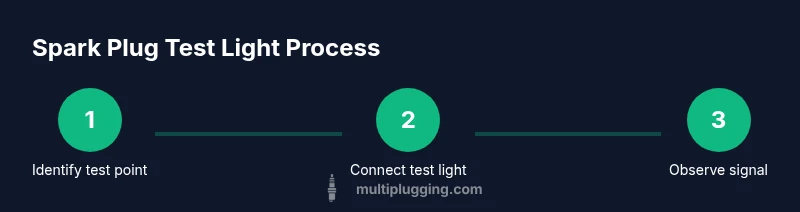
Identify the spark plug lead or coil connection you plan to test. For COP systems, you’ll usually test the coil lead rather than removing the plug. For distributor-based setups, locate the secondary lead from the distributor cap.
Tip: If unsure, consult the service manual for your exact engine layout. - 3
Set up the test light path
Connect one end of the test light to a known power source or to the coil terminal, and the other end to ground or to the plug case as appropriate for your chosen method.
Tip: Ensure all connections are snug but not forcing the wires. - 4
Perform the test
With the engine in the correct position and the ignition on (or while cranking if your method requires it), observe the test light. A steady glow means energy is reaching the path; a flicker or no glow indicates a fault.
Tip: Never touch moving parts; have a helper if you’re cranking the engine. - 5
Interpret results
Correlate the light signal with the known-good reference. If the path tests good but the plug shows wear, you may need to replace the plug or coils. When in doubt, re-check with a known-good component.
Tip: Record which cylinder you tested and the exact signal observed. - 6
Finalize and re-test
Reconnect battery, start the engine, and run the system briefly. Look for normal operation and absence of misfires. If issues persist, plan further diagnostics or professional help.
Tip: Document outcomes for future service or warranty considerations.
FAQ
Can a spark plug test light diagnose misfires?
A test light helps confirm whether electricity is reaching the spark path, but it cannot identify every misfire cause. Use it with plug/wire inspections and compression tests when needed.
A test light confirms the electrical path, but misfires can have multiple causes.
Should I remove the spark plug to test it?
Not always. For many systems, you test the coil and plug wires without removing the plug. If the plug itself must be inspected, remove it carefully and inspect electrodes.
Often you test without removing the plug; remove it only for visual inspection.
Is it safe to test while the engine is running?
Testing with a running engine increases risk. Prefer tests with the engine off and battery disconnected, then verify with the engine briefly running after reassembly.
Testing with the engine on is riskier—stick to off-testing, then re-check.
What does a bright versus dim light indicate?
A bright, steady light usually indicates a healthy circuit; a dim or flickering light points to resistance, a marginal ground, or a partial failure in the wiring.
Bright light means energy is reaching the path; dim or flickering means potential faults.
What other tools help diagnose spark plug problems?
A multimeter, spark plug tester, and visual inspection often complement a test light. Use these together for a full diagnosis.
Use a multimeter and plug tester alongside a test light for a complete check.
Watch Video
Main Points
- Verify ignition health with a spark plug test light before replacing parts
- Follow engine-specific safety steps to prevent shocks or fires
- Interpret glow patterns to isolate faulty path, coil, or wire
- Combine test-light results with plug/wire visual inspection
- The MultiPlugging team recommends documenting outcomes for future fixes