Understanding the Resistance of Spark Plug: Testing, Ranges, and Diagnostics
Explore what resistance of spark plug means, how to measure it safely, and how readings relate to ignition health. Practical, DIY guidance from MultiPlugging.


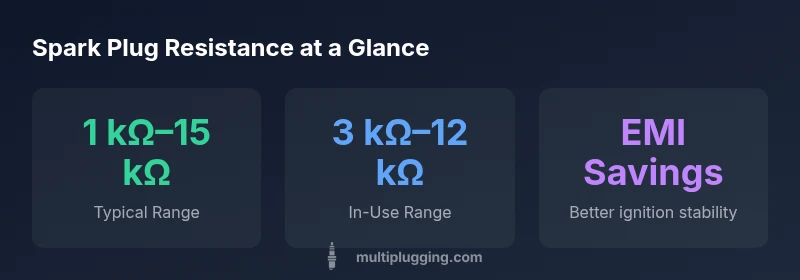
The typical resistance of resistor-type spark plugs ranges from about 1 kΩ to 15 kΩ per plug, depending on design. This range helps suppress EMI and stabilize ignition. Readings outside this band can indicate fouling, worn insulation, or damaged connections requiring inspection. For precise automotive diagnostics, test when the engine is cold and use a calibrated meter; small deviations can reflect measurement technique rather than a true fault.
What resistance means for spark plugs and why it matters
Resistance is not the spark itself; it's a property of the spark plug assembly and its surrounding circuit that influences how energy travels from coil to electrode. In practical terms, the resistance of spark plug—particularly resistor-type plugs—affects how much energy stays in the circuit to suppress unwanted radio frequency interference and how much remains to jump the gap and ignite the air-fuel mixture. In other words, resistance helps shape the spark and protect sensitive ignition components. According to MultiPlugging, understanding the resistance of spark plug is foundational to diagnosing ignition health before jumping to replacement. The resistance of spark plug varies with design, materials, and age, and it is normal for readings to drift slightly under different operating conditions. When you measure resistance, you are looking at a snapshot of the entire spark path—from the conductor in the ignition coil and plug wire through the terminal and resistor element, to the earth path via the engine block. A higher-than-expected reading can signal corroded connectors, worn insulators, or degraded resistor elements, while too-low values may indicate a shorted path or measurement error.
Resistor vs non-resistor plugs: what this means for your engine
Most modern spark plugs come in two flavors: resistor-type and non-resistor. The presence of a built-in resistor modifies the electrical path and, by design, raises the resistance to suppress EMI and radio noise. This is particularly important in vehicles with long coil wires or sensitive electronic control units. The resistance of spark plug in resistor designs is purposely set to a value in a wide range to balance spark energy, voltage requirements, and emissions compliance. Non-resistor plugs, by contrast, present a near-short path; they rely on the ignition coil and wiring to manage noise. The effect on engine performance depends on the ignition system architecture; some older cars tolerate non-resistor plugs well, while modern engines may experience misfires or timing issues if incompatible with the coil/ECU. As a practical rule, always verify compatibility with your vehicle manufacturer’s recommended plug type and specification. This matters not only for performance but also for warranty and long-term reliability.
Measuring resistance safely: tools, steps, and precautions
To measure resistance accurately, you need a high-impedance digital multimeter (DMM) and, ideally, a spark plug tester designed for automotive use. Always start with safety: kill the engine, disconnect the battery, and ensure you’re working in a dry environment. For resistor-type plugs, disconnect the spark plug boot and isolate the plug from the engine to avoid parallel paths. Set the meter to the kilo-ohm range (highest scale initially) and place probes on the central electrode terminal and the plug body ground connection or terminal. Take multiple readings and average them. Be mindful of temperature: readings taken when components are hot or at operating temperature will drift. If you measure in-circuit, remove the plug from the engine or disconnect the ignition coil to avoid alternate current paths. Document the temperature, engine state, and measurement method. If you obtain a resistance value within the expected range (1 kΩ–15 kΩ for resistor plugs, depending on design) then the plug is likely healthy; outliers require further checks of wires, boots, and the coil connection.
Interpreting readings across engines and temperatures
Engine type, ignition system design, and ambient temperature all influence resistance readings. A value near the lower end of the expected range in a cold engine is generally favorable, but warm-up can show higher resistance due to material expansion and moisture effects. In turbocharged or high-performance engines with advanced coil packs, readings can drift within a slightly wider window without signaling a fault. Always compare readings against the OEM specification for your exact plug model and vehicle. When trend data shows readings gradually shifting upward over multiple tests, it can indicate aging resistor elements, deteriorating boot seals, or increasing contact resistance at terminals. In any case, treat resistance as one data point in a broader diagnostic context that also includes compression, fuel trims, and misfire codes.
Maintenance implications: when to replace vs clean
Regular maintenance should include checking resistance in conjunction with spark plug wear and electrode condition. If resistance readings consistently sit outside the manufacturer’s specified range or if you notice symptoms such as rough idle, misfires, or reduced fuel efficiency, prioritize plug and coil inspection or replacement. While cleaning carbon buildup on the electrode can sometimes restore spark quality, resistance-related issues often reflect passive wear, degraded resistor elements, or damaged wiring that requires component replacement. Use OEM guidelines to determine compatibility and avoid using mismatched plugs that may alter resistance paths in the ignition system. In modern vehicles, replacing worn plugs and associated wiring is usually more reliable than attempting to rehabilitate aged resistor elements.
Troubleshooting scenarios: when resistance hints at failures
High resistance readings can point to corrosion on terminals, moisture intrusion in the boot, or a failing resistor element inside the plug. In such cases, inspect the boot-to-coil connector, ignition wires, and ground paths for moisture and damage. If you observe a misfire code alongside abnormal resistance, rule out injector and coil problems first, then reassess the plug. Very low readings often imply a short or measurement error, possibly due to testing in-circuit. Always re-test with the engine cold, ensure proper grounding, and verify that you use the correct test range on your meter. If repeated tests show persistent out-of-range values, replacement of the spark plug assembly and related ignition wiring is generally the recommended course.
How resistance affects ignition timing and performance
In most engines, resistance in the spark plug path affects the current available to jump the gap, which can influence ignition timing and the speed of flame kernel development. Excessive resistance reduces the energy reaching the gap, potentially causing delayed ignition and rough running at low RPM or under load. Conversely, very low resistance is unusual for modern plugs and can adjust coil loading or introduce EMI that interferes with ECU sensors. Always confirm that the selected plug (resistor vs non-resistor) aligns with the vehicle’s ignition coil design, wiring harness, and EMI tolerance specifications. When in doubt, rely on OEM recommendations and consult service manuals for exact resistance targets.
Comparison of resistor vs non-resistor spark plugs
| Aspect | Resistor Plug Range | Non-Resistor Plug | Notes |
|---|---|---|---|
| Typical resistance (per plug) | 1 kΩ–15 kΩ | ≈0 Ω | EMI suppression vs spark energy |
| Measurement complexity | Moderate | Easy | Requires proper meter and technique |
| Impact on misfire risk | Within range: lower risk | Potential higher risk without resistor | Depends on system compatibility |
| Maintenance interval | Regular testing recommended | Less critical | Check per OEM spec |
FAQ
What is resistor-type spark plug?
A resistor-type spark plug contains an internal resistor to suppress electromagnetic interference and stabilize spark energy. This affects measured resistance and how the plug interacts with the ignition system.
A resistor plug has a built-in resistor to cut EMI and help spark stability.
What is the normal resistance range for resistor spark plugs?
Typical resistor plugs sit in the 1 kΩ to 15 kΩ range; testing should be done with the engine cold and with proper equipment.
Most resistor plugs read between 1k and 15k ohms.
Can a spark plug have zero resistance?
Resistor plugs should not read zero. A zero reading usually signals measurement error or a bypassed path in the test setup.
Zero resistance is a red flag and likely a testing error.
How often should I test spark plug resistance?
In routine DIY maintenance, test during inspection intervals like every 6,000–10,000 miles, or whenever misfires are suspected.
Test during regular maintenance intervals.
What causes high resistance readings?
Fouling, moisture intrusion, worn resistor elements, or damaged wiring can raise readings.
Fouling or damage can push resistance higher.
Do all spark plugs have resistance?
Not all plugs have built-in resistance; non-resistor plugs rely on EMI suppression through other means and may interact differently with the ignition system.
Some plugs are non-resistor and suppress EMI differently.
“Resistance readings are a practical heartbeat check for your ignition system; they reflect the health of spark plugs and wiring more accurately than peak voltage alone.”
Main Points
- Identify resistor-type plugs and confirm target range.
- Test resistance with a proper meter at cold engine.
- Readings outside the range suggest fouling or wear.
- Use OEM guidelines to ensure compatibility.
- Inspect wiring and coils if readings drift.