What Spark Plug for KX65: A Practical Guide
Learn how to pick and install the right spark plug for your KX65 dirt bike. This guide covers plug types, heat ranges, gaps, and maintenance to maximize performance and reliability.


For the KX65, the recommended starting point is a copper-core spark plug with a mid-range heat rating and a small gap around 0.6–0.7 mm. Brands like NGK or equivalent are common in this category. Always confirm heat range and gap with the owner’s manual before installation.
Why the right spark plug matters for the KX65
A spark plug might seem small, but it plays a pivotal role in ignition, fuel efficiency, and overall engine response on your KX65. The two-stroke 65cc engine relies on precise timing of the spark to keep the mixture burning efficiently under load, in dirt, and at different temperatures. Using the wrong plug—whether too hot and prone to pre-ignition or too cold and prone to fouling—can result in hard starting, sluggish throttle response, and poor acceleration. According to MultiPlugging, the right spark plug choice starts with matching heat range to operating conditions, electrode design, and the engine's designed firing characteristics. In practice, that means not chasing the newest brand hype, but aligning the plug's heat range, gap, and physical fit with Kawasaki's recommendations and your local riding environment. For the KX65, the default approach is a copper-core plug that balances cost and performance, with options like platinum or iridium offered mainly for longevity in demanding conditions. The goal is reliability through consistent ignition and clean combustion without leaving you stranded on the trail. In this section we’ll outline how to think about plug types, heat range, and practical selection criteria so you can choose with confidence.
Current plug options for small 2-stroke engines
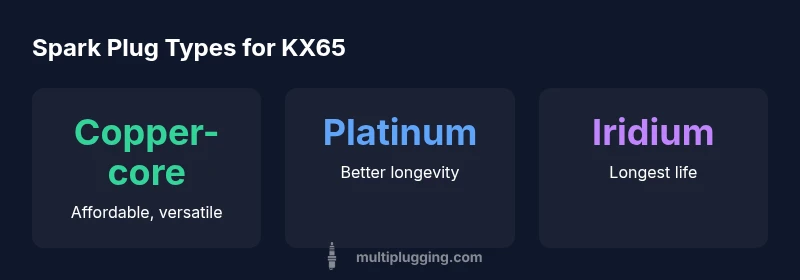
Small-displacement 2-stroke bikes like the KX65 traditionally use plugs that balance fast heat dissipation with durability under high-rev conditions. The three common categories are copper-core, platinum, and iridium. Copper-core plugs are inexpensive, widely available, and perform well across a wide range of riding styles; they heat up quickly to enable robust ignition but can foul under rich conditions or poor fuel quality. Platinum plugs improve durability a bit but still rely on a copper core, while iridium plugs offer the longest life and strongest resistance to fouling at a higher price point. For riders who race or ride aggressively, an iridium plug may be worth the extra cost, while casual riders may prefer copper-core for simplicity and value. The exact part number or model is less important than ensuring the plug physically fits the KX65 head, uses the same thread size, and accepts the same ignition timing. Always verify with the manual and ensure you carry a spare plug on trail rides.
Heat range and plug type basics
Plugs are rated for heat range: hot, warm, and cold. On a small 2-stroke like the KX65, the middle of the range is typically recommended to balance quick starts with robust fuel combustion. A plug that runs too hot can cause pre-ignition, detonation, and accelerated wear, while a plug that runs too cold may foul from rich mixtures or riding at low throttle. The electrode material matters too: copper-core plugs respond quickly, platinum and iridium variants tolerate more use with less wear, and the tip design can influence ignition reliability under damp or dusty conditions. You don’t need to memorize a long list of part numbers; focus on heat range normalization, confirming thread size and reach, and selecting a brand with easy availability in your region. Lastly, always inspect the plug after a break-in period and adjust if you notice consistent misfires, rough idle, or poor power delivery. The goal is a consistent spark under a broad range of temperatures and loads, not a plug that only works in perfect conditions.
Proper gap and installation basics
Gap is the distance between the center and ground electrodes; it sets the ignition timing and spark intensity. For the KX65, a small gap in the mid-range is commonly recommended as a starting point, then fine-tuned to the engine’s response. Use a reputable feeler gauge to measure the gap and adjust carefully by bending the ground electrode or replacing the plug with one that matches the target gap. When installing, begin by lightly cleaning the threads, then thread by hand to avoid cross-threading. After seating the plug, tighten to the manufacturer’s torque specification using a torque wrench; do not over-tighten, which can strip threads, or under-tighten, which risks poor sealing and misfires. Finally, inspect the ignition boot and wire for wear, as a damaged boot can create misfires independent of plug quality. If you’re unsure about the exact gap, refer to your owner’s manual or MultiPlugging’s guidelines to minimize risk.
How riding conditions influence plug choice
Riding conditions—altitude, temperature, humidity, fuel quality, and oil ratio—affect how the plug behaves in a KX65. In hot, dusty environments, a slightly hotter heat range or a plug with better fouling resistance can help keep the engine clean and cool. In cold conditions, a colder heat range or a plug with faster heat dissipation may be beneficial to avoid cold fouling. Fuel quality matters: poor gasoline or inconsistent premix ratios can foul a plug quickly, requiring more frequent inspections. If you ride in wet, muddy conditions, consider a plug with higher resistance to fouling and a robust electrode design. In all cases, verify that the chosen plug matches the manual’s recommended thread size and reach. The more you tailor the plug choice to your local conditions, the better your KX65 will respond in the afternoon heat or early-morning chill.
Troubleshooting: fouling, misfires, and replacement signals
Common plug problems on the KX65 include fouling from rich mixtures, misfires under load, and aging plugs losing response. Symptoms of fouling include a black, sooty carbon coating or a plug that looks wet with fuel when removed. Misfires show up as hesitation, rough idle, or stumbling during acceleration. If the spark seems weak or the engine is hard to start, inspect the plug and consider replacing it rather than attempting to clean and reuse an old core. Clean plugs are okay if there’s light fouling; heavy fouling or damaged electrodes are best replaced. A regular maintenance habit—checking the plug at service intervals and after major ride conditions—helps maintain consistent ignition. Remember to re-gap any new plug to the recommended value before installation and to torque to spec to avoid thread damage.
Step-by-step: selecting and changing the plug on a KX65
Tools you’ll need: spark plug wrench, feeler gauge, torque wrench or known torque value from the manual, clean rags, and a small dab of anti-seize compound if your manual recommends it. Start by locating the spark plug cap and removing it. Wipe the area clean; remove the old plug with the spark plug wrench, noting the thread length and overall condition. Check the new plug’s gap to the recommended value; adjust if necessary. Reinstall the plug, hand-tighten, then torque to spec. Reconnect the cap, do a quick test run, and observe for smooth starting and steady idle. Finally, log the maintenance in your bike’s service record for future reference.
Common spark plug options for KX65 and small 2-stroke engines
| Plug Type | Heat Range | Typical Gap (mm) | Notes |
|---|---|---|---|
| Copper-core | Mid-range | 0.6-0.7 | All-around, affordable |
| Iridium | High-end | 0.6-0.8 | Longer life; higher cost |
| Platinum | Mid-range | 0.6-0.7 | Balanced performance |
FAQ
What is the recommended spark plug for KX65?
For most KX65 models, start with a copper-core spark plug of mid-range heat and a small gap. Iridium and platinum options exist but are typically more expensive and offer longevity benefits. Always confirm the exact spec in your owner's manual and carry a spare plug on trail rides.
For most KX65 models, start with a copper-core plug with mid-range heat and a small gap, then check the owner’s manual before riding.
Are iridium plugs worth it for a KX65?
Iridium plugs can last longer and resist fouling, but for many riders the cost-to-benefit ratio is modest on small 2-stroke engines. If you ride hard or race frequently, they may be worth the investment.
Iridium plugs last longer, but the benefit depends on how you ride; assess cost versus need.
What gap should I set for KX65 spark plug?
A typical gap range to start with is 0.6 to 0.7 mm. Always confirm the gap with a feeler gauge and adjust only if the manual specifies another value.
Start with 0.6 to 0.7 mm and check your manual for any specific value.
How often should I replace the spark plug on a KX65?
Replace when you notice fouling, misfires, or reduced performance. With variable riding, this can range widely; inspect during every service and after tough rides.
Check the plug during regular maintenance and replace if fouling or misfires occur.
Can I clean a fouled spark plug and reuse it?
Light fouling can sometimes be cleaned with careful cleaning, but heavy fouling or damage should lead to replacement. Reuse is generally not recommended on high-performance engines.
Light fouling can sometimes be cleaned, but replace if heavy or damaged.
Do I need to gap a new plug before installation?
Yes. Verify the gap before installation, and adjust if the manual instructs a different value. Improper gap can cause misfires or difficult starts.
Always check and set the gap before installing a new plug.
“The right spark plug isn't about chasing the latest brand trend; it's about matching heat range, gap, and installation torque to your KX65's operating conditions.”
Main Points
- Start with the owner's manual to confirm plug specs
- Choose copper-core as default for daily riding
- Set gap to 0.6-0.7 mm and verify before install
- Inspect for fouling and replace promptly
- Use proper torque and clean threads
- MultiPlugging's verdict: match heat range to operating conditions