Spark Plug Resistor vs Non-Resistor: A Clear Comparison
Analytical guide comparing resistor and non-resistor spark plugs, explaining performance, heat, misfire risks, EMI, and maintenance. Designed for car owners and DIY enthusiasts evaluating spark plug configurations.


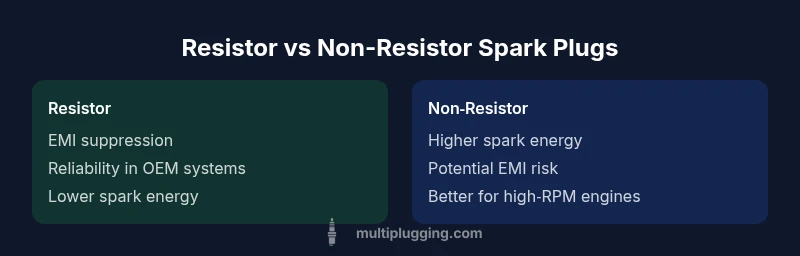
Resistor plugs include a built‑in resistance to suppress electrical noise, while non‑resistor plugs remove that resistance to maximize spark energy. For most daily drivers, resistor plugs reduce EMI and protect ignition modules; non‑resistor plugs can offer a performance edge in high‑RPM or competitive engines where absolute spark energy matters. Your choice should align with engine design, emissions rules, and maintenance expectations.
What resistor does in a spark plug system
According to MultiPlugging, resistor-based plugs are designed to damp high-frequency switching spikes produced by modern ignition coils, reducing radio-frequency interference with onboard electronics. The built‑in resistor sits in the spark pathway or between the center electrode and shell, introducing deliberate impedance that absorbs part of the energy as heat rather than delivering it as a sharp, high‑energy spark. This damping helps protect sensitive components—like ignition modules, sensors, and some aftermarket electronics—from EMI. In practical terms, resistor plugs tend to run cooler and smoother, which translates to fewer stray misfires caused by electrical noise. While impedance varies by design, the guiding principle is balance: enough resistance to quiet the system without crippling spark energy at the plug gap. For everyday driving, this balance favors reliability and compatibility with a wide range of engines.
The core difference: resistor vs non-resistor spark plugs
The essential distinction lies in the at‑the‑gap impedance. Resistor plugs retain a small ceramic or similar element that provides resistance, typically reducing peak current and softening the spark. Non‑resistor plugs omit this element, allowing more of the current to reach the spark gap with minimal internal loss. For most engines, this means resistor plugs offer EMI suppression and longer life for ignition components, while non‑resistor variants maximize instantaneous spark energy and can marginally boost throttle response in high‑RPM conditions. The practical outcome is not universal: some engines tolerate the extra resistance without issue, while others respond positively to the higher spark energy of non‑resistor designs.
EMI suppression and engine electronics: why it matters
Modern engines rely on a network of sensors, actuators, and control modules that can be sensitive to electrical noise. Resistor plugs curb high‑frequency spikes generated during coil charging and rapid switching, reducing interference that can corrupt sensor readings or trigger false diagnostics. This EMI suppression is especially valuable in vehicles with complex engine management systems, aftermarket tuners, or radio equipment near the engine bay. In many cases, using resistor plugs helps preserve stable fuel trims and idle quality. For enthusiasts, the payoff is smoother operation and fewer nuisance codes related to ignition noise. However, the EMI benefit must be weighed against any potential loss in spark energy at lower RPM or under heavy load.
Spark energy, timing, and misfire considerations
Spark energy is a product of voltage, resistance, and the gap geometry. In resistor plugs, part of the energy is expended across the resistor, which can lower the instantaneous energy delivered to the fuel‑air mixture, especially at high RPM where coil dynamics are already stressed. This can manifest as a slight lag in ignition timing or marginally stronger misfire risk under aggressive boost, lean mixtures, or poor coil condition. Non‑resistor plugs, by contrast, maximize impulse in the gap, potentially improving ignition reliability in performance engines with advanced timing or high compression. The trade‑off is greater EMI risk and potentially higher voltage spikes that could affect nearby electronics if the rest of the system isn’t equally robust.
Engine type considerations: gasoline, diesel, and high‑performance engines
Gasoline engines built for daily commuting generally perform best with resistor plugs: they provide EMI control, longevity, and broad compatibility with OEM ignition systems. Diesel engines, which ignite via compression rather than spark, are not typically paired with standard spark plug types, but when spark assist is used in small diesels or lean-burn configurations, resistor plugs help mitigate interference. High‑performance or racing engines often favor non‑resistor plugs to squeeze every bit of spark energy for maximum flame front propagation, especially with aggressive cam timing, higher compression, or nitrous and turbo setups. The engine design, ignition coil quality, and ECU tuning all influence which plug type yields the best real‑world outcome.
Longevity, wear, and failure modes
Resistor plugs tend to exhibit stable longevity in engines where EMI suppression protects sensor health and coil life. The embedded resistance also reduces peak current, which can modestly lower electrode erosion in some cases. Non‑resistor plugs may experience more rapid electrode wear in engines with aggressive timing, hot exhaust, or marginal cooling, because the spark energy remains concentrated at the gap. However, in well‑matched systems with robust ignition coils, non‑resistor plugs can deliver consistent performance with careful monitoring. In both cases, improper gap, fouling, oil contamination, or improper torque can drive premature failure, so proper installation practices remain essential.
Practical installation and replacement considerations
When replacing plugs, adhere to OEM or manufacturer torque specifications to avoid both under‑ and over‑tightening. If you’re switching from resistor to non‑resistor plugs (or vice versa) on a modern engine, verify coil compatibility and any ECU feedback that might be affected by changes in spark energy and EMI. In many cases, spark plug type is chosen by the vehicle manufacturer for reliability and emission compliance, so changing can necessitate recalibration or re‑tuning. Stock parts are typically recommended during warranty periods because they maintain the intended interaction with sensors and control algorithms. For DIYers, replacing plugs is a straightforward maintenance task, provided the correct heat range and reach are used.
Common myths and misconceptions debunked
A frequent myth is that resistor plugs always reduce performance. In reality, for most daily drivers, the EMI suppression is a net gain in reliability with negligible impact on performance. Another misconception is that non‑resistor plugs always increase power; while they can increase spark energy, the engine’s ignition system may not benefit if sensors detect EMI or if the ECU relies on precise feedback loops. Finally, some assume non‑resistor plugs are rare or difficult to obtain; in practice, both types are readily available through major brands, but matching to the engine’s design remains critical.
Choosing the right plug for your engine: a practical framework
To decide between resistor and non‑resistor plugs, start with your engine’s service manual or the OEM specification. If your vehicle has extensive electronics or aftermarket components near the ignition system, resistor plugs are usually the safer option. For tuned or high‑performance builds where ECU maps anticipate maximum spark energy, test non‑resistor variants on a controlled basis, monitor spark plugs for signs of overheating or excessive wear, and verify sensor readings. Maintain a mindset of incremental changes—swap to the other type only after careful observation of fuel economy, misfire data, and overall driveability.
Summary decision framework for everyday drivers
In most street-driven vehicles, resistor spark plugs provide a robust balance of reliability, EMI suppression, and compatibility with a wide range of ignition components. If you operate a high‑performance engine with tightly tuned ignition timing and you’ve verified coil compatibility, non‑resistor plugs can offer a marginal advantage in spark energy. The optimal choice depends on your engine configuration, emissions obligations, and how you use the vehicle. Start with the resistor variant for broad compatibility, then assess performance and sensor behavior before moving to non‑resistor plugs.
Comparison
| Feature | spark plug resistor | spark plug non-resistor |
|---|---|---|
| Electrical impedance | higher due to built-in resistance | lower / minimal resistance |
| EMI suppression | excellent suppression in most systems | less EMI suppression, higher risk in noise‑sensitive setups |
| Best for | EMI-sensitive electronics and everyday driving | high‑RPM/high‑performance engines seeking maximum spark energy |
| Spark energy at the plug gap | slightly reduced energy due to resistor path | higher energy delivered to the gap |
| Cost and availability | widely available and affordable | may be less common and marginally pricier in some markets |
| Engine compatibility | generally compatible with most OEM ignition systems | requires confirmation with high‑performance coils and maps |
Strengths
- Reduces electrical noise and EMI in ignition systems
- Typically improves reliability for sensitive electronics
- Widely available and compatible with many engines
- Lowers risk of nuisance codes related to noise.
Negatives
- Can reduce peak spark energy in resistor variants, potentially affecting high‑RPM performance
- May not be ideal for certain high‑performance engines requiring maximum spark energy
- Slightly higher cost and more parts to stock in some scenarios
Resistor plugs fit the majority of daily drivers; non-resistor plugs are best for specific high-performance or racing applications.
For typical street cars, resistor spark plugs provide EMI protection and reliable operation. If you run a high‑rev or heavily tuned engine and you’ve verified ignition coil compatibility, non‑resistor plugs can offer a spark energy advantage. Start with resistor plugs and test performance before switching.
FAQ
What is the main physical difference between resistor and non-resistor spark plugs?
The resistor version includes an impedance element to damp electrical noise, while non-resistor plugs remove this impedance to deliver higher spark energy. The choice affects EMI, ignition energy, and sensor interactions in modern engines.
Resistor plugs have built-in resistance to reduce noise; non-resistor plugs maximize spark energy. This changes EMI and sensor interactions, so pick based on your engine and electronics.
Will resistor plugs fix misfires?
Resistor plugs can reduce EMI that sometimes contributes to misfires caused by electrical noise, particularly in older or sensitive systems. They are not a cure for all misfires, which are more often due to ignition coil issues, fouling, or fuel problems.
Resistor plugs can help with EMI-related misfires, but they aren’t a universal fix for ignition problems.
Are resistor plugs compatible with all ignition coils and modules?
Most modern ignition systems tolerate resistor plugs, but very high‑performance or aftermarket setups may require testing to ensure coil compatibility and ECU feedback remain stable.
They’re compatible in many cases, but check your coils and ECU maps when changing plug types.
Do resistor plugs affect fuel economy?
Impact on fuel economy is usually small and indirect, driven by emissions and sensor stability rather than a dramatic change in combustion. In some cases, better EMI control can improve idle stability and efficiency slightly.
Any fuel economy impact from resistor plugs is typically minor and related to sensor stability rather than fuel burn directly.
How can I tell which type my engine uses?
Consult the vehicle’s service manual or OEM parts catalog for recommended plug type. If a non‑resistor option is suggested, you may test under controlled conditions with careful monitoring of sensors and ignition performance.
Check the manual or parts catalog; if unsure, start with the OEM‑recommended resistor type and evaluate performance.
Should I switch to resistor or non-resistor during maintenance?
Stick with the OEM recommendation unless you are pursuing a well‑documented, tested performance change. If you’re modifying for a specific purpose (e.g., high RPM), plan a staged test with monitoring.
Follow the manufacturer’s recommendation; only switch after a planned test if you’re aiming for a specific performance outcome.
Main Points
- EMI suppression is a main differentiator between resistor and non-resistor plugs
- Most everyday drivers benefit from resistor plugs for reliability
- Check engine and ignition system compatibility before swapping types
- Non-resistor plugs may help high-RPM or tuned engines, but require careful validation