Spark Plug BPR5ES Equivalent: Cross-Brand Guide
A practical cross-brand guide to spark plug BPR5ES equivalents, how to verify heat range, gap, and torque, with data tables, examples, and FAQs for DIYers.


A spark plug BPR5ES equivalent means a cross-brand plug that matches the heat range, thread size, reach, and electrical characteristics of the original BPR5ES. In practice, automotive owners look for NGK BPR5ES equivalents in Denso and Bosch catalogs and must verify gap and resistor type before installation to avoid misfires.
What "BPR5ES equivalent" means in practice
According to MultiPlugging, the term spark plug bpr5es equivalent refers to a cross-brand plug that matches the original device in heat range, thread size, and resistor configuration. The goal is to preserve combustion behavior and firing stability while allowing owners to source the part from a preferred brand or local retailer. In real-world use, this means identifying a plug from NGK, Denso, or Bosch that shares the same fundamental electrical and mechanical specs as the BPR5ES. The nuance is that even with a matching heat range designation, subtleties such as electrode design, sealing type, and boot compatibility can affect performance. DIYers who want flexibility while keeping engine behavior consistent should treat a cross-reference as a recommended starting point, then verify each spec against the engine’s service manual and the manufacturer’s cross-reference catalog. The important takeaway is that a BPR5ES equivalent is not a literal substitute; it’s a spec-aligned replacement that requires careful confirmation before installation.
How cross-reference compatibility is determined
Cross-brand compatibility hinges on several core specs: heat range, thread diameter, thread reach, electrode design, and whether the plug includes a resistor. Heat range dictates how quickly the plug heats to the optimal operating temperature and how quickly it cools, influencing ignition stability and misfire resistance. Thread size and reach ensure the plug fits the engine’s threaded hole and reaches the combustion chamber correctly. Resistor type impacts electromagnetic compatibility and fuel-air mixture stability. When evaluating a BPR5ES equivalent, engine manuals, OEM cross-reference catalogs, and reputable aftermarket catalogs must align on these items. It’s also sensible to check boot fitment and electrical connector compatibility to avoid mis-wiring or boot-torque issues. In practice, you’ll compare the official NGK BPR5ES data with Denso and Bosch equivalents to locate matches, then validate the specs side-by-side in the official catalogs.
Step-by-step cross-reference workflow
- Confirm your engine’s required heat range and thread size from the owner’s manual or service bulletin. 2) Locate the BPR5ES specification in NGK’s catalog and identify candidate equivalents in Denso and Bosch catalogs. 3) Compare heat range, thread size, reach, electrode type, and presence of a resistor. 4) Check the recommended gap for your engine and verify tolerance ranges in the cross-reference. 5) Ensure boot compatibility and torque specs are consistent with installation; adjust as needed. 6) If possible, perform a gentle test run and monitor for misfires or rough idling. 7) Record the exact replacement part number used for future maintenance and warranty records.
Practical cross-brand examples and cautions
In practice, NGK BPR5ES is often used as the reference plug. Cross-brand equivalents are available from Denso and Bosch, but exact part numbers vary by market and model. Some engines tolerate a range of equivalents as long as the heat range and mechanical fit are preserved. Always verify with official catalogs, and avoid substituting a hotter or cooler plug without a documented rationale, as drastic heat-range changes can alter combustion dynamics and fuel economy. If your vehicle has a performance tune or emissions mod, or you own a late-model ECU, cross-referencing becomes even more critical because the ignition system interacts with engine management in nuanced ways.
Practical steps to verify an equivalence for your engine
- Start with the vehicle’s service manual to determine the exact heat range, thread size, and reach. - Use the official NGK cross-reference to locate potential equivalents from Denso and Bosch. - Compare the heat range, thread specification, and resistor configuration; ensure they match or are explicitly approved as alternatives. - Confirm the spark plug gap recommended for your engine and set it with a precise feeler gauge before installation. - Install the plug with the correct torque using a torque wrench and re-check the gap if you adjust it.
Common pitfalls and how to avoid them
- Mismatching heat range: Always align the heat range with the engine’s operating temperature. - Incorrect reach or thread: Verify the engine’s bore design and cylinder head compatibility. - Neglecting gap: A wrong gap can cause misfires and poor fuel economy; measure and set correctly. - Ignoring resistor requirements: Some engines require resistor plugs to suppress EMI; make sure the resistor type matches the OEM spec. - Overlooking manufacturer catalogs: Use official cross-reference data rather than relying on retailer listings alone.
Cross-brand spark plug equivalence basics
| Aspect | Details | Notes |
|---|---|---|
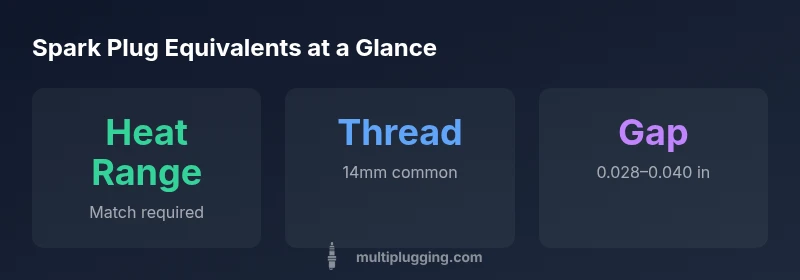
| Heat range | Typically around 5 for BPR5ES equivalents | Confirm exact spec with OEM cross-reference |
| Thread size | Common 14mm | Check engine compatibility |
| Reach | Typically ~19mm | Verify engine-specific reach |
| Gap | Usually 0.028–0.040 inches | Measure before installation |
| Resistor type | Resistor present or not | Important for EMI and fuel mixture |
FAQ
What does 'BPR5ES equivalent' mean in practice?
It refers to a cross-brand spark plug that matches the same heat range, thread size, reach, and resistor configuration as the BPR5ES. Always verify each spec against official catalogs before install.
A BPR5ES equivalent is a cross-brand plug that matches the same specs; check the official catalogs before you install.
How can I verify-equivalents safely across brands?
Start with your engine’s manual to know the required heat range, thread size, and reach. Then cross-reference NGK with Denso and Bosch catalogs and confirm gap and resistor type.
First check your manual, then compare NGK, Denso, and Bosch catalogs to confirm the gap and resistor type.
Can I mix heat ranges if I adjust the gap?
Mixing heat ranges is not generally recommended. The engine is designed for a specific range, and altering it can affect combustion and emissions; always use an approved cross-reference.
Mixing heat ranges is risky; use only approved cross-references and keep to the recommended range.
Will using a cross-brand plug affect my warranty?
Some warranties require OEM-approved parts. Always check your vehicle’s warranty terms and keep documentation of the cross-reference used.
Check your warranty terms; keep records of the cross-reference used to be safe.
Should I adjust torque when using an equivalent plug?
Torque should follow the plug’s specification regardless of brand. If the cross-reference has a slightly different thread or seating, consult the engine’s manual and use a torque wrench.
Follow the torque spec for the plug you install and use a torque wrench.
“Cross-brand equivalents are a practical option, but engines rely on precise heat range and electrical specs; always confirm with official catalogs.”
Main Points
- Verify heat range and gap before selecting an equivalent
- Consult official catalogs for cross-reference accuracy
- Check thread size, reach, and resistor type
- Follow OEM torque specs during installation
- Record the exact cross-reference used for future maintenance