Champion vs NGK Spark Plug: Brand Comparison
A detailed, objective comparison of Champion and NGK spark plugs, covering design, performance, compatibility, price, and reliability to help DIY enthusiasts choose the right plug for their engine.


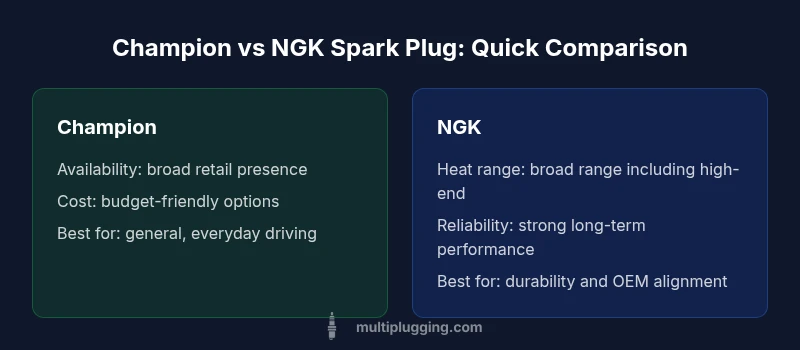
NGK generally offers broader heat-range coverage and long-term reliability, making it a safer default for many engines, while Champion often presents strong value and broad availability for budget-focused DIYers. The best choice depends on your engine specs, local availability, and maintenance goals. If you rely on OEM cross-reference data, NGK is the safer default because it tends to align with manufacturers; however, Champion's designs are compatible and may provide better cold-start performance in engines.
champion vs ngk spark plug: Brand Showdown
Selecting the right spark plug involves balancing performance, price, and compatibility. This guide compares champion vs ngk spark plug with an emphasis on practical implications for everyday drivers and DIY enthusiasts. The differences between Champion and NGK reflect distinct design philosophies, supply networks, and target markets.
According to MultiPlugging, the champion vs ngk spark plug decision often comes down to your engine’s specifications, maintenance cadence, and your local parts ecosystem. Champion plugs are typically positioned as dependable, budget-friendly options that cover a broad range of domestic and older-model engines. NGK, by contrast, leans into a reputation for precise heat-range control and long-term reliability, especially in modern vehicles and import engines. For the home mechanic, this means that the same cross-reference approach you use for other components will apply to spark plugs here as well. In many setups, you won’t notice a night-and-day difference in everyday driving, but the right choice can affect cold starts, fuel efficiency, and misfire resistance under heavier loads.
The core question is not which brand looks better on a shelf, but which plug best aligns with your engine’s design and your maintenance habits. This article uses an evidence-based lens to help you decide.
Key design differences between Champion and NGK plugs
Spark plug design varies by brand, and two brands can approach the same problem from different angles. Champion often emphasizes broad coverage across many engine families, including budget segments, with designs that favor predictable performance in everyday driving. NGK concentrates on precision in heat-range control, electrode technology, and long-term consistency, especially for modern engines and import markets. Understanding these differences helps you select a plug that matches your engine’s operating window and your maintenance cadence. If your engine relies on a specific heat range for optimal combustion, NGK’s approach to selecting heat ranges often aligns well with OEM specifications. Champion, meanwhile, can excel in value-driven scenarios where the goal is reliable ignition without overspecifying heat range.
Cross-compatibility matters here too. OEM recommendations may list a preferred brand or a preferred cross-reference. MultiPlugging emphasizes verifying the exact model number and gap specification rather than assuming a direct one-to-one substitute. When in doubt, refer to your owner’s manual and use cross-reference charts from the brands to avoid misfires, cold starts, or fouling caused by a mismatch in heat range or electrode design.
Availability, OEM positioning, and global reach
Market presence influences practical decisions for DIYers. Champion has historically aimed for broad coverage in North America and other regions, delivering acceptable performance across many domestic engines and older platforms. NGK, by contrast, has cultivated a robust global distribution network and a strong OEM alignment in several vehicle classes—particularly imports and engines designed by Japanese and European manufacturers. For the DIY enthusiast, this translates into easier procurement, especially when shopping at local auto parts stores or big-box retailers. It also means more consistent cross-brand support, particularly when an engine expects a certain heat range and electrode configuration. The key is to confirm stock availability locally and check whether the engine’s recommended cross-reference supports the model you intend to install.
Heat range, gap design, and engine compatibility explained
Two core questions govern plug choice: heat range and physical design. NGK’s lineup often emphasizes a wide heat-range spectrum and premium materials in higher-end lines, which can translate to more robust performance under demanding conditions. Champion offers a solid range as well, with models designed to fit a broad array of engines, including older domestic cars and some modern configurations. The practical impact is that some engines perform more cleanly with NGK under heavy load or high-temperature operation, while others respond well to Champion in normal driving cycles. In any case, verify the exact heat-range specification and gap requirements for your engine before purchase, and avoid substituting a plug with a heat range outside the engine’s intended operating window.
Durability, wear patterns, and long-term performance
Durability is closely tied to electrode material, insulator quality, and how well a plug maintains its gap over time. NGK’s premium lines often feature advanced electrode materials and coatings designed to resist erosion, carbon buildup, and fouling, which can translate to longer replacement intervals in the field. Champion’s standard lines provide dependable performance at a lower upfront cost, which is appealing for budget-conscious owners or vehicles that see limited mileage. The trade-off is that some Champion variants may require more frequent inspection or cleaning in high-demand driving conditions. In DIY practice, the key is to watch for buildup, glazing on the electrode, and signs of misfire, then adjust maintenance intervals accordingly.
Price, value, and buying considerations for DIYers
Price dynamics between Champion and NGK reflect positioning as budget-friendly versus reliability-focused options. Champion commonly presents strong value options that are appealing when budget constraints are a primary concern, especially for older vehicles or fleets. NGK typically occupies a mid-to-premium segment in many markets, with premium lines justified by extended longevity and stricter tolerance to detonation and misfire during high-load operation. The practical takeaway: if your engine tolerates a broader heat range and you prioritize long service life, NGK may justify the extra cost. If you complete maintenance quickly and are price-sensitive, Champion can offer a reliable, lower-cost alternative. Always compare model numbers, cross-reference guidance, and local pricing to determine the best buy.
Cross-reference charts, OEM guidance, and practical steps for choosing
Cross-reference charts are your friend when selecting between Champion and NGK. Always cross-check the OEM-recommended plug for your engine with the model numbers in both brands’ lineups. Some engines accept multiple cross-compatible options, while others require a precise model to maintain fuel economy and ignition stability. Practically, start with the OEM specification, then review the heat range, electrode material, and dirt/fouling tendencies described by each brand. If you’re unsure, consult a trusted local technician or use owner forums to confirm that the chosen plug won’t cause misfires under your typical driving conditions.
Comparison
| Feature | Champion spark plug | NGK spark plug |
|---|---|---|
| Market presence | Broad retail and aftermarket distribution (North America) | Global distribution with strong OEM alignment |
| Core design & materials | Copper-core with varied alloy options; broad coverage | Premium lines with palladium/iridium options; precise heat control |
| Heat range compatibility | Wide range to fit many older and domestic engines | Extensive heat-range options including modern engines |
| Price/value balance | Typically budget-friendly; strong value | Mid-range to premium; longevity-focused |
| Warranty & support | Brand warranties vary by region and line | Consistent regional policies across major markets |
| OEM cross-compatibility | Common in domestic engines; cross-reference needed | Widely used in imports; verify OEM recommendations |
| Durability under load | Solid everyday performance | High durability for long-term reliability |
| Maintenance cycle | Moderate replacement frequency depending on model | Often longer life in premium lines |
| Best for | Budget builds and fleets | Reliability-focused builds and OEM alignment |
Strengths
- Broad availability and strong value in Champion options
- NGK offers broad heat-range coverage and reliable performance
- Cross-reference charts simplify brand switching when brand fits engine
Negatives
- Champion lines may have variable performance by region
- NGK can be more expensive for premium variants
- Cross-compatibility is not guaranteed without validation
NGK generally edges Champion for most engines due to broader heat-range coverage and long-term reliability
If your engine benefits from precise heat-range control and proven durability, NGK is the safer default. Choose Champion for budget-friendly, readily available options where OEM alignment is flexible and replacement intervals are shorter.
FAQ
Is Champion spark plug as reliable as NGK?
Both brands offer reliable options, but reliability depends on the specific model and engine compatibility. NGK’s premium lines are often favored for longevity and consistent performance under varying conditions.
Both brands are reliable; for longevity, NGK's premium lines are usually favored, but model and engine compatibility matter more.
Can I use Champion in a car that originally uses NGK?
Yes, if the Champion model is cross-referenced to the OEM NGK specification and has the correct heat range and gap for your engine. Always confirm with OEM guidance or a trusted cross-reference chart.
Yes, as long as it matches the OEM specs and heat range.
Which brand is cheaper?
Champion generally offers budget-friendly options, while NGK covers a range from mid-priced to premium. Actual prices depend on model, region, and promotions.
Champion is usually cheaper, NGK varies by line.
Do Champion and NGK have the same heat range?
Not exactly. Each brand provides multiple heat ranges across different lines, and using the wrong range can affect performance. Always verify the exact model’s heat range.
They don’t always have the same heat range; check the model.
How can I tell if a spark plug is worn?
Look for worn or rounded electrode edges, heavy carbon buildup, glazing on the insulator, or frequent misfires. A compression test can help diagnose combustion-related wear.
Check electrode wear and buildup; run a compression test if unsure.
Should I switch brands during engine maintenance?
Switching brands is possible if the replacement matches OEM specs and heat range. Use cross-reference charts and consider engine warranty implications.
You can switch brands if the specs line up.
Main Points
- Check OEM specs before choosing a plug brand
- Verify heat range and gap for your engine
- Balance price against long-term reliability
- Use cross-reference charts to guide brand switches
- Consider local availability and service network when buying