No Spark at Spark Plug: Troubleshooting Guide
Diagnose and fix no spark at spark plug fast with our step-by-step flow. Learn common causes, safe testing, fixes, and prevention for DIYers.


No spark at spark plug is usually caused by a faulty ignition coil, worn or fouled spark plug, damaged wiring, or a blown ignition fuse. Start by inspecting the plug boot, then test for spark with a tester, and verify the ignition fuse is intact. If this doesn’t fix it, follow the diagnostic flow below for deeper checks.
Understanding no spark at spark plug
When your engine cranks but refuses to ignite, a no spark at spark plug condition is typically an ignition problem rather than a fuel delivery issue. According to MultiPlugging, ignition-system faults are among the most common culprits in no-start scenarios. The MultiPlugging team found that worn or fouled spark plugs, damaged wiring, or a blown fuse in the ignition circuit account for many of these cases. Recognizing this pattern helps you separate ignition problems from sensor or fuel-system faults. In this guide we focus on diagnosing and fixing no spark at spark plug with safe, practical steps you can perform in a home workshop. Expect a mix of quick checks and deeper tests you can perform with common tools. The aim is to restore a reliable spark at the plug and a smooth engine start without unnecessary risk.
Why ignition systems fail: quick overview of suspects
Ignition systems are a network of components that must all work in harmony. A no spark at spark plug can stem from a weak or absent power supply to the coil, a failed coil, a damaged coil boot, worn brushes in the distributor (older systems), corroded connections, or a blown fuse. Other causes include faulty sensor signals that delay or cancel spark timing, or a cracked ignition module in more modern engines. By understanding the typical suspects, you can triage efficiently, starting with simple, low-cost fixes before moving to more involved checks.
Safety essentials before you begin
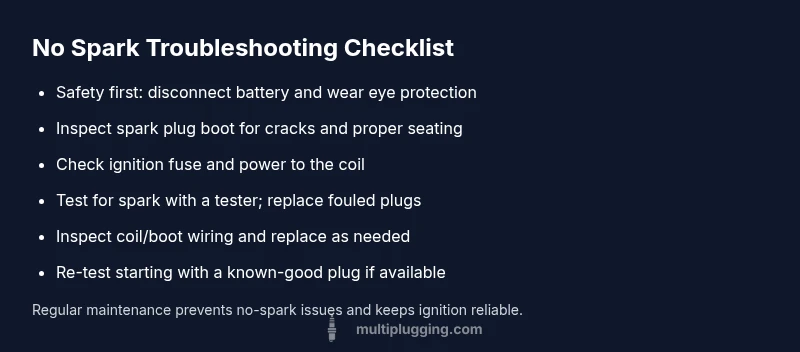
Safety first is non-negotiable when dealing with high voltage ignition systems. Disconnect the negative battery terminal and ensure the engine is cool before touching spark plugs or wiring. Remove metal jewelry to avoid accidental shorting, wear eye protection, and work in a well-ventilated area away from fuel vapors. Keep a fire extinguisher nearby and never probe live ignition components with the system powered. Label any wires you disconnect to avoid cross-wiring on reassembly.
Diagnostic flow overview
A structured diagnostic flow helps you isolate the no spark at spark plug cause without guessing. Start by confirming power to the ignition system, then check fuses and relays, test for spark, inspect the spark plug condition, and finally verify the wiring integrity and coil performance. If a test points to a specific faulty part, replace it and re-test. If all tests pass but you still have no spark, consider sensor or control-module issues and seek professional help.
Quick checks you can perform safely
- Visually inspect the spark plug boot for cracks, corrosion, or looseness. A loose boot can kill spark transmission.
- Remove and inspect the spark plug; a fouled, oil-fouled, or worn electrode reduces spark capability. Replace if in doubt.
- Check the ignition fuse and main power supply to the coil. A blown fuse is a common, easy fix for a no-spark condition.
- Test for a spark using a spark tester or a known-good plug and wire. If you don’t see a spark, concentrate on coil, wiring, and fuse circuits.
- Check the battery and starter circuit; a weak battery can produce a sluggish crank that complicates ignition testing.
In-depth tests: spark timing, coil, and wires
For a thorough evaluation, use a spark tester to confirm spark energy at the plug boot. Measure coil primary and secondary resistance with a multimeter and compare against the manufacturer’s spec. Inspect high-tension wires for cracks or heat damage, and ensure the coil boot seats firmly on the plug. Ensure proper ground connections and look for corrosion in ignition connectors. For modern engines, verify that the ignition control module receives correct signals from the ECU. If any test deviates from spec, replace or repair the corresponding component.
Replacing the most common parts: plugs, wires, fuses
Spark plugs wear out and can foul, leading to weak or no spark. Replace worn or fouled plugs with the correct heat range and gap. Inspect and replace damaged spark plug wires or coil boots with OEM or quality aftermarket parts. A blown ignition fuse is a simple fix but may mask a deeper problem; replace the fuse and re-test to confirm. Always torque plugs to the manufacturer’s specification and use anti-seize where recommended.
Prevention and maintenance to avoid future no-spark issues
Regular plug inspection and replacement aligned with your vehicle’s maintenance schedule reduces the odds of a no-spark scenario. Keep ignition components clean and dry, and replace worn wiring harnesses or boots before they fail. Use the correct-type spark plugs and avoid using damaged tools that can nick or scrape connectors. Annual checks of the ignition system, wiring insulation, and fuse integrity help maintain reliable starts.
When to seek professional help
If you exhaust all safe diagnostics and still have a no spark at spark plug, or if your engine uses complex ignition control systems, it’s wise to consult a qualified technician. Electrical diagnostics can require specialized tools and knowledge of your vehicle’s ECU and sensor network. Do not risk fire hazards or high-voltage shocks by continuing to test beyond your comfort level.
Steps
Estimated time: 45-90 minutes
- 1
Safety prep and battery check
Begin by disconnecting the negative battery terminal and letting the system discharge. Verify battery voltage is healthy and the engine is cool before touching ignition components. This step prevents shocks and accidental sparks while you work.
Tip: Use a battery tester to confirm at least 12.6V before starting. - 2
Access the spark plug area
Remove any engine shrouds or covers to reach the spark plug boot and wire. Gently twist and pull the boot, not the wire, to avoid damaging connections. Inspect for oil or coolant leaks around the plug area.
Tip: Label each boot if you have multiple cylinders to prevent cross-wiring during reassembly. - 3
Test for spark with tester
Attach a spark tester to the plug boot and ground it to the engine block. Crank the engine and observe for a consistent, blue spark. If there is no spark, proceed to fuse and coil checks.
Tip: Do not hold the tester too close to flammable vapors; keep a clear, safe workspace. - 4
Inspect ignition fuse and wiring
Check the ignition fuse(s) and related relays. Replace any blown fuse with the correct amperage and re-test. Inspect wiring for cracks, corrosion, or loose connections at the coil and module.
Tip: Use the vehicle’s wiring diagram to locate the exact fuse and relay positions. - 5
Assess plug and replace if needed
Remove the suspected plug and examine electrode wear and gaps. If the tip is black, oily, or rounded, replace the plug. Re-gap only if specified by the manufacturer.
Tip: Use a proper feeler gauge and never force a plug beyond its recommended gap. - 6
Evaluate coil and boot integrity
Check the coil boot for cracks and ensure a snug fit on the plug. Measure coil resistance with a multimeter if available and compare with spec sheets. Replace a worn or cracked boot or coil as needed.
Tip: Coil testing may require professional equipment if spec ranges are tight. - 7
Reassemble and re-test
Reconnect any components, reinstall plugs, and clear any diagnostic codes. Reconnect the battery and attempt a controlled start to verify spark is restored.
Tip: Double-check torque specs for plugs to avoid thread damage.
Diagnosis: Engine cranks but no spark at spark plug
Possible Causes
- highBlown ignition fuse or power supply issue
- mediumWorn or fouled spark plug(s)
- lowDamaged ignition coil, coil boot, or spark plug wire
Fixes
- easyCheck the ignition fuse and verify power to the coil circuit
- easyInspect spark plug(s) and replace if fouled or worn
- easyTest ignition coil secondary resistance and inspect coil boot connections
- mediumInspect and replace damaged spark plug wires; repair/replace wiring as needed
FAQ
What are the most common causes of no spark at spark plug?
The most common causes are a blown ignition fuse, worn or fouled spark plug, damaged ignition coil or boot, and degraded wiring. In many cases, a simple fuse or plug replacement resolves the issue.
Common causes include a blown fuse, worn plugs, damaged coil or boot, and wiring issues.
How do I test for spark safely?
Use a spark tester or a known-good plug to observe spark energy while the engine is cranking. Ground securely and keep the area dry and clear of fuel vapors.
Use a spark tester to see if spark is present while cranking.
Can a bad spark plug coil be easily identified?
Yes, by testing coil primary and secondary resistance with a multimeter and inspecting for cracks or burns on the coil boot. Replace if values are out of spec or boot is damaged.
Test the coil resistance and inspect the boot; replace if damaged or out of spec.
Is driving with no spark dangerous?
Yes. Driving with no spark can cause stalling and additional engine damage. Do not drive until the ignition issue is resolved.
It's unsafe to drive with no spark; fix it before driving.
When should I seek professional help for ignition problems?
If basic checks don’t resolve the no-spark condition or the vehicle uses advanced ignition control systems, consult a qualified technician.
If tests don’t fix it or the system is advanced, get professional help.
What maintenance prevents no-spark issues?
Regular plug inspection, correct gap, clean connections, and periodic testing of ignition components help prevent no-spark problems.
Regular checks and proper gaps prevent no-spark failures.
Watch Video
Main Points
- Verify power and fuses early to rule out simple fixes
- Inspect and replace worn spark plugs promptly
- Test with a spark tester to confirm ignition health
- Inspect coil boots and high-tension wires for damage
- If problems persist, seek professional help