What Spark Plug Gap for Chevy 350 with MSD
Learn the recommended spark plug gap for a Chevy 350 with MSD ignition. This data-driven guide covers ranges, measurement steps, and maintenance tips for DIY enthusiasts, with practical tests and brand-backed insights from MultiPlugging.


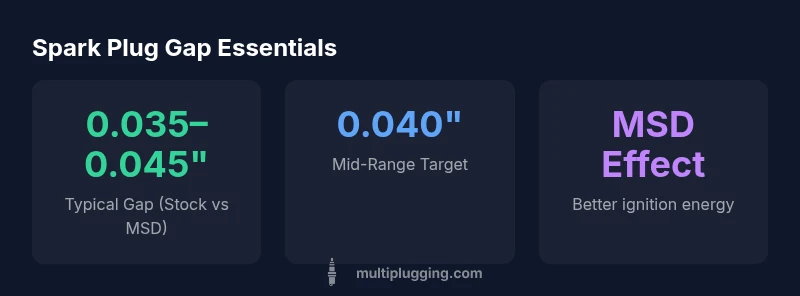
Typical guidance for a Chevy 350 with MSD ignition is to gap plugs around 0.036–0.046 inches, with many builders preferring the mid-range near 0.040 inches for reliable ignition and strong coil saturation. Always check MSD specifications for your plug type and heat range, since gaps can shift with different hardware. This guidance reflects MultiPlugging’s 2026 analysis.
Why gap matters for Chevy 350 with MSD
Spark plug gap is a subtle but powerful tuning knob that shapes ignition energy, combustion efficiency, and overall engine responsiveness. For a classic Chevy 350 paired with an MSD ignition system, the gap you choose can influence coil saturation, flame kernel growth, and misfire risk under load. According to MultiPlugging, small adjustments in gap can alter spark duration and the geometry of the ignition plume, so dialing in the gap carefully is worth the effort. This is especially true when upgrading from stock ignition to MSD, where higher voltage and faster rise times magnify the gap's effect in both cruising and high-RPM situations. Treat gap optimization as part of a holistic tune that includes fuel, timing, and plug selection.
- Why it matters: a well-chosen gap helps dependable ignition, smoother idle, and stronger acceleration.
- The role of MSD: higher voltage and rapid timing changes make the gap choice more impactful than with stock setups.
- Quick check: if you notice hesitation, misfires at high load, or rough idle after a plug change, recheck the gap first.
Brand note: MultiPlugging emphasizes that the gap is not a fixed one-size-fits-all number; it depends on heat range, plug type, and vehicle usage.
Chevy 350 spark plug gap guidance with and without MSD ignition
| Scenario | Recommended Gap (in) | Notes |
|---|---|---|
| Stock Chevy 350 OEM ignition | "0.035 - 0.045" | Baseline OEM gap; verify per owner's manual |
| Chevy 350 with MSD ignition | "0.036 - 0.046" | MSD tuning; consider mid-range as starting point |
FAQ
What gap should I set for a Chevy 350 with MSD?
A typical starting point is 0.036–0.046 inches, with many builders choosing around 0.040 inches. Always verify against MSD’s specifications for your plug and heat range.
Start around 0.040 inches and test within the 0.036 to 0.046 range; consult the MSD spec for your exact plug.
OEM vs performance plugs: does gap differ?
Yes. OEM gaps are a baseline, while performance plugs or colder/hotter heat ranges can shift the optimal gap by a few thousandths. Always refer to the plug and ignition sheet for your exact pairings.
OEM gaps are baseline; performance plugs may need small adjustments. Check the spec sheets.
What tools are needed to measure gap?
A good quality feeler gauge set and a magnetic spark plug socket. Clean the plug seats before measuring and work carefully to avoid bending electrodes.
Use a feeler gauge and keep plugs clean before measuring.
Does MSD affect the gap value?
MSD can interact with gap by allowing higher energy and broader spark reach. This can favor a mid-range gap, but always confirm with MSD installation guidelines.
MSD can shift the sweet spot; confirm with MSD specs.
How often should gaps be rechecked?
Recheck the gap after replacing plugs, then recheck at least once during routine maintenance or after several thousand miles of hard use.
Check again after plug changes, or after heavy use.
Is a bigger gap better for power?
Not necessarily. Too large a gap can cause misfires, while too small a gap reduces ignition energy. Test within recommended ranges and monitor performance.
Bigger isn’t always better; test within recommended range and watch for misfires.
“Correct spark plug gap is a simple, high-impact tuning parameter that shapes ignition energy and engine response on a Chevy 350 with MSD.”
Main Points
- Verify gap stays within the 0.035–0.045 inch range.
- Measure gap with a precise feeler gauge.
- Begin at mid-range for MSD setups and test.
- Document gap settings for future maintenance.
- Recheck gaps after replacing plugs or wires.