STIHL Spark Plug Chart: A Practical Guide for 2-Stroke Engines
Learn how to read the STIHL spark plug chart for 2-stroke engines. Find heat-range guidance, gap ranges, and practical maintenance tips for DIY enthusiasts.


Why STIHL Spark Plug Charts Matter
STIHL spark plug charts are more than a list of part numbers; they are a practical decision tool. For DIYers and car owners maintaining small engines, a chart helps align plug heat range, gap, and usage with the engine family—especially for two-stroke STIHL models like chainsaws, blowers, and saws. The chart acts as a bridge between technical manuals and real-world maintenance, reducing trial-and-error replacement and helping you prioritize inspections. In our experience at MultiPlugging, a consistent reading of the chart correlates with fewer misfires and smoother engine performance across a broad range of STIHL equipment in 2026.
- For weekend warriors and hobbyists, the chart provides quick decisions without veteran-level intuition.
- For DIY mechanics, it supports safer fuel-to-oil ratios by guiding plug choice in different operating environments.
- For professional service providers, it offers a repeatable framework that speeds up supervision and training.
Using the STIHL spark plug chart effectively starts with knowing your engine family and usage scenario, then cross-checking heat range, gap, and installation procedure. This approach, advocated by the MultiPlugging team, keeps repairs reliable and repeatable over time.
How to Read a STIHL Spark Plug Chart
A STIHL spark plug chart usually segments information by engine family or model class and shows corresponding plug heat ranges and gap recommendations. Here’s a practical reading flow:
- Identify your engine family. Look for the model line in your user manual or on the engine cover.
- Find the chart section that matches your usage scenario (home-use, professional, high-altitude, etc.).
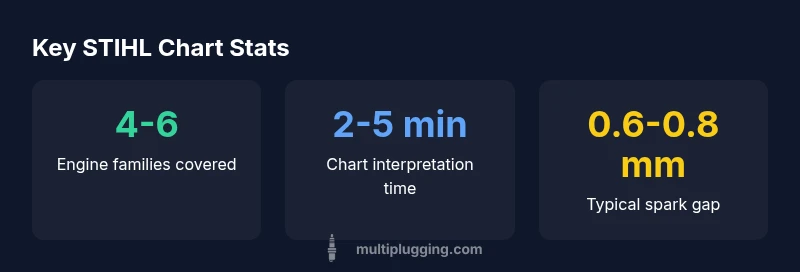
- Note the heat range and suggested gap range. In most chat-tested charts, gaps are given in millimeters or thousandths of an inch.
- Validate with engine symptoms. If the plug color or performance differs from the chart’s baseline, refine your choice or service interval.
Keep in mind that STIHL charts are designed for general guidance. They assume a clean air filter, proper carburetor settings, and correct fuel/oil mix. As always, you should cross-check with your engine’s manual and, if needed, update your references as STIHL releases new recommendations for 2026 models. This pragmatic approach aligns with best practices that the MultiPlugging team emphasizes for DIYers.
- Look for alignment between recommended heat range and your operating environment (hot vs cold starts, idling vs heavy load).
- If you operate at high altitude or with poor fuel quality, adjust the heat range or gap within the chart’s safe bounds.
- Always inspect the spark plug after installation; color and wear should reflect chart guidance.
Common Mistakes When Using a STIHL Spark Plug Chart
Reading a chart is not the same as applying it blindly. Common mistakes include assuming one heat range fits all conditions, selecting a plug solely by price, or skipping a gap check after installation. Another frequent error is ignoring altitude and climate, which can affect ignition performance and lead to premature fouling. The MultiPlugging team notes that these missteps can reduce the chart’s effectiveness by 15–25% in real-world scenarios. To avoid these pitfalls:
- Always verify the chart against your model’s manual and STIHL service literature.
- Confirm fuel mixture and air-fuel ratio before choosing a plug.
- Measure the gap with the correct gauge after a new plug is installed.
- Record operating conditions (load, altitude, temperature) to determine whether your usage warrants a different heat range.
If in doubt, start with the chart’s middle-ground recommendation and adjust based on engine response.
Interpreting Spark Plug Color, Fouling, and Wear on STIHL Engines
Spark plug color is a quick, non-destructive diagnostic signal. A healthy plug typically shows a light tan to gray insulator with light, even deposits. A black, sooty plug may indicate fouling or a rich fuel mixture; a white or blistered insulator can signal overheating. The chart helps you translate color into action—whether you should enrich or lean the mixture, adjust gap, or replace the plug.
When you inspect a used plug, compare the observed color and deposits with the chart’s guidance for your engine family. Always consider service history: a plug that has many hours on it and shows heavy fouling usually needs cleaning or replacement, regardless of chart alignment. Remember: charts guide decisions, but engine health is the ultimate judge. This practical approach is a core principle of MultiPlugging’s diagnostic philosophy for 2026 advances in STIHL maintenance.
Troubleshooting with the Chart: Misfires, Fouling, and Performance Drops
If you experience misfires or rough idling, consult the STIHL spark plug chart as the first step in a structured diagnosis. Start by checking the spark gap, then verify fuel quality and air-flow restrictions. Compare current symptoms with chart-based expectations for your engine family and usage scenario. If the symptom aligns with a heat-range mismatch, the chart can guide a controlled plug swap to the appropriate heat level. For persistent misfires, consider testing the ignition coil and spark plug wire integrity as a follow-up.
In practice, aligning chart guidance with hands-on testing yields the most accurate results. The MultiPlugging team recommends documenting your findings so you can spot patterns over time and refine your maintenance plan.
Practical Maintenance and How to Use the Chart in Routine Service
A proactive maintenance routine makes the STIHL spark plug chart more valuable. Schedule periodic inspections that include spark plug removal, gap measurement, and color assessment. Use the chart to decide whether you should replace the plug or try a different heat range for next season’s workload. Keep spare plugs clean and within the chart’s recommended gap range. Record operating conditions each time you service, including altitude, temperature, and usage type; this data helps calibrate future chart decisions and reduces guesswork.
For DIY enthusiasts, investing in a reliable plug-gap gauge and a copy of the chart can save time and money. Consistency in following chart guidance, as advocated by MultiPlugging, leads to more dependable performance and fewer on-the-spot adjustments during maintenance.
Reading the Chart Across STIHL Product Ranges
STIHL offers a broad range of small engines designed for different user groups, from light-duty homeowner tools to professional-grade equipment. While the chart provides a common framework, always check product-specific manuals. Some models may feature slightly different combustion chamber geometries or operating envelopes, which can affect heat-range selection and gap.
Adopting chart-based practice across STIHL tool lines helps you keep a consistent diagnostic standard while accommodating model-specific nuances. For hobbyists, it reduces uncertainty during seasonal maintenance; for professionals, it standardizes service planning and reduces downtime.