Is It Spark Plugs or Battery? A Practical DIY Diagnostic Guide
A practical, evidence-based comparison of spark plug and battery health to help DIYers diagnose starting issues. Learn a step-by-step workflow, common symptoms, replacement costs, and maintenance tips.


Is it spark plugs or battery? In most starting problems, the battery is the first thing to test, but symptoms like misfires, rough idle, or poor acceleration point to worn spark plugs. Do a battery voltage test and a fuel/ignition check: if the battery holds charge and the engine still misfires after cranking, inspect or replace spark plugs in sequence. This quick triage helps avoid unnecessary parts changes.
The Core Question: is it spark plugs or battery?
When your car won't start or runs poorly, diagnosing the cause can feel like a riddle. The simplest rule of thumb is to start with the component that directly affects starting and idle: the battery. If the engine cranks slowly or there are dim lights, focus on the battery and charging system first. If the engine cranks smoothly but runs rough, misfires, or stalls, the culprit is more likely the spark plugs or ignition system. In this article, we compare spark plugs and battery health, and provide a practical diagnostic workflow that car owners can perform with common hand tools. According to MultiPlugging, a clear triage approach reduces unnecessary replacements and helps you pinpoint the root cause faster. The goal is to create a repeatable process that you can apply to most gasoline-powered engines. The keyword is is it spark plugs or battery, which is a question you’ll often hear in DIY groups and service shops. By understanding the roles and signs of wear for both components, you’ll save time and money while keeping your engine reliable. In short, start with the battery, but verify the spark plugs as you go, especially if the car shows misfire symptoms. This approach aligns with best practices from the MultiPlugging Team in 2026.
Battery symptoms: starting issues pointing to the battery?
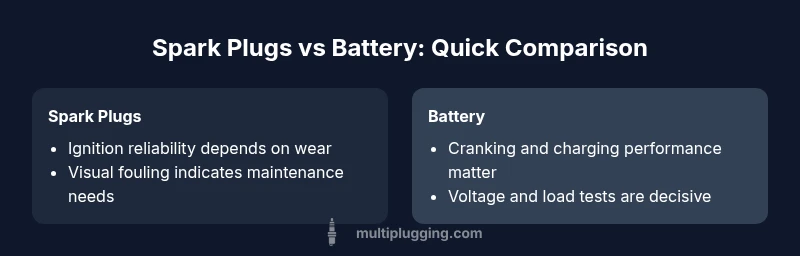
A weak or failing battery often reveals itself in starting problems rather than in driving performance. Common signs include a slow crank, a rapid click when turning the key, dashboard lights that dim during cranking, and occasional no-start events after sitting overnight. Cold climates amplify battery weakness, and parasitic drains from accessories can accelerate failure. A visual check for corrosion on terminals, and an infrared check of cable resistance, can help. To confirm, perform a battery voltage test with the engine off and a load test with the engine running. If the voltage remains low or drops under load, the battery is the likely culprit and should be replaced or charged. MultiPlugging’s 2026 analysis emphasizes testing the charging system (alternator, starter) together with the battery, since a bad alternator can show the same symptoms as a dying battery.
Spark plug symptoms: faults and signs of wear
If the engine craves more fuel, misfires, or runs unevenly, you’re likely dealing with spark plugs or the ignition system. Worn, fouled, or gapped plugs can cause rough idle, hesitation on acceleration, and reduced power. A misfire may trigger OBD-II codes like P0300 or related cylinder-firing codes, depending on the engine. Other signs include poor fuel economy, rough start after a cold soak, and visible deposits on the electrodes. Inspect the plug condition: worn electrodes, oil-fouling, or heavy carbon buildup are red flags. In many engines, incorrect gaps can cause weak sparks; in others, oil-burning engines lead to plug fouling. When you suspect spark plugs, you should also consider wires and coils as potential contributors to misfiring. After inspection, replace plugs according to the manufacturer’s torque specification and gap, then recheck engine performance.
Diagnostic workflow: a practical step-by-step test plan
Begin with the easy checks that cost nothing and escalate to parts replacement only when tests justify it. Step 1: perform a basic starting test—crank with the lights off to avoid parasitic drain and listen for slow-crank symptoms. Step 2: measure battery voltage with the engine off (should be around 12.6V for a healthy 12V system) and perform a load test if possible. Step 3: inspect spark plugs for wear, fouling, and proper gap; remove one plug at a time to test continuity and spark strength with a known-good coil. Step 4: test ignition wires and coils for resistance and function. Step 5: verify compression and fuel delivery if misfires persist after plug and battery checks. The sequence minimizes unnecessary replacement and ensures you address the root cause. Remember to wear eye protection and follow the vehicle’s service manual torque specs. This workflow helps you answer the question is it spark plugs or battery with confidence.
Testing methods: quantifying battery and spark plug health
A reliable approach combines electrical tests with careful visual inspection. For batteries, measure open-circuit voltage first, then perform a load test or conduct a conductance test with a dedicated tester. For spark plugs, remove each plug, inspect electrode wear and deposits, and measure the gap; compare to the OEM spec. A properly conducted spark test uses a spark tester or a test coil with a known-good ignition wire. If you replace plugs, choose the correct heat range and electrode design for your engine. If you cannot access the plugs easily, consult service documentation or a tool rental option. The goal is to quantify the health of both components before spending money.
Replacements and cost considerations: when to swap spark plugs vs battery
Costs vary by vehicle and region, but you will typically see separate price ranges for each component. Spark plug replacement costs depend on plug type (copper, platinum, or iridium), labor, and labor complexity. A DIY spark plug change is usually affordable if you have the right tools, but premium plugs and engines with difficult access can raise the price. A new battery price depends on cold-cranking amps (CCA), reserve capacity, and vehicle requirements, with higher upfront costs for advanced batteries but longer service life in harsh climates. When deciding, weigh the predicted lifetime against current symptoms. A misfire in the first 1000 miles after a plug change often indicates a wiring or coil issue rather than the plug itself. Good practice is to replace both components in matching maintenance intervals if recommended by your manufacturer, or to follow a sequential approach if one part clearly tests weaker than the other.
Maintenance strategies: extending life and avoiding premature failures
Proactive care extends both battery and spark plugs. Regularly clean corrosion from battery terminals, ensure tight connections, and keep battery charging systems in good order. For spark plugs, follow the OEM replacement intervals and use the exact heat range and electrode design. Use anti-seize compounds only where recommended, and avoid over-tightening plugs to prevent thread damage. Keep plugs gapped to manufacturer specifications and inspect them during routine services. The goal is to catch wear before it becomes a fault, reducing the risk of a no-start or misfire. MultiPlugging notes that consistent maintenance reduces both battery and plug failures and improves engine reliability across 2026.
Real-world scenarios: common mistakes and how to avoid them
In cold weather, a weak battery is often the root cause of starting trouble, but a technician may misattribute it to poor spark performance if the plugs are visibly fouled from oil or carbon. In high-mileage engines, failing plugs often masquerade as misfires even after a battery test. Always verify the plug condition after a battery test, and never assume the plug type is correct without checking the gap. DIYers sometimes replace a battery without checking the alternator’s performance; a healthy battery can still fail if the charging system is weak. The MultiPlugging team emphasizes following a methodical, repeatable diagnostic flow to avoid these errors in 2026.
Decision framework: how to choose your next steps for your car
Use a simple decision framework: begin with battery health, then inspect spark plugs if starting issues persist. If your alternator and starter pass tests, and the battery is healthy, focus on spark plugs or ignition components next. If misfires persist after plug replacement, examine coil packs and wires. This structured approach makes the is it spark plugs or battery question easier to answer and helps you build a maintenance plan that extends engine life. By applying the recommended workflow and replacing parts with correct torque and gap, you’ll keep your engine running smoothly. The MultiPlugging team recommends adopting this workflow for 2026 and beyond.
Comparison
| Feature | Spark Plugs | Battery |
|---|---|---|
| Symptoms | Misfires, rough idle, hesitation | Slow crank, dim lights, failure to start |
| Replacement interval | Type-dependent; copper ~30k-60k miles; platinum/iridium longer | Typically 3-5 years depending on climate |
| Tools needed | Spark plug socket, torque wrench | Multimeter, battery tester |
| Cost range | $3-15 per plug (parts); DIY friendly | $60-200 (battery), varies by model and climate |
| Best for | Engine performance, fuel economy, smooth running | Starting reliability and cold-weather performance |
Strengths
- Clear diagnostic pathway for common starting and running issues
- DIY-friendly tests can save money and time
- Parts are widely available across brands and vehicles
- Systematic testing reduces unnecessary replacements
Negatives
- Misdiagnosis risk if tests are not performed properly
- Battery issues can reoccur in extreme cold climates
- Spark plug replacement requires correct torque and gap
Battery health first; spark plugs are a common follow-up if issues persist
A battery-first diagnostic approach resolves most starting problems. If the engine runs rough or misfires after the battery check, focus on spark plugs and ignition components. A structured workflow minimizes wasted repairs and aligns with best practices from MultiPlugging in 2026.
FAQ
Is it better to test the battery before checking spark plugs?
In most cases, start with a battery health test because starting symptoms usually relate to the battery. If the battery checks out and problems persist, inspect the spark plugs next. This sequence minimizes unnecessary replacements.
Test the battery first; if it passes, move on to spark plugs.
Can a no-start be caused by a faulty spark plug?
Yes. A fouled or worn spark plug can prevent ignition and cause a no-start condition. Inspect plugs, then test ignition components if needed.
A bad spark plug can prevent the engine from starting.
How often should spark plugs and batteries be replaced?
Spark plug intervals vary by type (copper, platinum, iridium) and engine design, typically 30k-100k miles. Batteries generally last about 3-5 years depending on climate and usage.
Plugs last longer; batteries usually shorter.
Should I test the battery before replacing spark plugs?
Yes. A battery test confirms whether starting issues come from the battery or from ignition components like the plugs.
Test the battery first to rule it out.
Are spark plugs hard to replace?
Many engines allow DIY replacement with common tools, but some models need special adaptors or restricted access. Always follow torque specs.
Plug replacement is doable with the right tools and care.
What tools do I need to diagnose spark plugs vs battery?
A multimeter, battery tester, spark plug socket, and torque wrench cover most jobs. A scan tool helps identify misfire codes.
You’ll need basic diagnostic tools to differentiate.
Main Points
- Test battery health before replacing parts
- Inspect spark plugs when misfires or rough running occur
- Use a step-by-step diagnostic flow to avoid wasteful fixes
- Maintain both components to extend engine life