How to Tell If Spark Plugs or Coils Are Bad: Urgent Troubleshooting
Urgent guide to diagnose spark plug and ignition coil problems. Learn how to tell if plugs or coils are bad, how to test, and safe fixes to restore engine performance.


Symptoms like rough idle, misfires, or hard starting often point to the spark plugs or ignition coils. The fastest check is a visual inspection, followed by a spark plug tester or a scan tool for misfire codes. If you’re unsure, start with the plugs, then test the coils, and consider replacement in batches to save time.
How to tell if spark plugs or coils are bad: quick orientation
If you're trying to tell if spark plugs or coils are bad, focus on symptoms and simple checks you can do today. The MultiPlugging team emphasizes a practical, stepwise approach: verify codes, inspect components, and isolate the faulty item before replacement. This guide focuses on the most common failure modes and gives you a safe, DIY-friendly path to restore performance. Visual signs (fouling, glazing, worn electrodes) and performance symptoms (rough idle, misfires, hard starts) are your first clues. Addressing ignition problems early saves fuel and prevents catalytic converter damage. When in doubt, rely on proven diagnostic steps rather than guessing, especially if your vehicle is older or has high mileage.
Visual and performance cues that help differentiate plug vs coil problems
Identify signs to narrow down the culprit. If the engine has a rough idle and frequent misfires only under load, the plugs or wiring could be suspect. If misfires are random and occur on multiple cylinders or if the engine runs with a loss of power but the plugs look clean, a coil issue is more likely. Use a systematic approach: inspect plugs for fouling (carbon, oil), inspect boots and wires for cracks, and check ignition coils for heat spots or damage. Clarify the typical fault signatures: worn plugs show consistent color and gap; failing coils often produce back-to-back misfires on multiple cylinders.
Safe, quick checks you can perform now
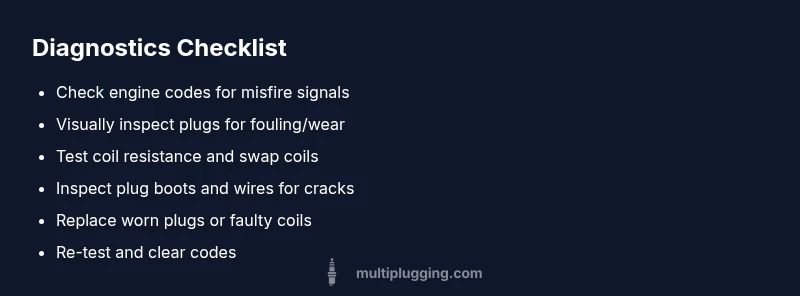
- Park on a flat surface, engage the parking brake, and ensure the engine is cool before touching ignition components. - Disconnect the battery negative terminal before removing any ignition components to reduce shock risk. - Check for trouble codes with an OBD-II scanner; note P0300-P0304 misfire codes and any cylinder-specific codes. - Inspect a few plugs: look for oil fouling, black carbon, or worn electrodes; measure gap against the service spec. - For coil-on-plug systems, gently swap a suspect coil with a known-good cylinder and observe whether the misfire follows the coil. - If available, use a spark plug tester to verify energy delivery or perform a controlled swap test to confirm the culprit.
Next steps: testing tools and when to seek professional help
If basic checks don’t reveal a clear culprit, prepare for more precise testing: resistance checks on coils with a multimeter, compression tests if you suspect a mechanical issue, and a weathered spark plug inspection for signs of oil leaks. A failing coil or plug will usually move with a swap test, while a healthy part remains stationary. If you encounter oil in plug wells, coolant intrusion, or high-voltage safety concerns, it’s time to bring in a qualified technician. Routine maintenance and timely replacements reduce the risk of catalytic converter damage and improve reliability.
Steps
Estimated time: 60-90 minutes
- 1
Safety prep and initial checks
Park the vehicle on a flat surface, engage the parking brake, and disconnect the battery negative terminal. Wear safety glasses and gloves. Clear the work area of any loose objects and ensure you have proper lighting. This step reduces risk when handling high-voltage components and sharp tools.
Tip: Double-check that the engine is cool before touching ignition parts. - 2
Scan for codes and note symptoms
Connect an OBD-II scanner and record any misfire codes (P0300-P0304, cylinder-specific codes) and live data. Note engine temperature, RPM, and load. This creates a baseline to correlate with physical checks.
Tip: Take photos of any codes and hose routing for reference. - 3
Inspect spark plugs visually
Remove accessible spark plug boots and inspect the plug electrodes, insulator color, and any fouling. Worn electrodes or oil/fuel fouling indicate plug problems. Measure the gap and compare to the manufacturer spec.
Tip: Keep track of which cylinder each plug comes from for reinstallation. - 4
Test ignition coils (or swap test)
For coil-on-plug, test coil resistance with a multimeter and compare to spec. If a spare coil is available, swap it with a suspect cylinder and observe whether misfire follows the coil.
Tip: Always disconnect the electrical connector before measuring resistance. - 5
Test spark energy and wiring
If you have access to a spark tester, check energy output from each plug. Inspect plug wires or boots for cracks or arcing. Re-seat connectors firmly to ensure good contact.
Tip: Replace deteriorated boots to prevent intermittent misfires. - 6
Decide replacement strategy
If a single plug or coil tests bad, replace that part. If several show wear or fouling, consider replacing in a matched set to maintain even performance. Re-gap after installation and re-check engine codes.
Tip: When in doubt, refer to the service manual for torque specs and sequence.
Diagnosis: Engine runs rough, misfires, hard starting, or reduced power
Possible Causes
- highWorn or fouled spark plugs
- highFailed ignition coils
- mediumDamaged spark plug wires or boots
- lowOil or fuel fouling on plugs
Fixes
- easyReplace worn/fouled spark plugs with the correct gap
- mediumTest and replace faulty ignition coils; use swap tests to confirm
- easyInspect/replace spark plug wires or boots; ensure solid connections
- mediumAddress root causes (oil leaks, fuel contamination); clean or replace affected plugs
FAQ
What are the first signs that spark plugs are bad?
Rough idle, misfires, and hard starting are common early signs of worn plugs. Inspect color and gap, and consider oil or fuel fouling as potential causes. If you observe consistent symptoms across multiple starts, test both plugs and ignition coils.
Rough idle and misfires often point to bad plugs; inspect color, gap, and consider coil health as well.
Can bad ignition coils cause misfires if plugs are new?
Yes. A bad coil can cause misfires even when plugs are new. Use a swap test or a cylinder-specific code to confirm which component is failing.
Yes, coils can cause misfires even with new plugs; swap tests help verify.
Should I replace coils in pairs on a coil-on-plug system?
If one coil fails, replace the faulty unit. Some technicians replace in pairs to balance performance, but evidence from testing should guide the decision.
Sometimes you replace just the faulty coil, but many professionals prefer replacing in pairs for balance.
How can I test ignition coils at home safely?
Use an OBD-II scan for misfire codes and a multimeter to check coil resistance. A swap test—moving a coil to another cylinder—often confirms the culprit.
Swap tests plus a multimeter check are common home methods.
What costs should I expect to fix spark plugs and coils?
Costs vary by vehicle and parts quality. Plugs are typically cheaper than coils. Always get a diagnostic quote before buying parts.
Prices vary; a shop can give a precise quote after testing.
Watch Video
Main Points
- Start diagnostics with codes, then plug health, then coil tests.
- Visual plug fouling points to fuel/oil issues; coil problems often misfire across cylinders.
- Use swap tests to isolate the faulty component quickly.
- Replace worn plugs and failing coils in a controlled, logical manner to protect engine health.
- Maintain a maintenance log to spot misfire patterns and prevent repeats.