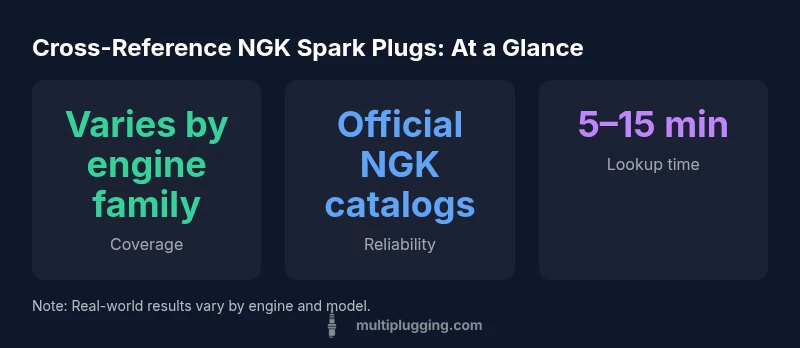
Cross-Reference NGK Spark Plugs: A Practical Guide
Master cross-referencing NGK spark plugs with reliable charts, official catalogs, and step-by-step checks to ensure engine performance and safety. Learn how to verify compatibility and install the right replacement.


Cross-reference ngk spark plug refers to the process of matching NGK part numbers to equivalent plugs from other brands, ensuring compatibility by thread size, reach, and heat range. This quick definition helps DIYers navigate catalogs when a specific NGK is unavailable. In practice, always verify cross-reference results with official NGK documentation before purchasing or installing.
What cross-reference ngk spark plug means
At its core, the phrase cross-reference ngk spark plug describes a mapping from an NGK part number to one or more substitutes from other brands that fit the same engine, cylinder head, and performance requirements. This concept is essential for DIY enthusiasts who run into stock-outs, regional availability issues, or when an aftermarket shop suggests an equivalent part. The value becomes clear when you maintain awareness of three core dimensions: thread size, reach, and heat range. While the NGK designation remains a gold standard for spark plug quality, a well-documented cross-reference enables you to source a compatible plug without sacrificing engine performance or warranty coverage. According to MultiPlugging, understanding this mapping helps you navigate catalogs confidently and avoid misfires caused by mismatched specifications.
In practice, a cross-reference is not a one-size-fits-all shortcut. The same NGK number may map to several compatible plugs across brands, but those substitutes will differ in fitment specifics or design details. Always begin with the engine’s OEM specification and then compare the cross-reference results against those specs. If you are unsure, consult the official NGK cross-reference catalog and compare the engine family, model year, and emission controls to confirm compatibility. Tools like a printed catalog, official website, or dealer portals greatly improve accuracy and reduce the risk of install errors.
Practical takeaway: use cross-reference ngk spark plug as a guide, not a guarantee. The goal is to narrow to a short list of candidates that you then verify against your engine’s exact specs and NGK’s official documentation. This approach minimizes misfires, reduces warranty questions, and keeps maintenance costs predictable.
How NGK cross-reference catalogs are organized
NGK organizes cross-reference information by engine family, spark plug type, and compatibility notes. The catalogs present NGK part numbers alongside substitute numbers from other brands that have identical thread patterns, reach measurements, heat ranges, and electrode configurations. A well-structured catalog will also flag any engine-specific constraints, such as turbocharging, high-compression scenarios, or emission-control requirements that might affect a plug choice. For DIYers, the key is to learn where your engine’s original NGK code sits in the catalog and then review the corresponding cross-reference entries for the same engine family.
NGK catalogs often differentiate between conventional, platinum, and iridium plugs, which influences performance and replacement intervals. When you see a cross-reference, you should verify whether the substitute shares the same heat range rating and the same terminal type. The broader lesson is that cross-referencing works best when you compare multiple catalog entries for the same engine to ensure full compatibility. The MultiPlugging team notes that relying on a single catalog page can be risky if that page omits engine-specific restrictions or revision changes.
Beyond the printed catalog, many manufacturers maintain online cross-reference tools. Using these tools in parallel with the official NGK catalog boosts accuracy and keeps you aligned with current part numbers, as NGK periodically updates cross-references to reflect new engine platforms or revised standards.
How to verify a cross-reference in practice
To verify a cross-reference effectively, start by collecting three data points: the engine’s exact model year, the OEM spark plug specification (as listed in the owner’s manual or service bulletin), and the NGK reference number you want to cross-reference. Then, perform a three-step check: (1) confirm thread size and reach to ensure the plug threads into the combustion chamber properly; (2) compare the heat range and electrode design with the OEM spec; and (3) examine the ignition system compatibility, including ignition coil impedance and ECU tolerances for the engine family. If any one of these dimensions does not align, a cross-reference is inappropriate for your application. Always cross-check the NGK catalog entry and the substitute’s datasheet. If there’s any discrepancy, default to the NGK specification rather than the substitute. The MultiPlugging approach emphasizes documenting each check so you can reproduce successful replacements in future maintenance.
When you’re done, perform a careful visual inspection during installation: verify the gasket seat is clean, the threads are free of debris, and the torque is within the manufacturer’s specification. Over-tightening can cause thread damage, while under-tightening may lead to misfires. For engines with performance tuners or modified exhaust systems, additional checks may be necessary to prevent fouling or misfiring under high load conditions. A conservative, methodical cross-reference process minimizes post-install issues and keeps the engine running smoothly.
Tools and resources for cross-referencing
A well-rounded cross-reference workflow relies on three main tools: the official NGK cross-reference catalog, the engine’s service manual, and a trusted parts retailer’s database. Start with NGK’s own cross-reference pages because they provide the most authoritative mappings and any engine-year-specific restrictions. Next, consult the service manual for your vehicle’s exact spark plug torque specifications, heat range expectations, and recommended replacement intervals, since some engines require precise recommendations that differ from generic mappings. Finally, use a reputable retailer’s catalog or dealer portal to compare current stock and verify compatibility with your region’s availability. When possible, cross-check all three sources to confirm a plug’s fitment before purchase.
If you operate a modern vehicle, you should also compare the NGK replacement with the OEM part’s performance notes, including ignition timing considerations and any notes about cold-start behavior or misfire codes. In some cases, a cross-reference might map to a different brand’s plug that provides similar performance, but only under certain operating conditions. The practical takeaway is to collect sources, confirm specs, and document the verification steps so you can repeat the process confidently for future maintenance.
Practical tip: save a short, engine-specific cross-reference note in your vehicle maintenance log. This note should include the NGK number, the substitute brand, the verified engine specs, and the final installation verdict. This habit makes future replacements faster and reduces the risk of incorrect plugs during busy maintenance windows.
Common pitfalls when cross-referencing NGK spark plugs
One of the most common pitfalls is assuming that any plug with the same thread pitch will fit. Engines care about heat range, reach, and electrode design, not just threading. Using a cross-reference that changes heat range or electrode geometry can alter combustion efficiency, fuel economy, and emissions. Another frequent mistake is ignoring engine-specific restrictions, such as turbocharged setups, high-horsepower applications, or certain emission-control systems. Always confirm the cross-reference with the engine’s original specification and NGK’s official charts. A third pitfall is relying solely on a single catalog entry. If you consult only one source, you risk missing revisions or region-specific variations. Always corroborate across NGK documentation, the service manual, and trusted retailer databases.
Finally, neglecting installation best practices can undermine a correct cross-reference. Ensure the plug is properly gapped (if applicable), the threads are clean, and a light anti-seize coating is used if recommended by NGK. Overlooking torque specifications can cause poor seating, which leads to misfires and performance problems. By avoiding these pitfalls, you’ll minimize risk and maximize the reliability of replacements based on cross-reference ngk spark plug mappings.
Reading cross-reference charts: a practical walkthrough
Imagine you’re maintaining a common passenger car and the engine requires an NGK plug, but you only have a substitute brand in stock. A cross-reference chart will show you the NGK equivalent and may display several candidates. The first step is to verify that the NGK entry and the substitute share identical thread size and reach. The second step is to compare heat range and electrode design to ensure combustion characteristics align with the engine’s ignition timing and fueling strategy. The third step is to review any engine-family notes that mention turbocharging, direct injection, or high-load operation, which can affect plug performance. If a substitute matches all these criteria, proceed to purchase the substitute under the guidance of the NGK catalog. This walk-through highlights why a careful, source-verified cross-reference strategy is essential.
When you’re ready to install, follow the engine manufacturer’s torque spec and cleaning recommendations. If you’re unsure about a specific cross-reference, contact an authorized dealer or the NGK technical help desk for confirmation. The goal is to complete the cross-reference with certainty and then perform a cautious test drive to observe idle stability, throttle response, and overall driveability.
Field testing and installation considerations
After selecting a cross-reference ngk spark plug substitute and confirming compatibility, field testing is critical to validate the choice. Start with a cold-start check to confirm combustion stability and smooth idle. During the initial drive, monitor for any rough running, misfires, or hesitation that could indicate a mismatch in heat range or gap. If the engine exhibits abnormal behavior, halt the test and re-check the cross-reference against NGK’s official charts and the engine’s service manual. When you are confident the plug is compatible, finalize the installation by following torque specifications precisely and applying any recommended anti-seize or dielectric compounds if dictated by the manufacturer. Keep a log of the plug type, date of installation, and observed performance to streamline future maintenance.
For engines with emissions controls, ensure the plug choice does not trigger fault codes or catalyst-related issues. If you notice an increased exhaust emission or a Check Engine light after switching to a cross-reference plug, revert to the original NGK specification or consult a professional technician. A disciplined, data-backed approach to cross-referencing helps sustain engine reliability over time.
Real-world scenarios and decision matrix
In the real world, cross-reference ngk spark plug usage often comes down to drivers encountering stock shortages, regional availability, or fleet maintenance constraints. A typical decision matrix begins with the engine’s OEM spec and the NGK catalog cross-reference. If a substitute brand maintains the same heat range, thread size, and gap, it can be a viable option. When in doubt, you can create a quick decision matrix: (1) Is the replacement identical in key dimensions? (2) Does NGK documentation authorize the substitute for the engine family? (3) Are there any region-specific notes or warranty considerations? By answering these questions, you can decide quickly and act confidently, minimizing downtime.
A practical tip for fleets or shared vehicles is to maintain a short list of trusted cross-reference substitutes that have been verified for specific engine families. This targeted approach reduces downtime during maintenance windows and ensures consistent performance across vehicles. Remember to document each decision and store the cross-reference sources in a centralized location so future service intervals remain efficient and consistent.
Building a quick, repeatable cross-reference workflow
To make cross-referencing ngk spark plug replacements repeatable, adopt a simple workflow you can reuse for any vehicle. Step one: collect the engine family, model year, and OEM plug specification from the service manual. Step two: consult the NGK catalog for the official cross-reference mappings and identify 2–3 substitutes with identical thread size, reach, and heat range. Step three: cross-check the substitutes against an alternative catalog to confirm consistency. Step four: verify with the dealer or NGK technical support if any discrepancy arises. Step five: log the final choice, installation notes, and observed performance for future maintenance.
This workflow keeps your cross-reference process predictable and repeatable across different vehicles, reducing uncertainty for DIYers and professional technicians alike. By formalizing the procedure, you can confidently respond to stock-outs, enabling faster maintenance without compromising engine safety.
Sample cross-reference mappings to NGK equivalents
| Cross Reference Source | NGK Equivalent | Notes |
|---|---|---|
| Generic Brand A | NGK cross-reference: see official catalog | Use only if listed in engine’s OEM spec |
| Generic Brand B | NGK cross-reference: verify with data sheet | Check thread size, heat range, and gap specifications |
| Official NGK Catalog | NGK equivalents by engine family | Best source for verified replacements |
FAQ
What is meant by 'cross reference' for NGK spark plugs?
A cross-reference maps an NGK part number to equivalent plugs from other brands that fit the same engine and meet the same specifications. It helps you source a compatible plug when the exact NGK part isn’t available, but you must verify compatibility with official NGK documentation.
A cross-reference maps NGK plugs to suitable substitutes from other brands, but you should always verify compatibility with official NGK docs.
Why do cross-references differ across engines?
Different engines require specific heat ranges, thread sizes, and reach. A substitute plug must match all these dimensions, not just the thread pitch, to prevent misfires and performance issues.
Because engines vary in heat range and physical specs, cross-references must match all key dimensions.
Can I use a cross-reference for a modern engine?
Yes, but you should verify with NGK catalogs and the vehicle’s service manual to ensure exact compatibility. Modern engines may have additional constraints from ECU tuning or emission controls.
Yes, but always double-check with official sources for modern engines.
Where can I find official cross-reference charts?
Official NGK catalogs and authorized dealer portals are the most reliable sources. Cross-reference charts are also included in vehicle service manuals and NGK technical bulletins.
Look up the official NGK catalogs and your service manual for the most accurate charts.
Are there risks using a non-NGK brand cross-reference?
Yes. A mismatched heat range or reach can cause misfires, poor fuel economy, or engine damage. Always ensure the substitute matches the OEM specs before installation.
Yes—mis-matched specs can cause misfires or damage; verify with official charts first.
How can I test if a cross-reference works?
Install the plug according to the engine’s torque specs, perform a controlled drive, and monitor for smooth operation and absence of diagnostic codes. If issues appear, revert to the original NGK specification.
Install carefully, test drive, and watch for misfires or codes; if issues arise, revert to NGK spec.
“Accurate cross-referencing is only as good as the documentation you rely on; always corroborate with NGK's official charts and engine specs.”
Main Points
- Use cross-reference as a guide, not a guarantee
- Always verify with NGK catalogs and OEM specs
- Double-check thread size, reach, and heat range
- Document the cross-reference for future maintenance
- Don't skip installation torque and gap checks