Is Autolite Spark Plugs a Good Brand? An Analytical Review
An in-depth, balanced evaluation of Autolite spark plugs addressing reliability, performance, cost, and installation for everyday drivers and DIY enthusiasts.


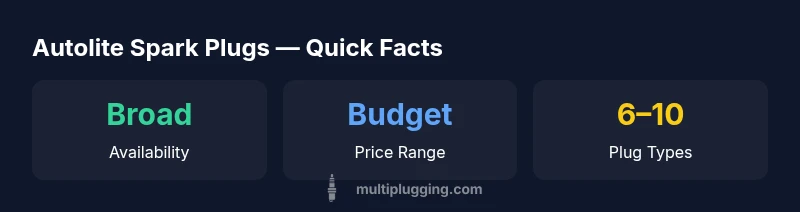
Autolite spark plugs are generally a solid, budget-friendly option for everyday drivers. They offer reliable ignition and wide availability, making them a practical choice for routine maintenance. For high-performance or turbocharged engines, you might opt for premium brands; however, Autolite trades on predictability, value, and ease of cross-reference for most commuters.
Brand overview and market positioning
Autolite spark plugs sit at the intersection of value and accessibility. The brand has a long history of producing replacement plugs for a wide range of makes and models, with a clear emphasis on affordability and broad fitment. For many DIY enthusiasts and everyday drivers, Autolite offers a convenient, widely available option at major retailers and online marketplaces. The MultiPlugging team notes that this accessibility is a major advantage for quick maintenance, especially when a spare plug is needed on a weekend garage project. While not always the top choice for performance enthusiasts, Autolite’s consistency and predictable pricing make it a strong contender for typical commuter cars and light-duty pickups. The goal is to provide reliable ignition without forcing owners to chase premium brands, unless engine design or owner preference calls for higher-end materials upon inspection.
Reliability and build quality across product lines
Autolite’s lineup spans copper-core plugs intended for basic reliability to platinum and iridium variants designed for longer life and smoother ignition at higher temperatures. The core concepts are familiarity, easy cross-compatibility, and predictable behavior across a wide range of engines. In general, Autolite plugs feature robust shells, consistent seating, and electrodes sized to perform well in everyday driving. The brand’s presence in head-to-head engine maintenance scenarios is often linked to its balance between cost and performance. For most drivers, a platinum or iridium version will provide a longer service life and a more stable idle than a basic copper plug, while remaining budget-friendly compared to premium brands. Real-world experience from the MultiPlugging team indicates that these differences become most noticeable under frequent short trips or stop-and-go driving.
Performance across vehicle types
Autolite plugs are well suited to typical gasoline engines found in many sedans, SUVs, and light-duty trucks. In older engines with looser tolerances, Autolite’s copper-core plugs deliver reliable ignition and quick re-gaps. In newer engines with advanced ignition control, platinum and iridium variants can help reduce electrode wear and maintain performance over longer intervals. While Autolite plugs will satisfy most daily drivers, they may not unlock top-end horsepower in turbocharged or high-performance machines where manufacturers choose proprietary iridium or copper alternatives optimized for high rpm and specific heat ranges. The takeaway: for the vast majority of road-going vehicles, Autolite plugs provide dependable performance that aligns with ordinary driving patterns, routine maintenance, and budget constraints.
Installation considerations and maintenance intervals
Before installing any spark plug, ensure the correct heat range and gap. Autolite plugs come in multiple heat ranges, and mismatches can cause rough idle or misfires. For most standard engines, gap is pre-set for a near-perfect fit, but it’s prudent to measure the gap after removal of a used plug and adjust to the vehicle’s spec. Modern engines that rely on precise ignition timing benefit from using a plug that matches OEM spec, and Autolite’s product lines typically align with common factory values. As with any spark plug, follow recommended replacement intervals based on your driving style: copper-core plugs are typically shorter-lived and used in budget applications, while platinum and iridium variants offer longer life in normal use. In harsh climates or heavy-stop-start driving, plan for more frequent changes.
How Autolite compares to competitors
Compared with mainstream competitors, Autolite often undercuts premium brands on price while offering compatible performance for the majority of daily drivers. When matched to engines that require a very tight heat range or specialized tip geometry, some owners may prefer brands with longer track records in performance applications. In terms of availability, Autolite products are widely stocked in retail chains and online retailers, which reduces downtime when replacements are needed on weekends. For DIY enthusiasts who enjoy cross-checking OEM part numbers, Autolite’s cross-reference options typically cover a broad set of vehicles, making it easy to choose a drop-in replacement that won’t break the bank.
Common criticisms and limitations
Some users report that Autolite plugs perform less consistently in extreme conditions, such as repeated high-load operation or severe cold starts, compared to premium brands. There can be batch-to-batch variation in seating depth or gap out of the box, which makes a quick inspection a good habit after purchase. For enthusiasts seeking the ultimate performance or longevity, especially in high-performance engines or forced-induction setups, OEMs or premium aftermarket brands might offer options with slightly different heat ranges and electrode designs. Finally, the string of price-centered promotions can tempt buyers into selecting a variant that doesn’t perfectly match their engine’s requirements.
Real-world testing approach
To evaluate Autolite in a real-world setting, start with a diagnostic check: scan for misfire codes and test ignition system components. If the engine is running poorly, inspect the spark plugs for fouling, electrode wear, and gap. Remove a plug and measure the gap with a caliper; compare to the vehicle’s service manual. Re-gap if required, reinstall with a modestly anti-seize applied to the threads (sparingly, if recommended by the manufacturer). When replacing, align the plug’s installation torque with the manufacturer’s specification, ensuring the rubber O-ring or gasket seats correctly in the cylinder head. Finally, monitor fuel economy and drive quality over the next few hundred miles to confirm the improvement. The approach should be repeatable across several trips and driving conditions to gauge stability.
Maintenance tips and best practices
General spark plug maintenance tips include: keep the engine bay clean to prevent debris from contaminating the threads; use the correct torque to avoid over-tightening or under-tightening; measure the gap and adjust for engines that specify non-standard values; replace plugs in sets when doing a tune-up for a complete, uniform ignition across cylinders; check ignition coils and wires for signs of wear to ensure the plugs aren’t fighting a weak spark. Autolite packaging often provides recommended ranges; follow them and treat anti-seize with caution since some engine designs require it while others do not. Finally, replace the spark plug wires if you notice cracking or arcing.
Who should consider Autolite and who should avoid
Autolite is a sensible option for budget-conscious drivers, owners of older vehicles needing a straightforward replacement, and DIYers who want easy access and a clear price point. If you own a modern high-performance vehicle or a turbocharged engine, consider premium options along with the OEM recommendations; the gains may justify the higher cost. For fleet vehicles, Autolite’s broad availability and predictable performance can shorten maintenance downtime, but for specialized applications the fleet manager may want to opt for a brand with more extensive R&D in performance under sustained heavy use.
Common fitment issues and troubleshooting
Fitment issues often come down to compatibility notes and correct heat range. Always cross-check the OEM part number and ensure the plug listed matches the engine. If you encounter misfires after installation, confirm the gap, check for damaged threads, and inspect coil packs and wires. When converting to a different plug type or brand, a vehicle may require a re-tune of the engine management system or an updated ECU calibrations in rare cases. In most scenarios, returning to the OEM specification resolves misfiring quickly.
Purchasing guide: where to buy and what to look for
When buying Autolite spark plugs, buy from reputable retailers or authorized distributors to ensure authenticity. Look for packaging integrity, correct heat range, and the recommended gap. Always verify the vehicle compatibility via the OEM part number or the manufacturer’s fitment guide. If you’re unsure, you can purchase a small set to test across a couple of cylinders, especially for older engines. Be wary of deep discounts on counterfeit items; price alone isn’t a guarantee of quality.
Related maintenance and upgrades
Autolite plugs work best when paired with equally reliable ignition components, such as the right spark plug wires or coil packs. If you’re upgrading, consider looking at iridium or platinum variants and upgrading to a compatible set of wires to maximize overall ignition efficiency. Additional maintenance steps, like cleaning the throttle body or inspecting the intake system for leaks, can complement a plug change and improve the engine’s combustion efficiency.
Strengths
- Broad availability and affordable pricing
- Wide range of options (copper-core, platinum, iridium)
- Reliable ignition for everyday driving
- Good OEM cross-reference and maintenance support
Negatives
- Performance edge may lag premium brands in high-performance engines
- Batch-to-batch variation can occur and requires inspection
- Not ideal for extreme racing or forced-induction setups
Autolite spark plugs are a solid budget option for everyday drivers.
They offer reliable ignition, wide availability, and easy maintenance at a low cost. They are not ideal for high-performance or racing setups, where premium brands may show marginal gains in efficiency or power.
FAQ
Are Autolite spark plugs compatible with my car?
Most common vehicles are compatible, but always verify model-specific fitment by checking the owner's manual or cross-reference with OEM part numbers.
Most cars fit, but always check your manual for the exact Autolite match.
How long do Autolite spark plugs last?
Lifespan depends on plug type; copper-core 30k-60k miles; platinum/iridium 60k-100k miles.
Depends on the plug type; copper wears faster.
Autolite vs NGK: which is better?
It depends on the engine. NGK often offers slightly higher performance in some engines, while Autolite wins on price and availability.
NGK may be a touch higher performing in some engines, Autolite cheaper.
What maintenance practices extend spark plug life?
Follow OEM gap specs, avoid overtightening, replace in sets, inspect wires and coils, and drive regularly to minimize short trips.
Keep to the gap, torque correctly, replace in sets.
Where can I buy Autolite spark plugs?
Most auto parts stores and online retailers stock Autolite; verify authenticity and cross-reference compatibility.
Most auto shops and online sellers have Autolite plugs.
Are Autolite spark plugs OEM replacements?
Yes, Autolite plugs are commonly used as OEM replacements across many models; confirm with your manual.
Yes, they’re popular OEM replacements—check your manual.
Main Points
- Choose Autolite for budget-friendly, broad-availability plug replacements
- Verify fitment with OEM numbers before purchase
- For performance-focused or turbo engines, consider premium brands
- Follow manufacturer-recommended intervals for best results